Our first group show on the MA Fine Art at UCA Farnham. Each artist produced a work on the theme in a week and the group worked together to install the show within an hour on Monday 7th October.
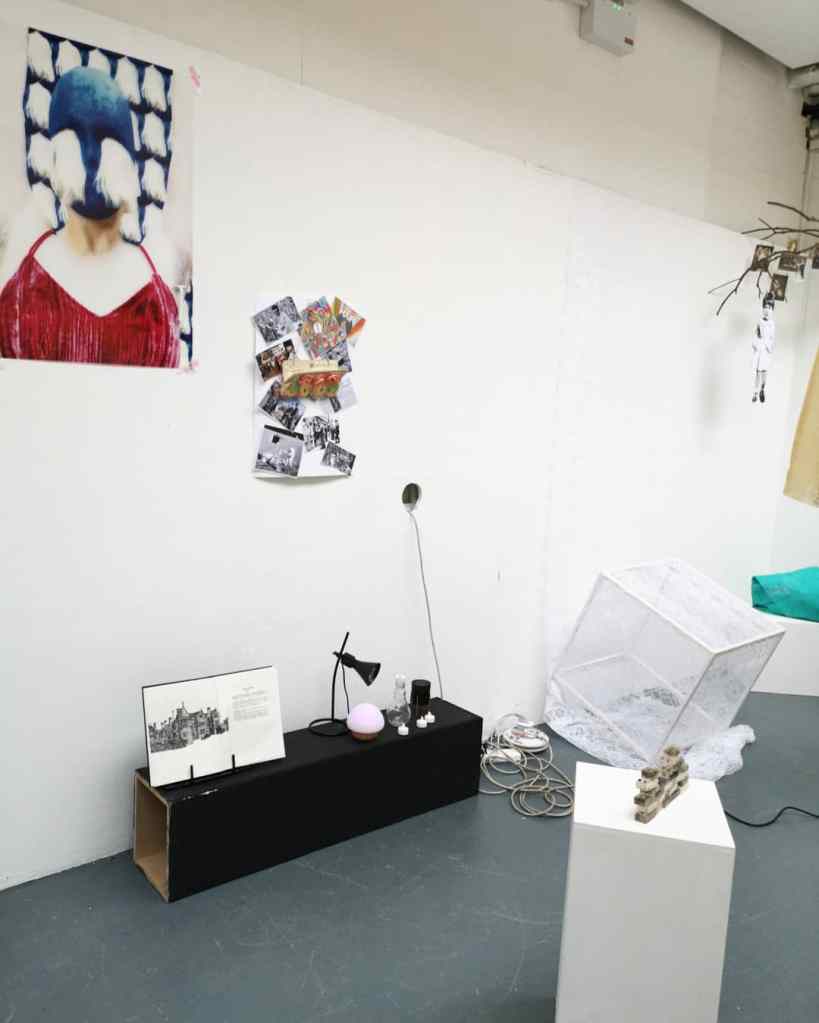

Janet McWilliam, Dawn Langley, Mike Kelly, Tianxing Wang, Soniya Purwal, Noelle Genevier, Robert Adlam, Nadine Senior and Liz Clifford.
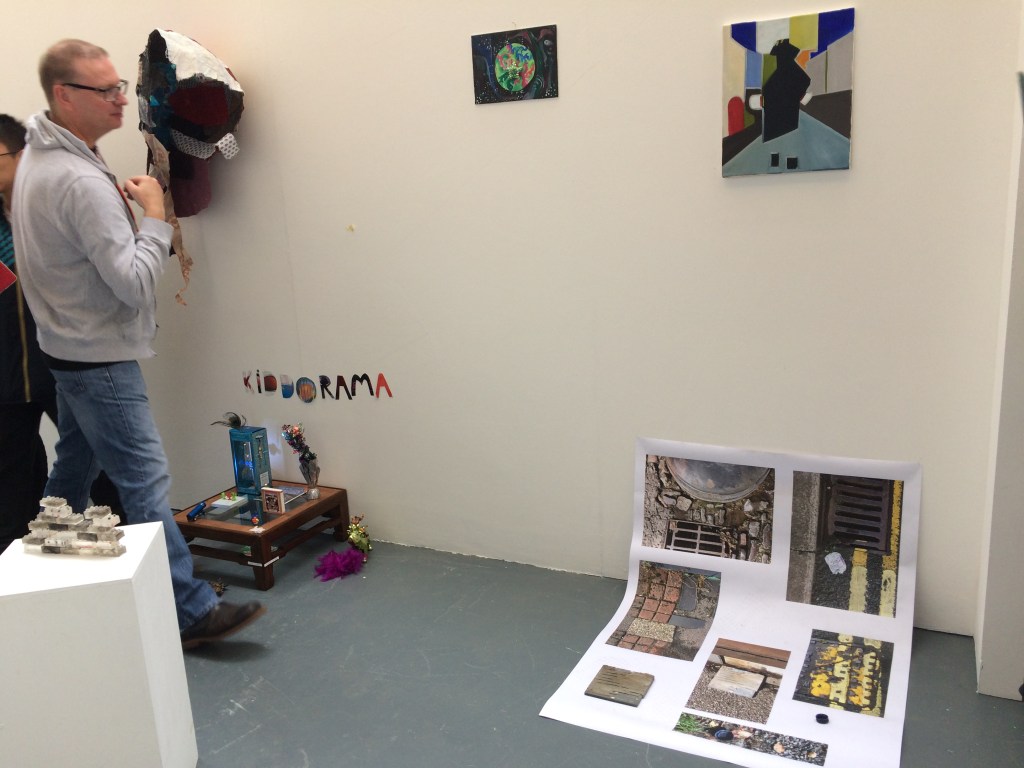
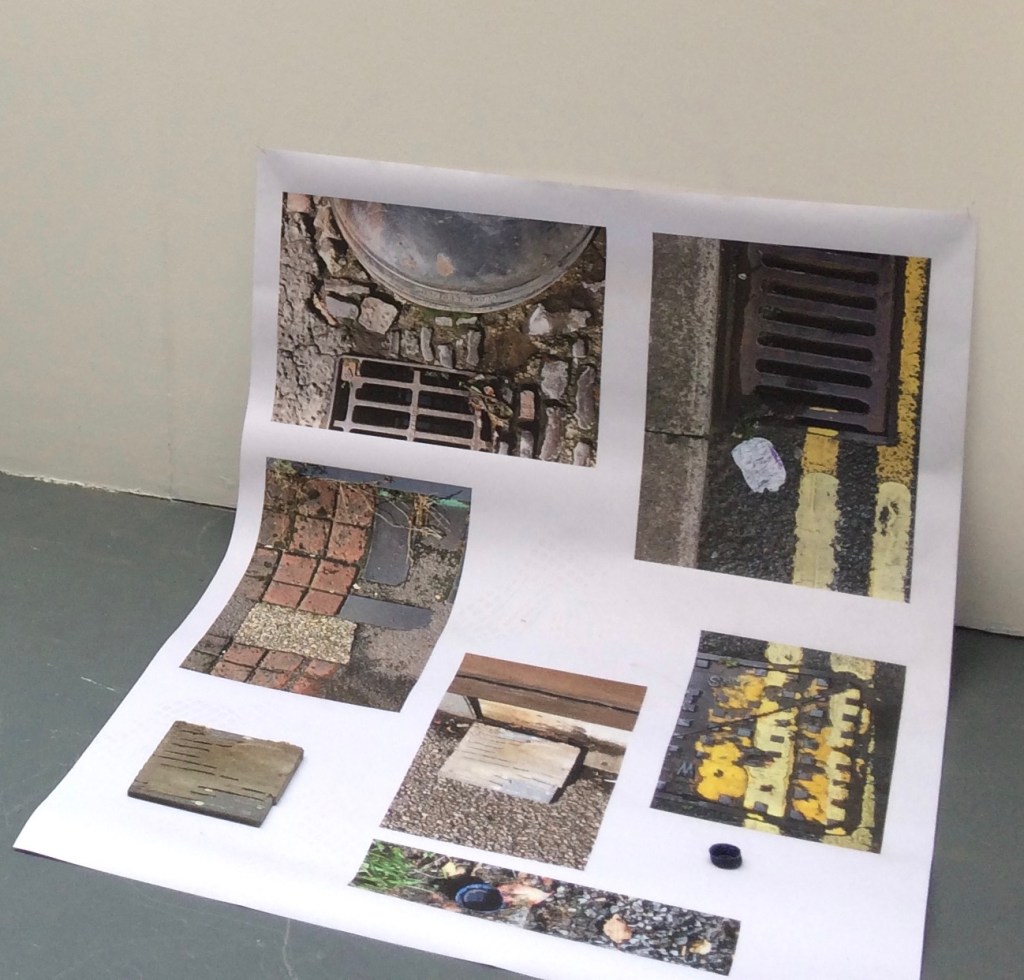
Negotiation was needed between the artists to ear-mark appropriate space for each work. Once set up we took turns to briefly explain our piece to the group. My response was a partial floor-piece. An AO sized photographic print rising up the lower part of the wall. Objects that featured in the photographs were placed on the paper between the images. Before installing I asked the group to walk over the paper, the pavements featured in the images. A faint series of footprints marks the work. Those footprints themselves answer the theme, as well as the materials of the pavements and their provenance. The layers that make up the history of Farnham and its people as well as the history of those who mined, worked and transported the materials. The hierarchy of those materials is reflected in the elevation of cast iron and stone to wall display whilst the images of ceramic tile, brick, tarmac, concrete and mud are on the floor. The scavenged ceramic tile and bottle top are placed next to their respective images. The bottle top is from Barr drinks, a Scottish drinks company, who produce Strathmore water and Irn-Bru.
Our next task was to re-hang the show. We all had to alter some aspect of how our work was displayed in order to make the show work better as a whole, as well as in terms of experiment for our own work. Negotiation and and teamwork was needed to achieve this in a short time.
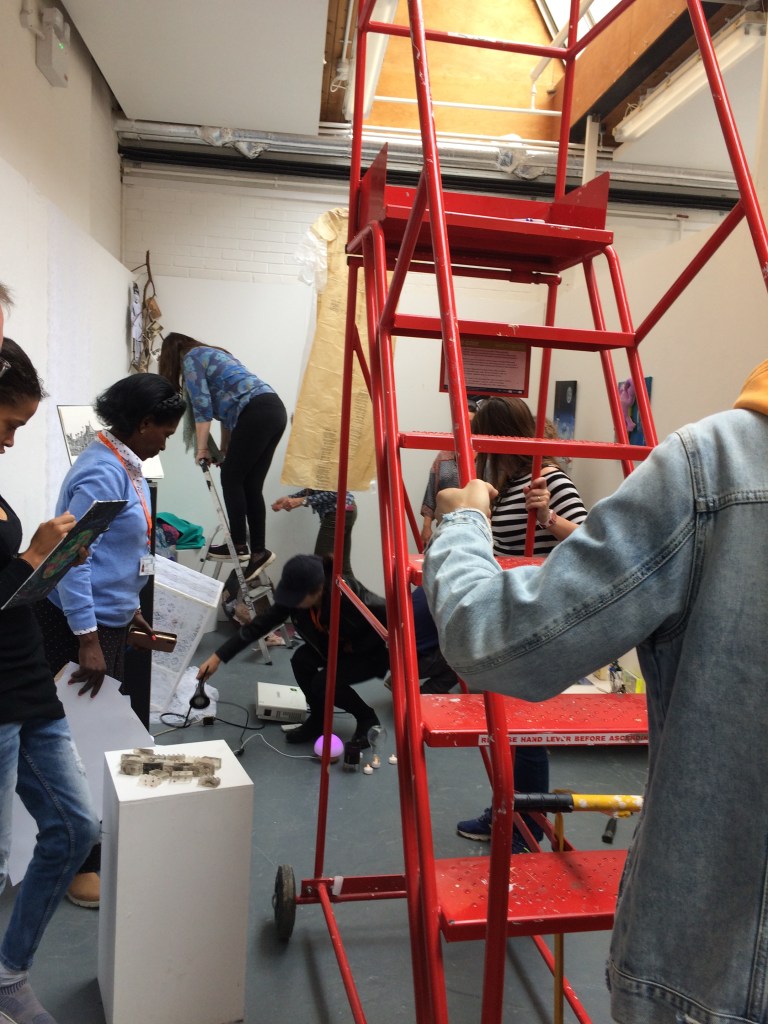
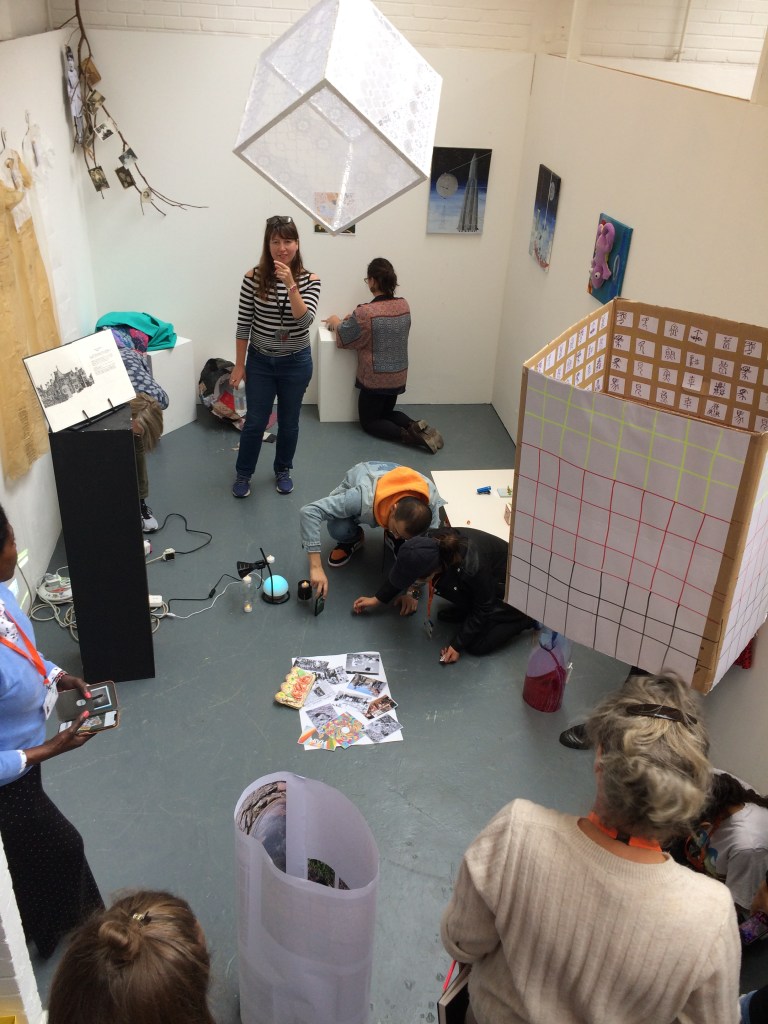
Some work was radically altered and other pieces simply tweaked. Lucy’s piece was suspended in the middle of the space, swapping it’s spot with Dawn’s which became a wall-piece. Meng dispensed with the plinth to make a floor piece, while Wasim stood that plinth upright to raise his piece to eye-level. Tianxing decided to suspend his box form at head height so that it could be viewed from the both inside and outside. Charlotte and I both decided to roll our sheets and stand them on the floor.
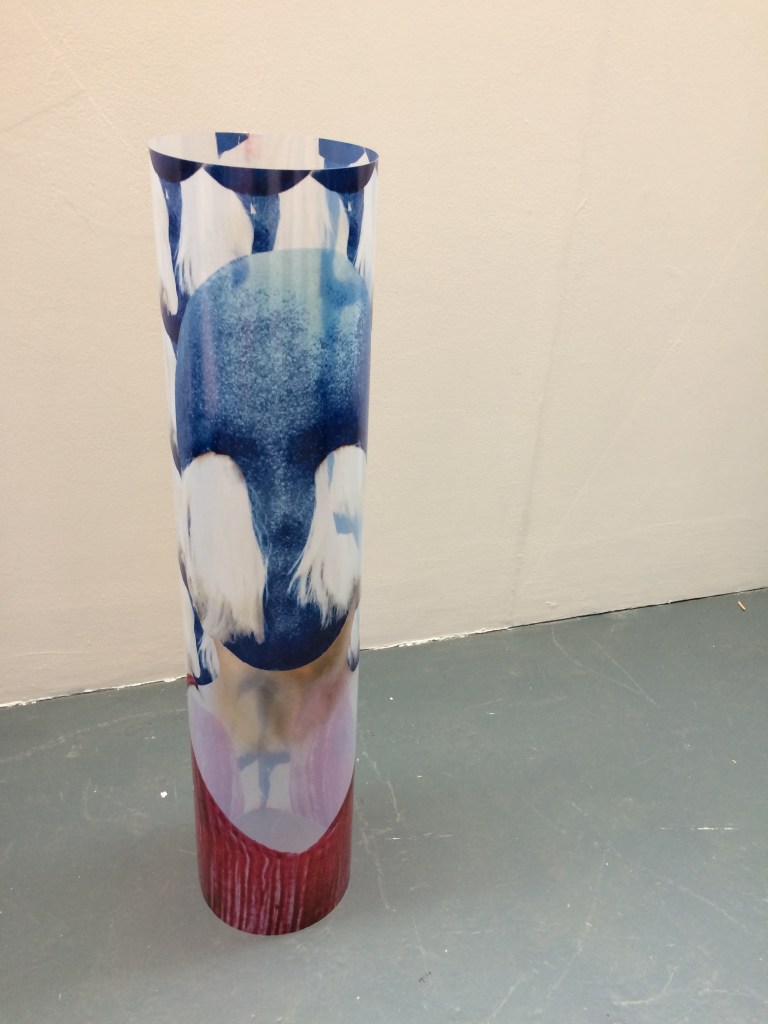

Charlotte’s image had been printed on Grafolac film so that it was translucent and relatively strong. The image could be viewed both through the tube and on it. On the other hand, I had printed on poster paper and at the larger scale of AO. Consequently, my piece was really too flimsy due to the thinner material and its additional size. The images were partially visible from the outside, but not convincingly so. I placed the found objects on the floor inside my tube. These lowly materials, at the bottom of the hierarchy of materials photographed, on the floor next to the images of them. The audience could walk around the work and peer into it but the objects on the grey floor were not very visible. It would be worth thinking about lighting, from above or below, to make objects and images more visible. Experiments with the Grafolac film or tracing paper may lead to possibilities for shining light through the images, making projections and layering. Comparing the two setups of the work, I think the first was more successful, although the second has definitely raised areas for further investigation and had the advantage of allowing circulation around it.
 Liz Clifford