
Ford Fossil 2019. Plaster. Liz Clifford
I have been working with plaster rather than chalk recently to move my embedded objects forward. Up to now I have embedded the actual objects in the material but the work pictured above is made entirely from plaster. I hope this new approach will enable me to work on a larger scale as I continue to explore ideas around fictional Palaeontology.

Liz Clifford
As can be seen in the above photograph of my 2009 Carbon Vestige, the pieces of found chalk are really too small for embedding the larger plastic vehicle trim that I’d like to focus on. Hence the need to either work with larger blocks of stone or to rethink the approach. By making a simple press-mould in clay I can cast from my found objects to make them resemble real fossils. The clay has to be the correct softness to enable a good impression to be made but if it is too wet it will stick to the object. Using talcum powder helps prevent it sticking but I’ve had to experiment to find the best solution. The great thing about using clay is that I can build a ‘rock’ form to cast and then finish it by carving into the plaster as it dries.
I have been collecting images of fossils, being drawn towards those large collections of strewn dinosaur bones or what fossil collectors call ‘hash plates’ of diverse fossils all found in the same piece of rock. My plan is to make grouping of castings from my collections of smashed car parts to resemble these ‘hash plates’. As the work gets bigger I will need to add scrim and reinforcing to the plaster. Some hollowing out will need to happen to prevent the work getting too heavy as well.
I have recently discovered the work Daniel Arsham, Shan Hur and Maarten Vanden Eynde, all of whom work with the idea of fictional futures and fictional archaeology. I saw Maarten Vanden Eynde’s work recently in a show called “Jusqu’ici tout va bien?” (So far, so good?) at Cent Quatre in Paris. He carves into stone to make his Technofossil (Samsung E570) in which we encounter a ‘fossilized’ mobile phone and takes a human skeleton and rearranges it to present the remains of Homo Stupidus Stupidus. His work resonates with me through its environmental concerns and the irony he uses. The whole show is subtitled ‘Archeology of a Digital World’ and runs until 9th February 2020. For more details see link below.
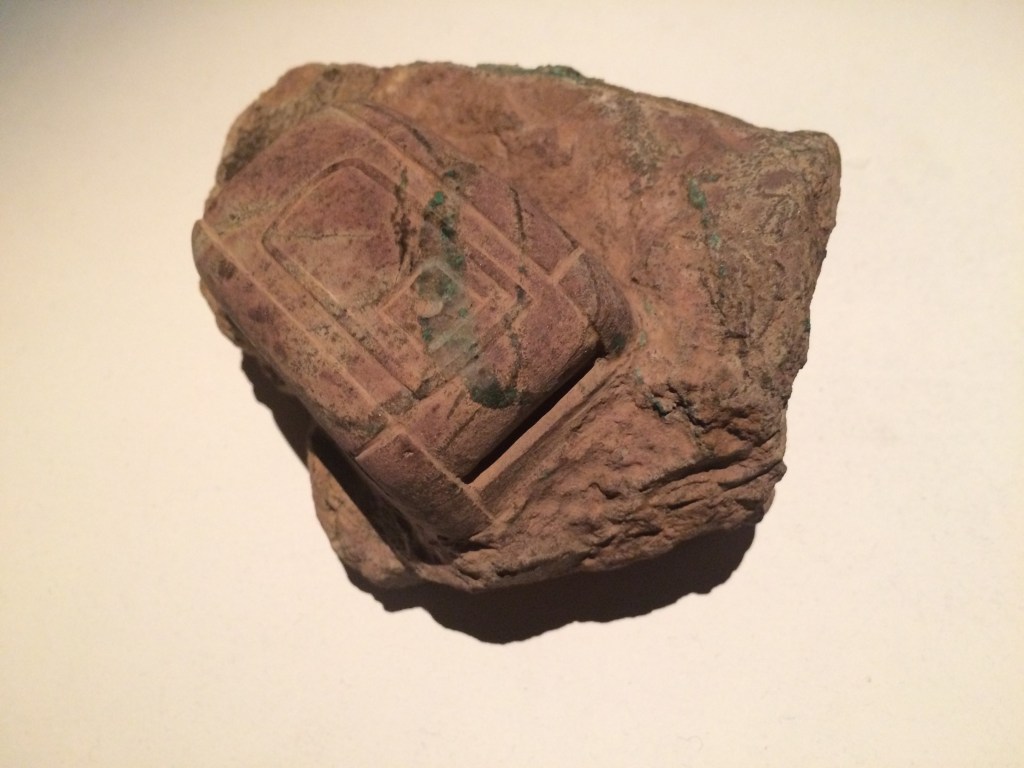
photo by Liz Clifford
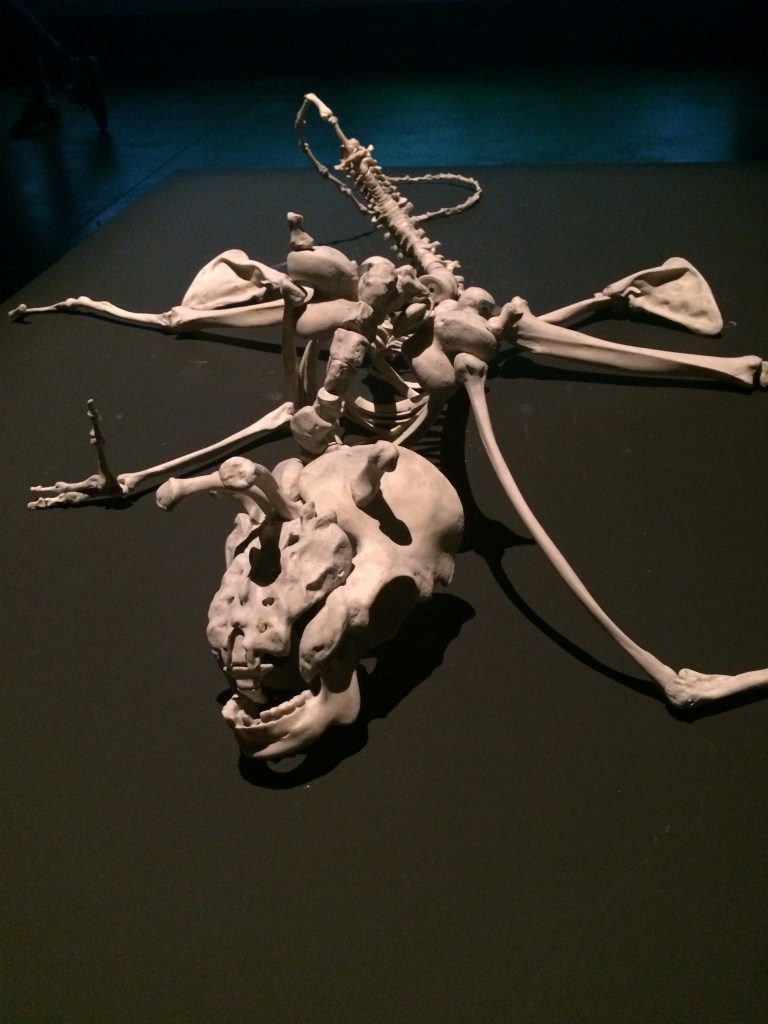
photo by Liz Clifford
 Liz Clifford