
Gallery exterior with window installation for The World After by David Blandy.
Photo by Liz Clifford
I was really lucky to catch this fabulous show before it closed recently. “The World After” by David Blandy at Focal Point Gallery, Southend-on-Sea, Essex. The project was part of a larger initiative, New Geographies, a three year partnership across arts organisations in the East of England to commission site-specific work that responds to a series of publicly nominated locations across the region. One of nine commissioned artists, David Blandy’s work for this exhibition takes inspiration from the unique post-industrial setting of Canvey Wick on Canvey Island, near Southend. Canvey Wick is a Site of Special Scientific Interest on the south west corner of Canvey Island and was once the site of an oil refinery that was only partially developed in 1970s and never operational due to the oil crisis of 1973. It is now one of the most biodiverse areas of the UK but is very low lying and threatened by rising sea levels.
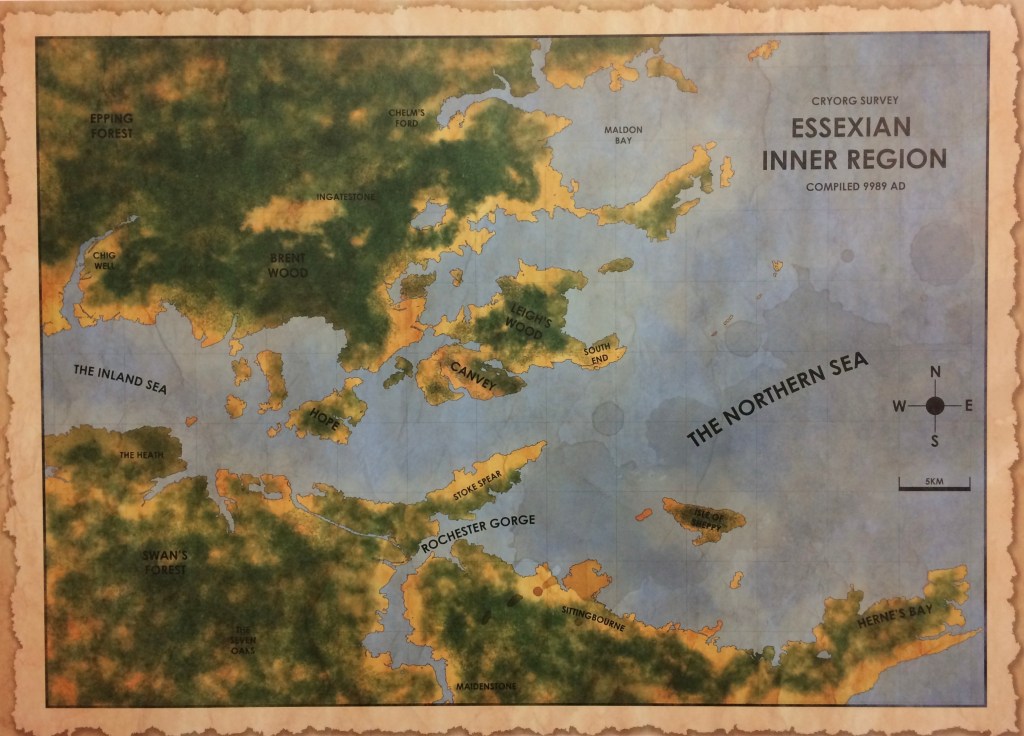
photo by Liz Clifford
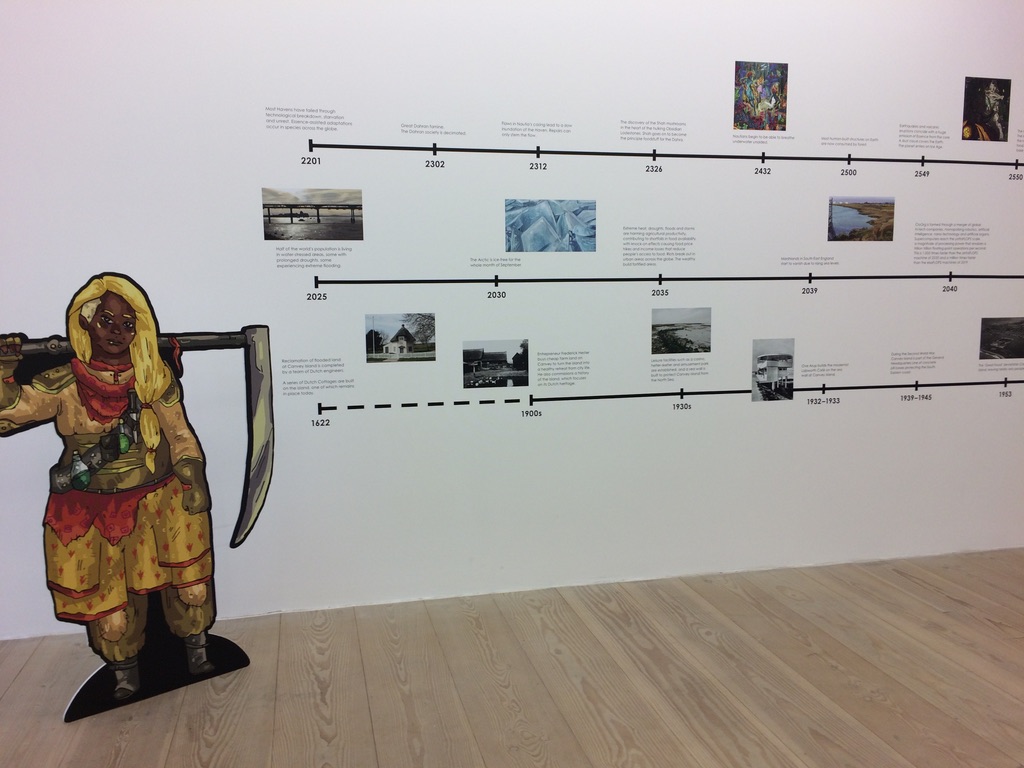
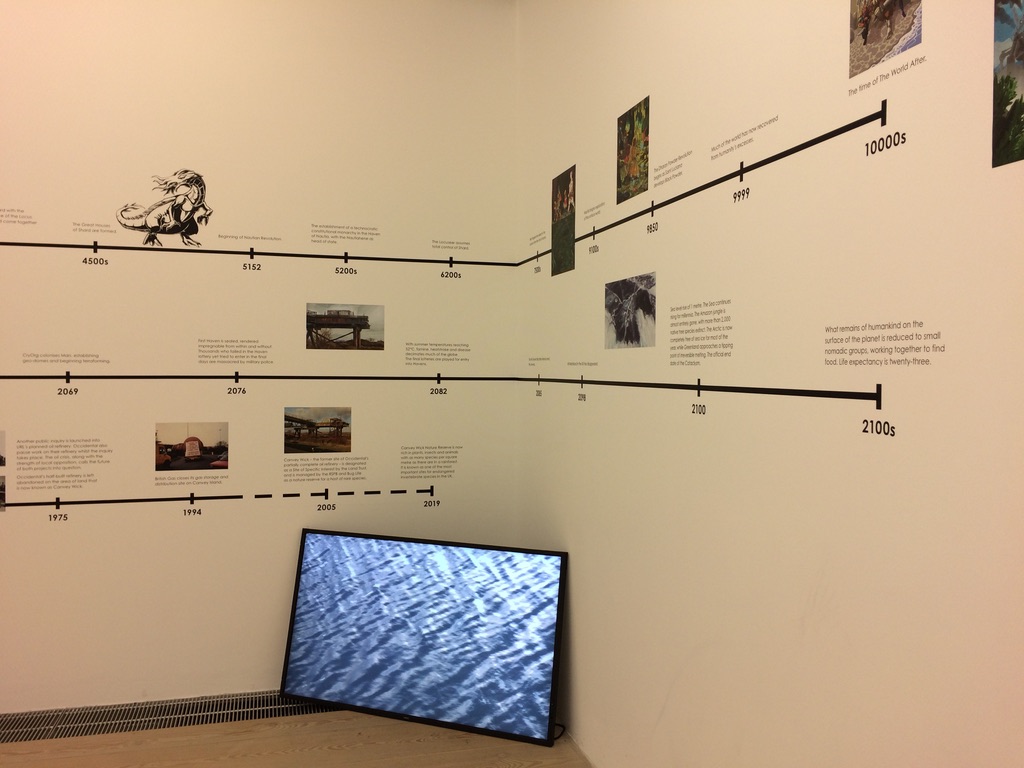
The World After show consisted of a film, an installation and a table top role play game. The artist made use of the whole of this beautiful new gallery space, including the foyer and window. I found myself in the installation first which was a very good move, as that set me up really well for understanding the other elements. The installation was a time line on the wall akin to that you would find in a well presented visitor centre. Starting with the 20th century through to 2019 and then layered with a fictional future to 10000AD accompanied by audio archive from survivors of the devastating floods of 1953 and moving images of water.

photos by Liz Clifford
The lower level of the time-line deals with the history of Canvey Wick to 2019, then the upper two layers take events into the imagined future when surviving humans move underground to escape the climate cataclysm they have caused. Some of the descendants of these humans evolve physically and socio-politically to emerge in 10000AD to The World After. A cardboard cut-out of one of these stands to the side of the time-line.


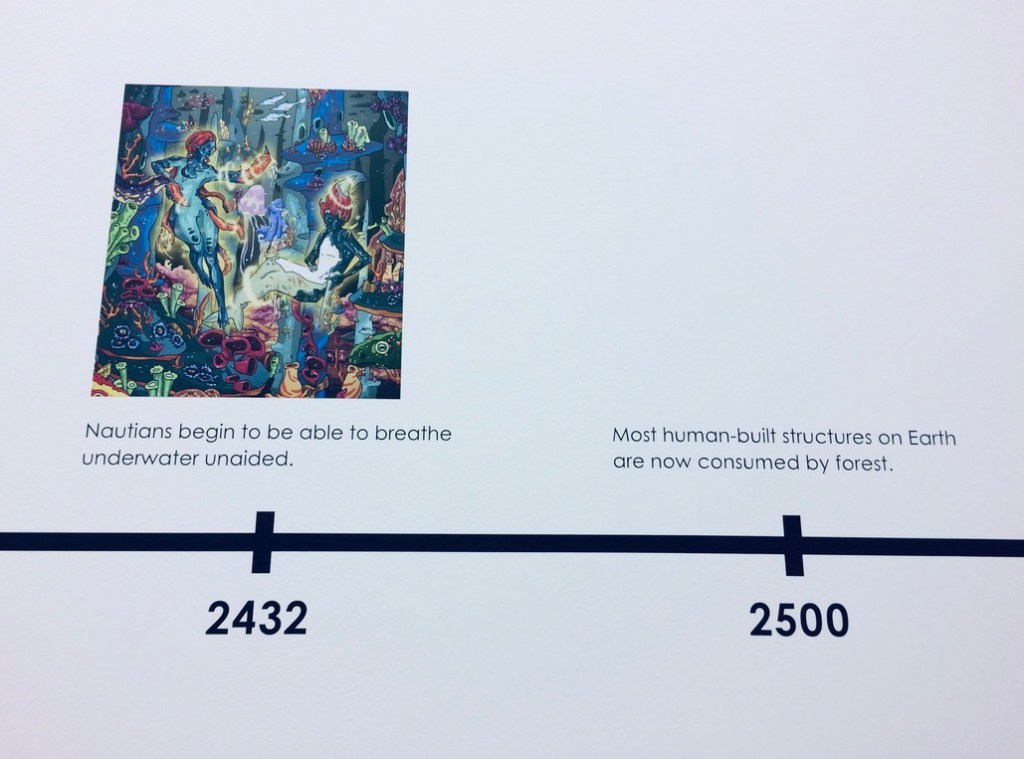
photo by Liz Clifford
The 30 minute film being screened during the show was made by Blandy after visiting the Canvey Wick site every month for a year to record the changing seasons on an iphone, much of it in macro close-up. The images show nature carrying on against the backdrop of a post-industrial ruin, the abandoned oil refinery. The voice-over is told from the perspective of surviving humans of the fictional time-line who emerge from their underground havens to experience the wonders and dangers of the World After, the post-anthropocene. It is accompanied by a symphonic score composed by Blandy and recorded by the Southend Symphony Orchestra. The aural history of the commentators is referred to in the script when they talk of the “elders” and their accounts of the “climate cataclysm”. The film is screened within an installation of its own. Materials are used to make an environment rather than a cinema. The smell of tar emanates from planks salvaged from the original Southend Pier, here repurposed to make a walkway from which the audience views the film. The floor is covered in rubber tyre offcuts and the area in front of the screen is littered with industrial relics – concrete blocks and steel rails.
The role play game book which accompanies the film and time-line installation was devised in collaboration with the Essex gaming community and published by The Focal Point Gallery. The players have to develop the characters of the World After and work together to forge a new society. The graphics and models from the collaboration were displayed in the gallery foyer. The game book was displayed and for sale, and sessions were held where the public could participate in the game. These sessions happened in a side room which also acted as a library of the books that the artist had been reading whilst researching for the project. These included works by Ursula Le Guin, Donna Haraway and Bruno Latour along with publications specifically dealing with the local area. This room helped the viewer feel the depth of research and collaboration that had gone into the project.

photo by Liz Clifford
It was a really impressive show that all held together. Each part shed light on the next and the attention to detail made for a convincing, heart-rending, and thought-provoking take on the predicament we find ourselves in, with a glimmer of hope thrown in.
 Liz Clifford