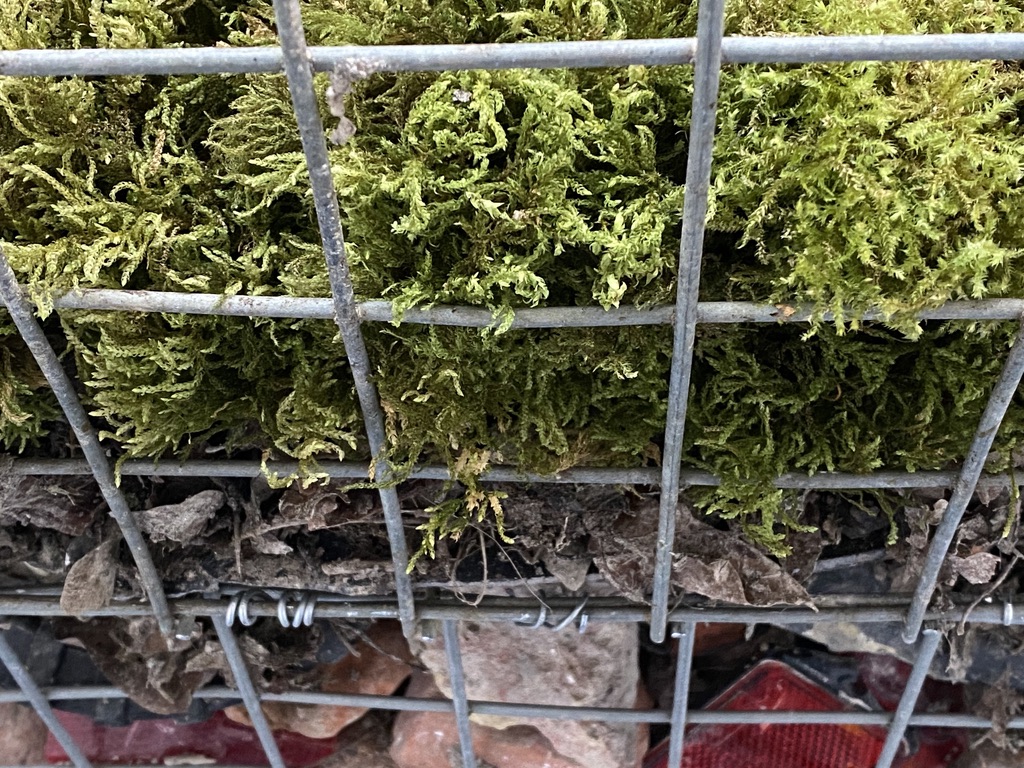
This work consists of a stack of hand built gabion baskets filled with collected materials from the landscape. The largest layer is chalk, then flint, brick, concrete, plastic and metal objects, earth and moss.
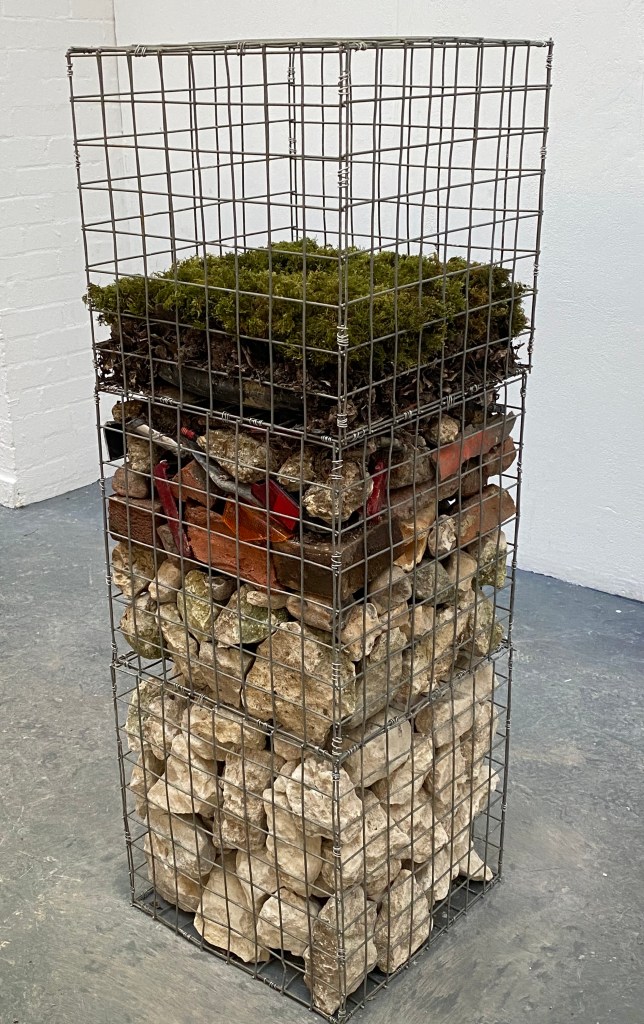
122 x 42 x 42 cm
The chalk layer represents the vastness of geological time, and the work references human impact on the fossil record as well as geo-engineering and the climate emergency. The materials contained within the gabion structure were all collected in the same location over a number of years and form a version of the “non-site”, as pioneered by Robert Smithson. The outdoors brought indoors. The plastic and metal detritus comes from fossil-fuelled recreational vehicles and is layered with the brick and concrete. It pokes through the living layers of mud, leaf mould and moss. The moss layer is easily viewed from above as it is only one metre off the ground. The audience is encouraged by its seductive colour and texture to peer down into it but finds sinister glimpses of the plastic hidden beneath.
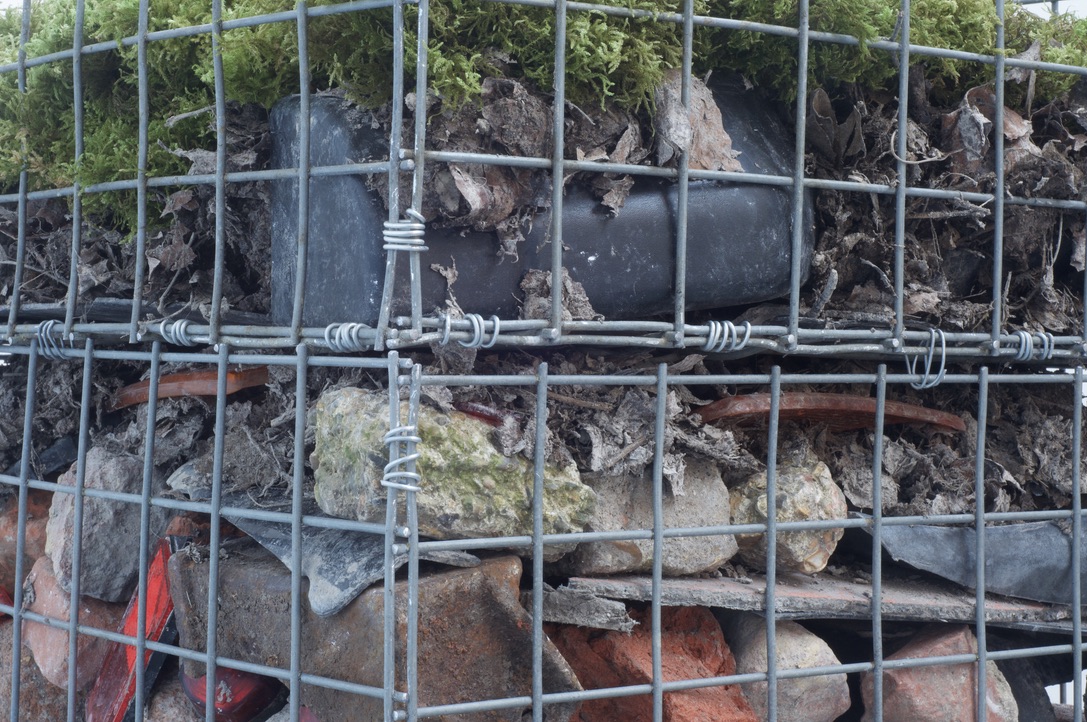
Gabion baskets are cages filled with rocks that are used extensively in flood defences and other civil, as well as military, engineering projects. The idea dates back to the Renaissance when a type of gabion was used for the foundations of buildings. I had been building my own gabions as plinths for other pieces of work because of the flood defence/climate emergency resonances when I started to move towards using the form in the work itself.
The earth and moss layers are sprayed with water which gives the piece a living smell as the moss revives. Olafur Eliasson’s Moss Wall and Moss Valley series of photographs fed into my decision to use this material. It also provides a colour contrast with the layers below. The green moss, black and red plastic, layered with brick and concrete, on top of the white chalk. The space above the moss layer is empty. It is the space occupied by the stratum of air in this column of strata. As the audience leans in to inspect the moss layer from above, they breathe in the air stratum and the aroma of moss and earth given off by it.

In my research for this piece of work I came across Spanish artist Miguel Sbastida. His “Technofossils of the Anthropocene” is an installation of sculpture, photographs and found objects. The work explores the formation of trace fossils from industrial waste already showing in the rock strata of the estuary at Bilbao, Northern Spain. Between 1920 and 1970 more than 120,000,000 tonnes of industrial waste from the metallurgic industry was pumped into the sea there. Tides and wave actions have returned much of it to the shore where it has sedimented to form a 6 metre tall rock stratum containing layers of recognisable industrial materials, most strikingly, the fire-bricks used in the metallurgic furnaces. Sbastida’s desire to make work from a vital materialist, post humanist perspective really resonates with me. The installation itself blends a cool display of the facts, through the found objects and photographs, with a much more emotional response embodied in the sculpture referencing the space within a closed human palm made from site-specific sediments.
In my work, Substrata, I am referencing geology on the physical level but I am also exploring geology as a metaphor. Deleuze and Guattari in chapter 3 (The Geology of Morals) of their book “A Thousand Plateaus” 1988 investigate the constant state of flux that exists within a stratum and between strata. They take as an example the behaviour of crystalline formations in the milieu of rock strata and apply this observation to all milieu, abstract and physical, macro and micro. The crystals form on the exterior as the interior is emptied. The centre moves to the periphery and back again in cycles. The middle is really important – the “milieu”. When something leaves its milieu it forms assemblages and evolves. It’s that flux and it’s unforeseen consequences again. Within the organic stratum, Charles Darwin observed in 1888 how earthworms work to make a fertile topsoil that in turn allows humans to grow food. The worms’ “small agency” allows for human production and the preservation of artefacts in the soil. This is not an intended outcome but the unintended consequence of an assemblage. Within my work, Substrata, the organic strata of mud and leaf mould do contain a few earthworms. They are composting the work as it is displayed. There is that ephemeral aspect to the work which I am keen to keep developing as I puzzle through ways of bringing the experience of walking, observing and collecting in the landscape to a gallery audience.
 Liz Clifford