
Hayward Gallery, Southbank Centre, London. Open Wednesday to Sunday until 31 October 2020.
I was hoping to see this exhibition before lockdown but my plans were thwarted. So perhaps I have relished the opportunity to visit it all the more as there are still not many exhibitions open.
In addition, I now find myself working directly in a wooded space and have been nurturing rescued saplings, so the show has more immediate relevance to my own work than it might have done back in March.
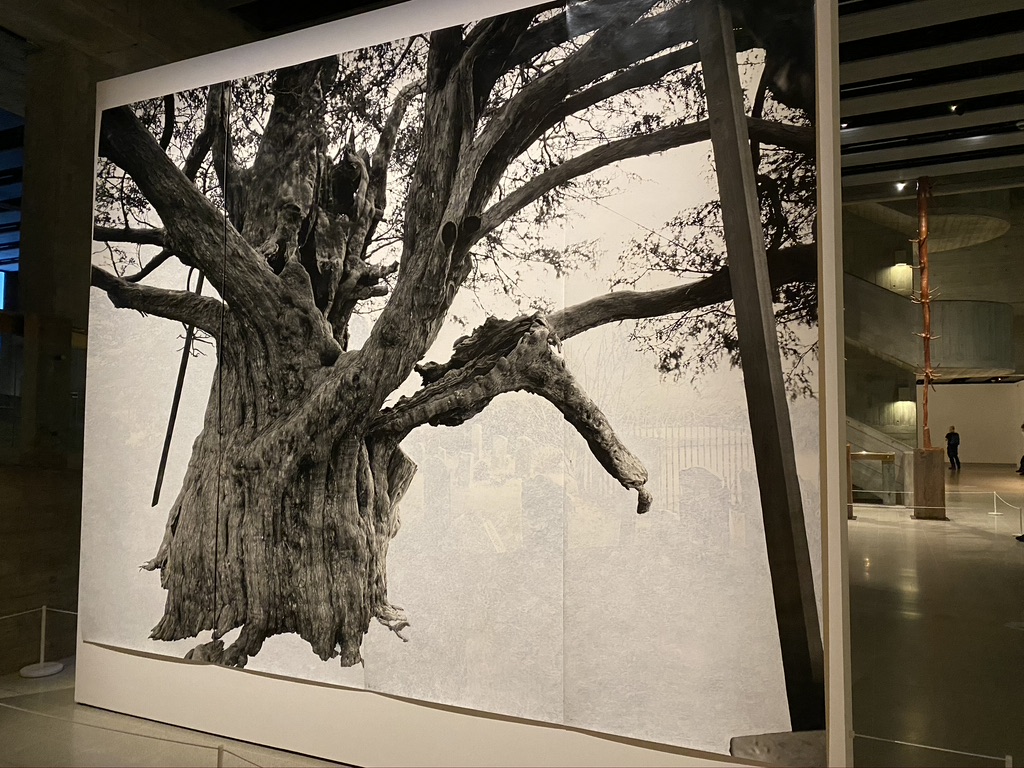
Here I’ll pick out a selection of works from the show that particularly resonate for me. First of all, there is the theme of time running through a lot of the work. Trees are long-lived and often outlive humans by hundreds or thousands of years as seen in Tacita Dean’s painted photograph of one of the oldest yew trees in Britain, Crowhurst 11 2007 which confronts you in the gloom of first room of the exhibition.
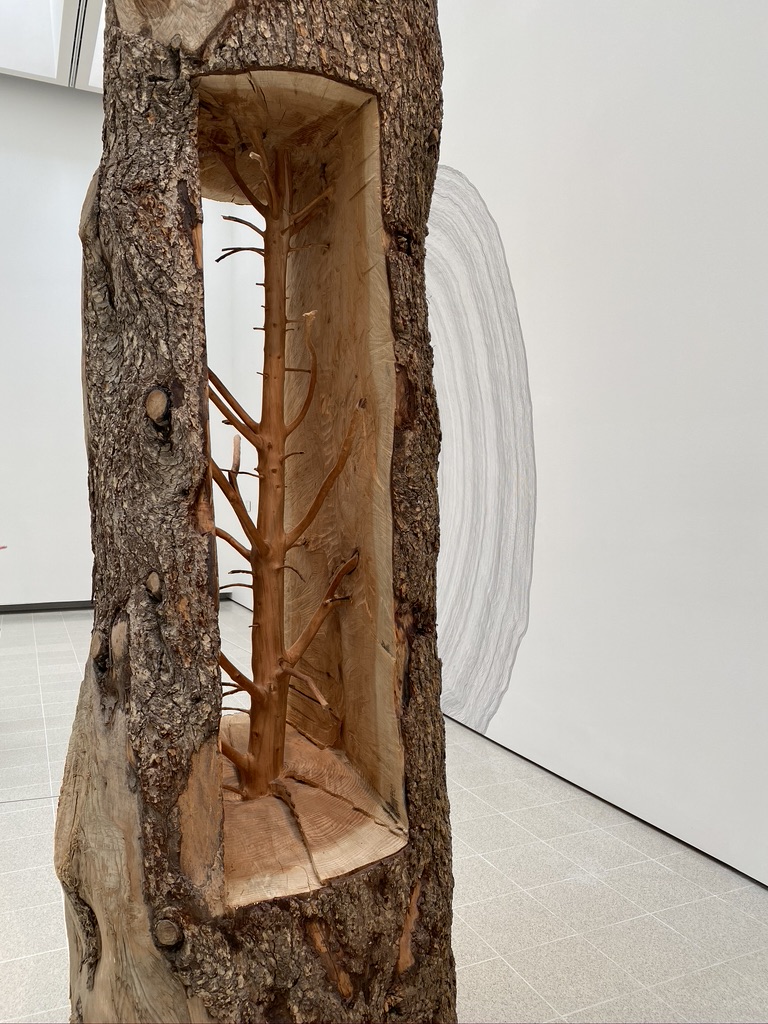
Giuseppe Penone’s Door Tree – Cedar 2012 is all about growth and aging as he cuts into the trunk of a tree to reveal its core and the rings that mark its years of growth. This piece is shown alongside his drawing Propagazione/Growth Rings at the centre of which he placed his thumb print and from which the rings are extended onto the gallery wall to make the cross-section of an ancient trunk.
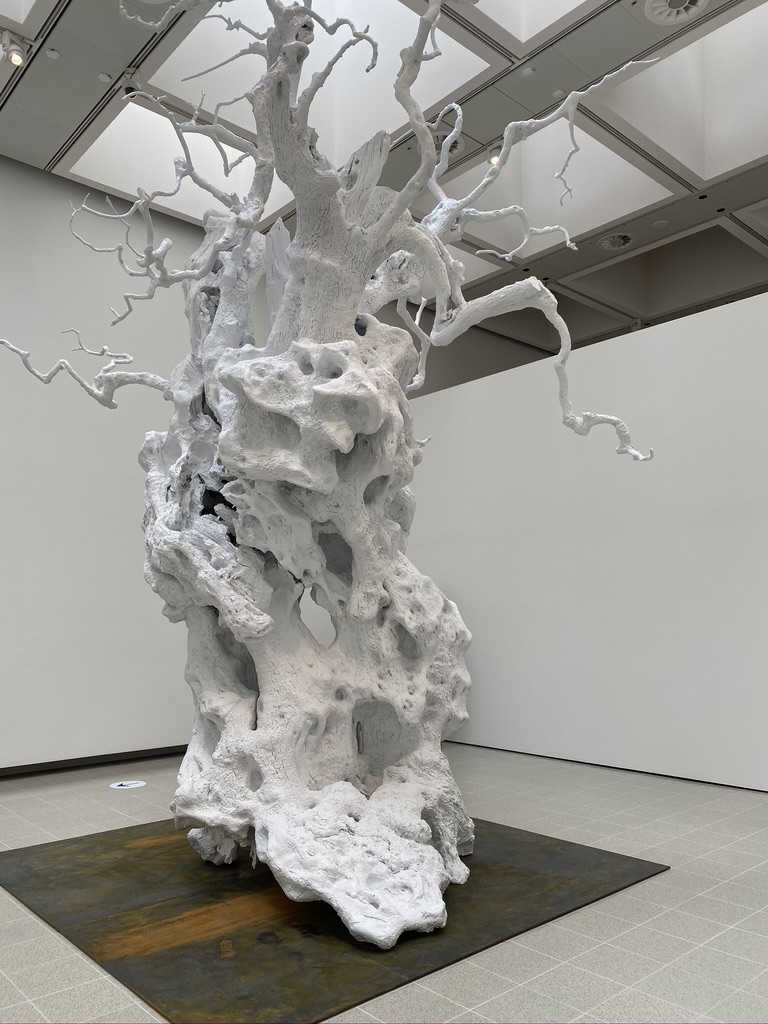
Ugo Rondinone’s Cold Moon 2011 is also a portrait of a specific Italian olive tree cast in aluminium and painted white. It has a ghostly presence, the original tree being over 1000 years old and hugely weathered by the elements, an assemblage of time and the forces of nature.
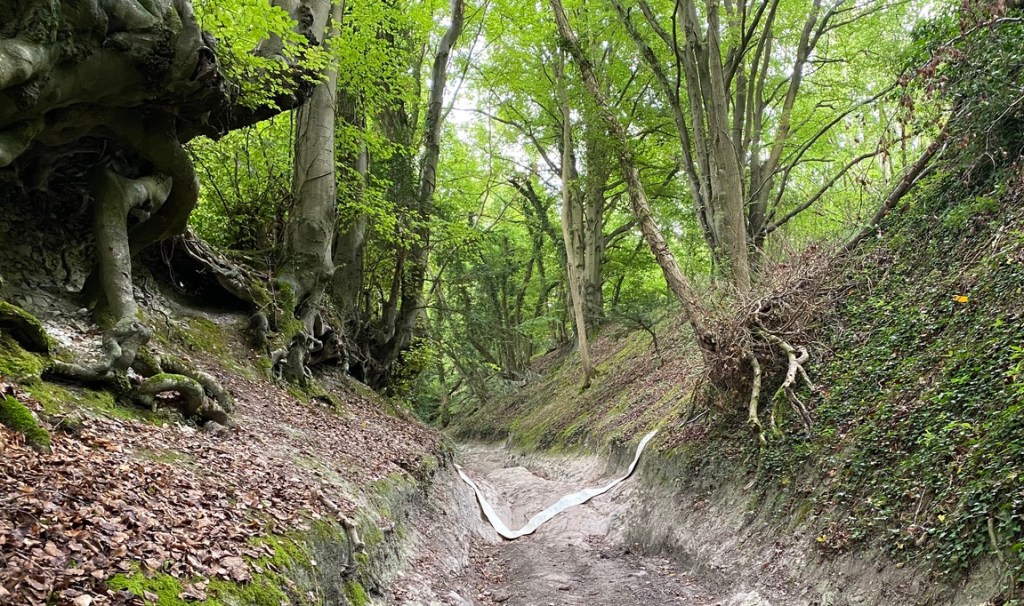
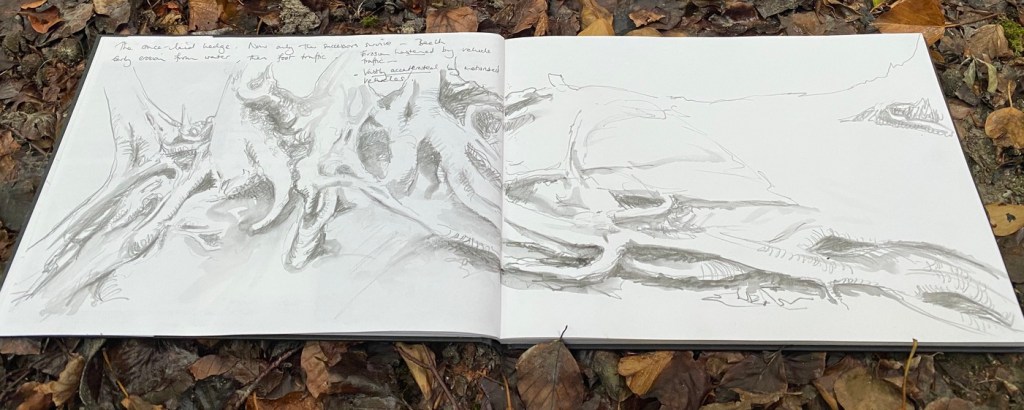
The woodland through which Byway 745 climbs is what’s known locally as a “Hanger” of beech and yew. The track is bounded to the East by a former laid beech hedge now grown out over several hundred years. This line of gnarled trees with exposed roots and horizontal growth marks the boundary of the ancient public right of way and private land. The chalk beneath the shallow roots has eroded away in places, making caves and hollows as the trees form great protuberances over the track as seen in the photograph above. I have started making a series of drawings of this line of beeches including the example below.
Horizontality and focus on roots is apparent in the approach to the subject matter of a number of the artists in the exhibition, most notably Finnish artist Eija-Liisa Ahtila whose video work Horizontal – Vaakasuora 2011, in my first image, is a life size portrait of a spruce shown horizontally so that it fills the whole back wall of the gallery and thereby fits into the space. Thomas Struth’s photograph of a mossy Japanese forest floor draws attention to exposed roots as does Robert Smithson’s 1969 series of Upside Down Trees in which he buried young trees to expose their roots for a series of photographs, exploring and drawing attention to what goes on underground. There are echoes here not only in the subject matter of my drawings but also of recent reading in which the root and rhizome systems are used as metaphors for the entanglement of everything. By Deleuze and Guattari in A Thousand Plateaus (Deleuze & Guattari,1987:5) and Jane Bennett’s attention to horizontal relationships between human and non-human in Vibrant Matter (Bennett,2010:112). The work of earth system scientists is celebrated by Bruno Latour and curators of the Critical Zones Exhibition, currently running at ZKM Karlsruhe, and this has introduced me to the work of biologist Lynn Margulis on the holobiome and rising awareness of the networks of roots, fungi and bacteria that connect living organisms and create ecosystems.

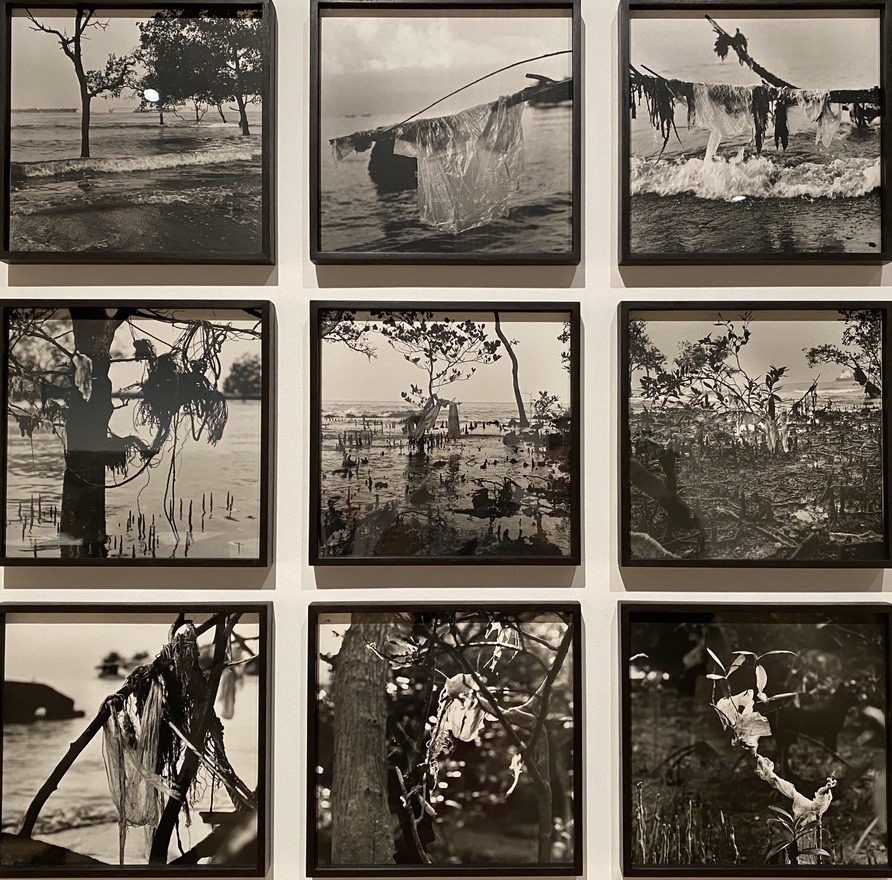
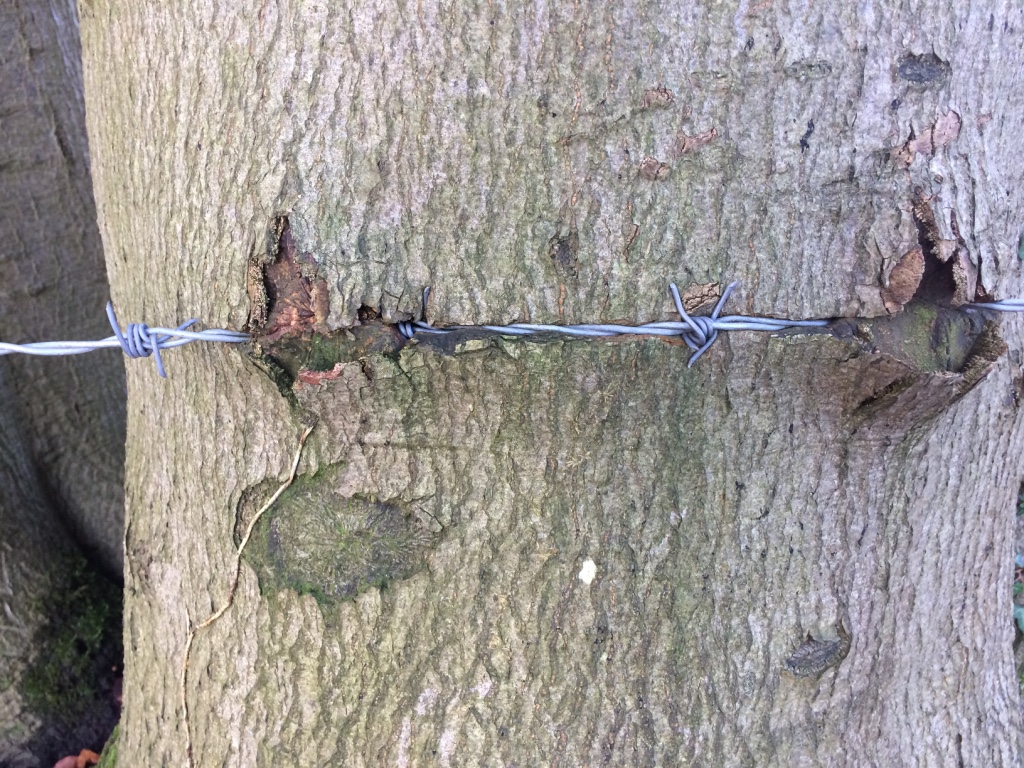
The human impact on trees is explored by artists who draw attention to their role in bearing witness to the atrocities of human activity. Steve McQueen’s location shot for the film 12 Years a Slave actually turns out to contain a tree that had been used in lynchings. The tree is an accomplice and a witness. Simryn Gill makes a record of the plastic detritus that washes into the mangrove trees along the Straits of Malacca in a series of black and white square photographs and Zoe Leonard records trees in New York City that have grown around the wire enclosures that humans have forced them to grow within, leaving them scarred and deformed. In rural boundary-marking trees are also often defaced and injured as my own photographs of trees defaced by being used as posts for barbed wire fencing illustrate.

Time, entanglement and scarring are the themes that stand out and connect with me here but many others run through the exhibition. The Hayward have done a great job in opening up, so get along there if you can.
All photographs by Liz Clifford.
Bennett, Jane (2010) Vibrant Matter: A Political Ecology of Things. Durham, NC: Duke University Press.
Deleuze, Gilles and Guattari, Felix (1987) A Thousand Plateaus, Capitalism and Schizophrenia. Translated by Brian Massumi. 2013. London: Bloomsbury.
 Liz Clifford
I like your comment about time and the landscape and how trees bear witness to events from your reading of the exhibition Among The Trees and in describing your own work.
LikeLike
Liz – a long time since Homerton & our trip to Holland whilst still students. I love your response to where we are now and your expressive creativity. I am still working with the next generation of artists at Lincoln college of Art and celebrate the contribution you make to our environment, the natural art around us and how you enrich that experience for those who see your work with your energy, creativity and vision. I am delighted I happened upon your website this evening in the year in which we really need to open our minds and hearts, not to mention our eyes. I hope one day soon our paths cross again. Best wishes Emma (Awdry) Hoare
LikeLiked by 1 person