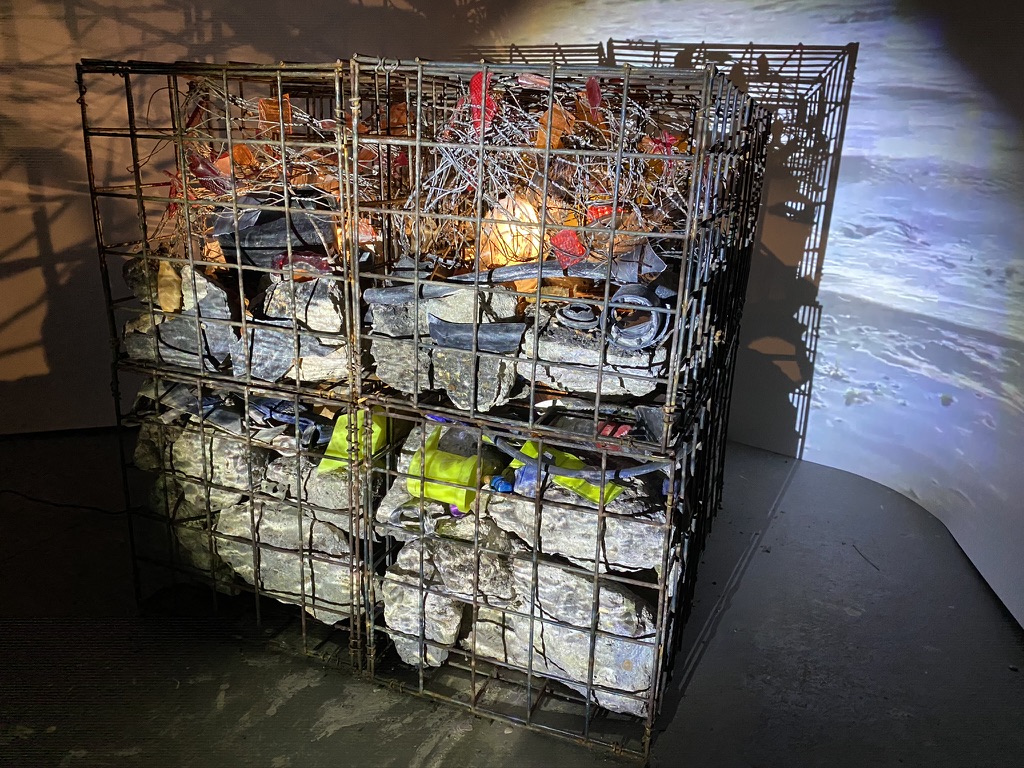
This work is a response to a description of a measure of the Anthropocene, the period since the beginning of the twentieth century during which human activity has triggered irreversible change on Earth, outlined by geologist Jan Zalasiewicz in his lecture ‘Visualising the Anthropocene’. This was delivered as part of the Lovelock 100 conference at the University of Exeter in 2019 and again at the opening events for the Critical Zones Exhibition still running at ZKM Karlsruhe in Germany. He describes a cubic entity in which some elements are growing and others diminishing. It is half full of the stuff of our cities, most significantly the new form of rock – concrete. Compounds like aluminium and plastics coat it and carbon dioxide and ash particles are filling up the spaces between. A continuously burning lightbulb is gently heating everything around it. This is an analogy in four dimensions – depth, mass, volume and time. The diversity of technofossils, human-made artifacts, is growing to beyond 1billion different types just as biodiversity is reducing. Water from ice-melt and the volume of plastic is growing all the time.
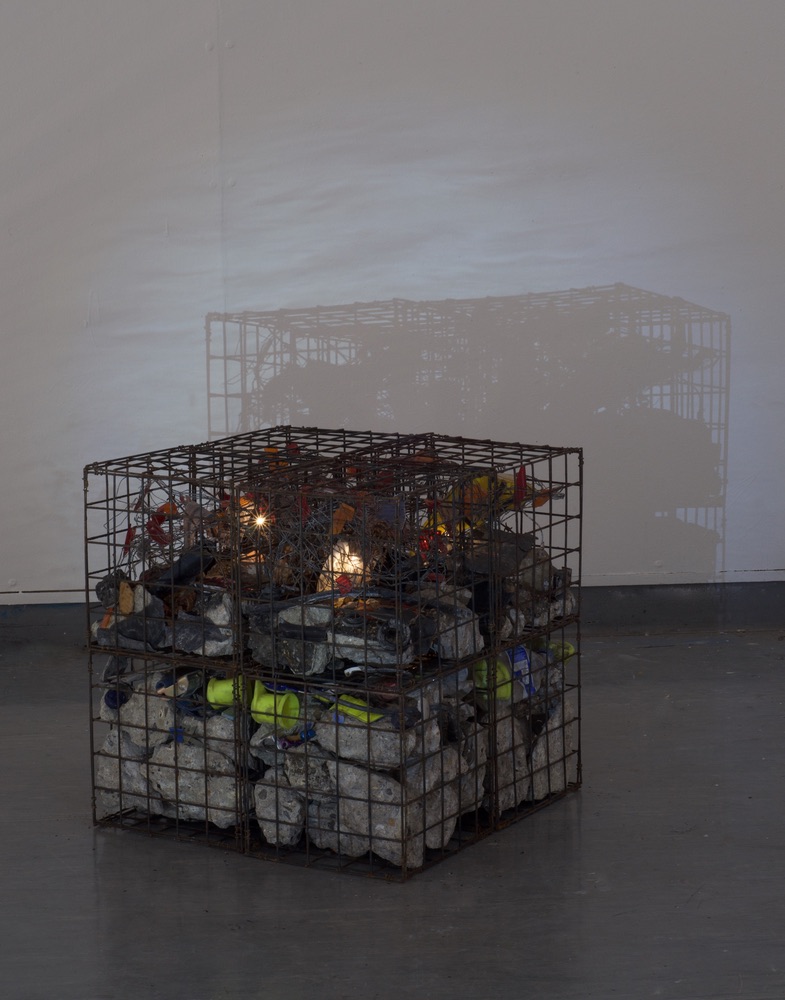
Hearing this description, which is intended to stimulate us to understand the enormity of what confronts us, prompted me to attempt my own visualisation. I have worked with the cube, or rather 8 cube formed gabion baskets. It is roughly half the size envisaged by Jan Zalasiewicz. The stack of them make a 53 cm cube, more than half filled with salvaged concrete. The remaining materials have all been found discarded in the area of The South Downs National Park I have been studying. These are wire, plastic, cans and car parts. A small amount of biomass is present in the form of autumn leaves.
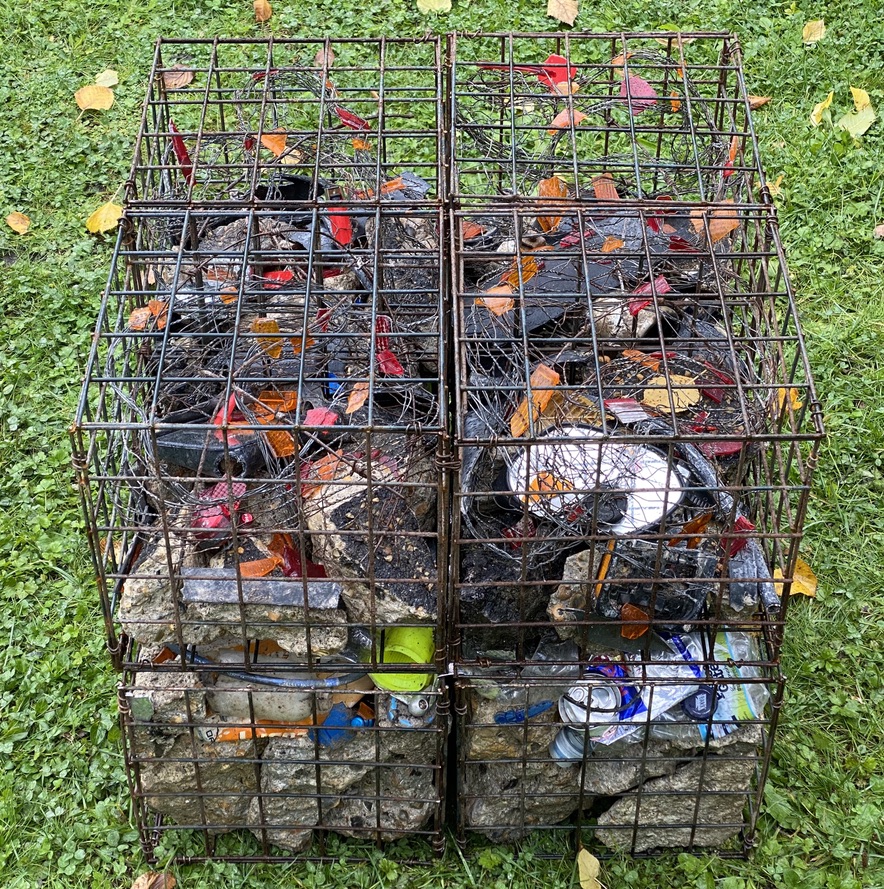
The first iteration of the piece was made and recorded outdoors. The elements of rain and wind, as well as falling leaves became part of the piece but there was no resolution for the idea of warming or water levels. I have since been experimenting with the possibilities for curation indoors and specifically with the effects of lighting and projection prompted by seeing the work of Sarah Sze. Her work is currently part of the Critcal Zones Exhibition and is also in Paris at the Foundation Cartier in a show called De Nuit en Jour. I’m interested in how she uses multiple video projections, photographic images and lighting in her installations. The audience becomes part of the piece as they walk across the projector beam or get picked up by a camera. The outside is brought into the space and shadows and light are cast to the edges of the space. Disparate things meet. Although the Foundation Cartier is currently closed due to Covid-19 their website has a fascinating video tour in which she talks about the work with Bruno Latour.

For Cubic Measure I’ve placed LED lights within the structure. The ‘continuously burning 1 watt bulb’ referred to by Jan Zalasiewicz in his lecture. These make the plastic vehicle reflectors more gem-like and also illuminate scraps of printed imagery. This printed imagery is the same as the projection I have been working with. Water lapping the shore. A still from the footage, printed on tracing paper and torn is placed in the upper level of the work. The water is growing and so breaks the bounds of the structure.
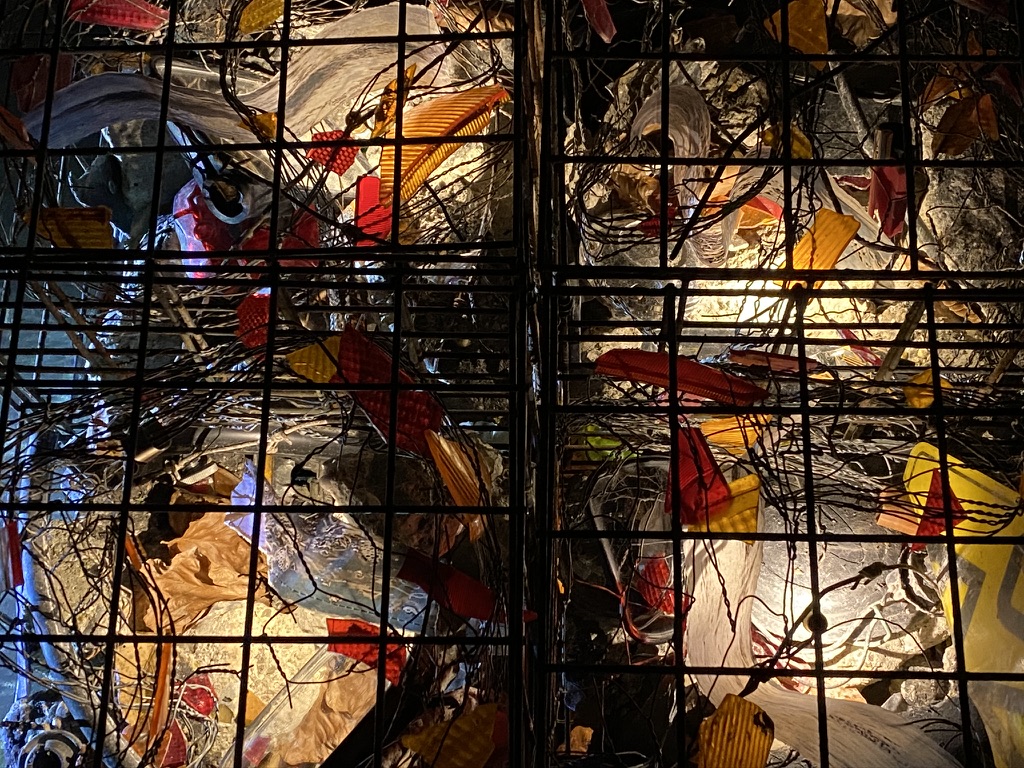
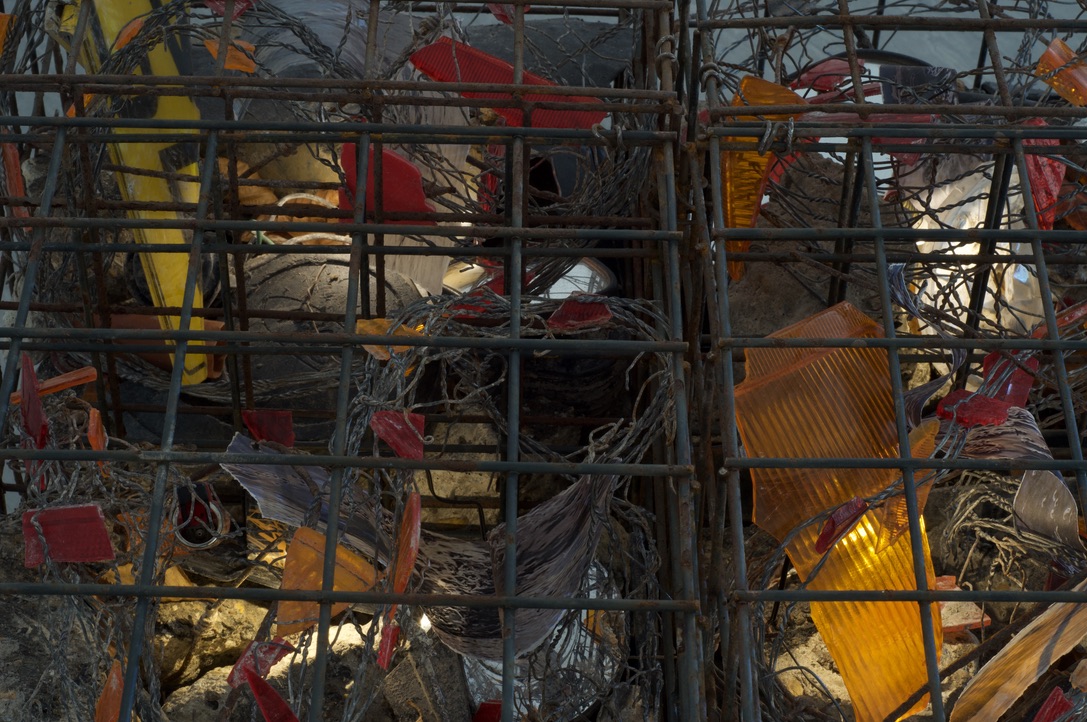
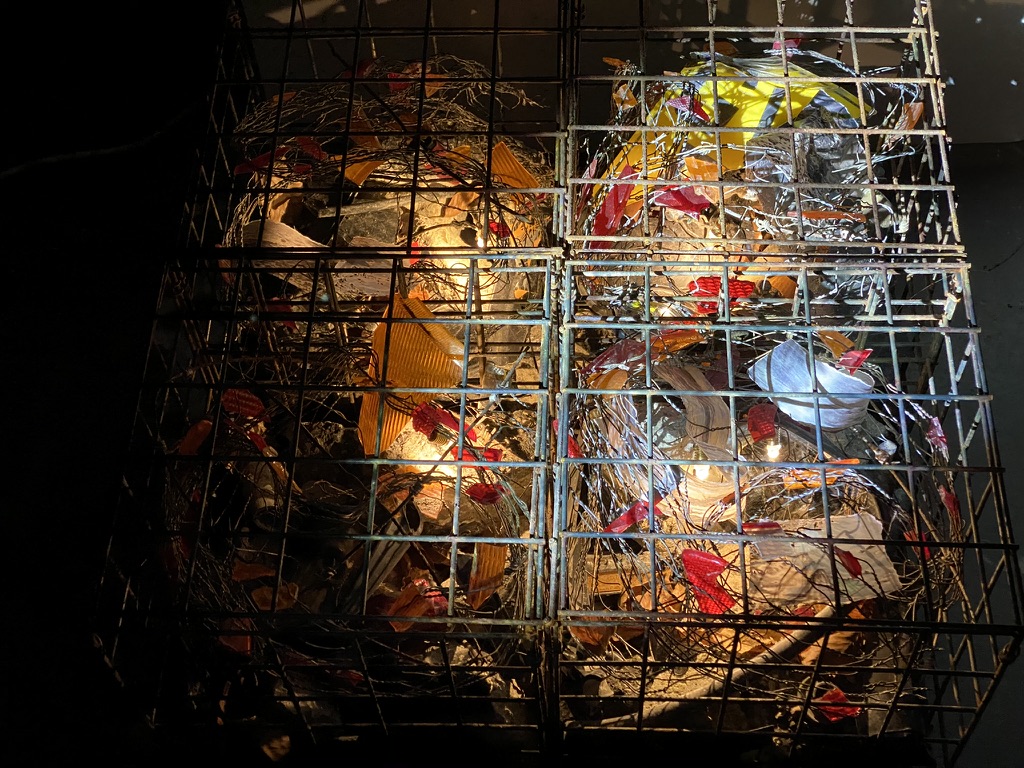
The water footage is accompanied by audio of a gentle lapping of waves on the shore. Keeping the projector low and adding a filter to soften the image into an oval concentrates it around the object but also allows shadows to be cast out into the space. Interesting secondary images are thrown out from the wing mirrors in the structure. I will experiment with additional projected images from different angles so the piece really expands into the surrounding space.
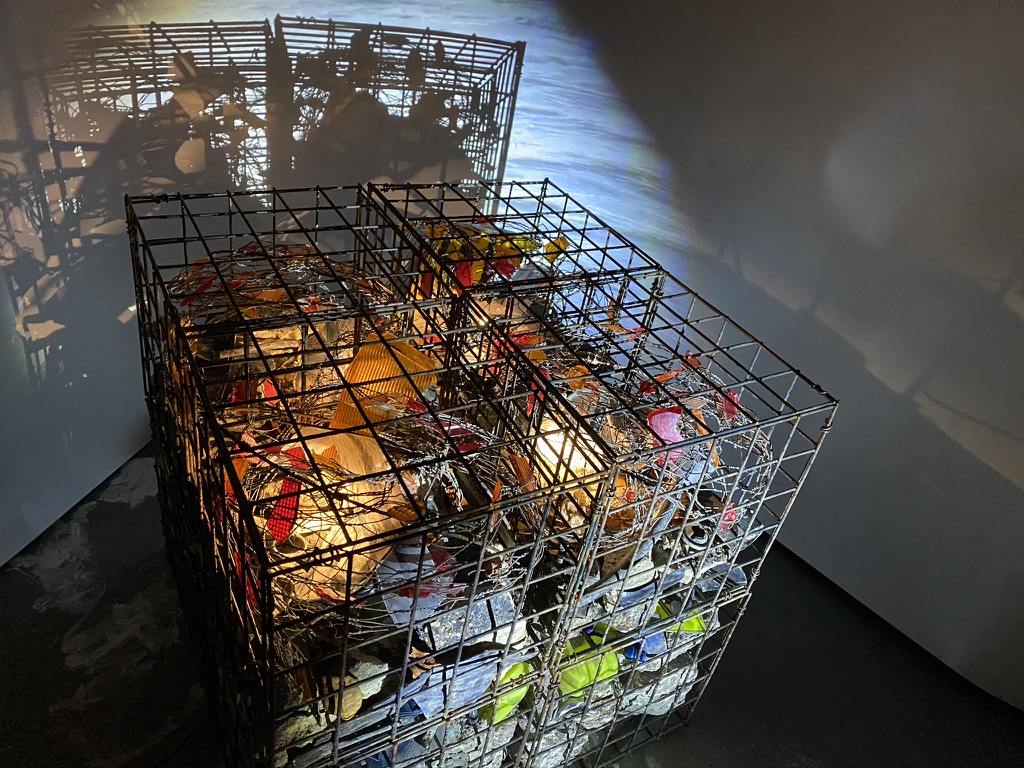
The installation of the piece in the image above and in the video link was made in a totally dark environment but I have also worked with the piece in a semi-dark space. In that environment the drama of the cast shadows is reduced but the projected light is also less harsh and the elements within the gabion baskets can be more easily read. Having more space to move around the object is useful and using several projections has more potential for the audience to become part of the work as they cross the beams of light. The time based media of video and audio add that fourth dimension to the work and the movement creates dynamism and fragility that I’d like to pursue further.
 Liz Clifford
I’m sorry I missed your presentation last week. Such an interesting, if disturbing, subject. I think the last image looks quite ominous in a good way.
LikeLike