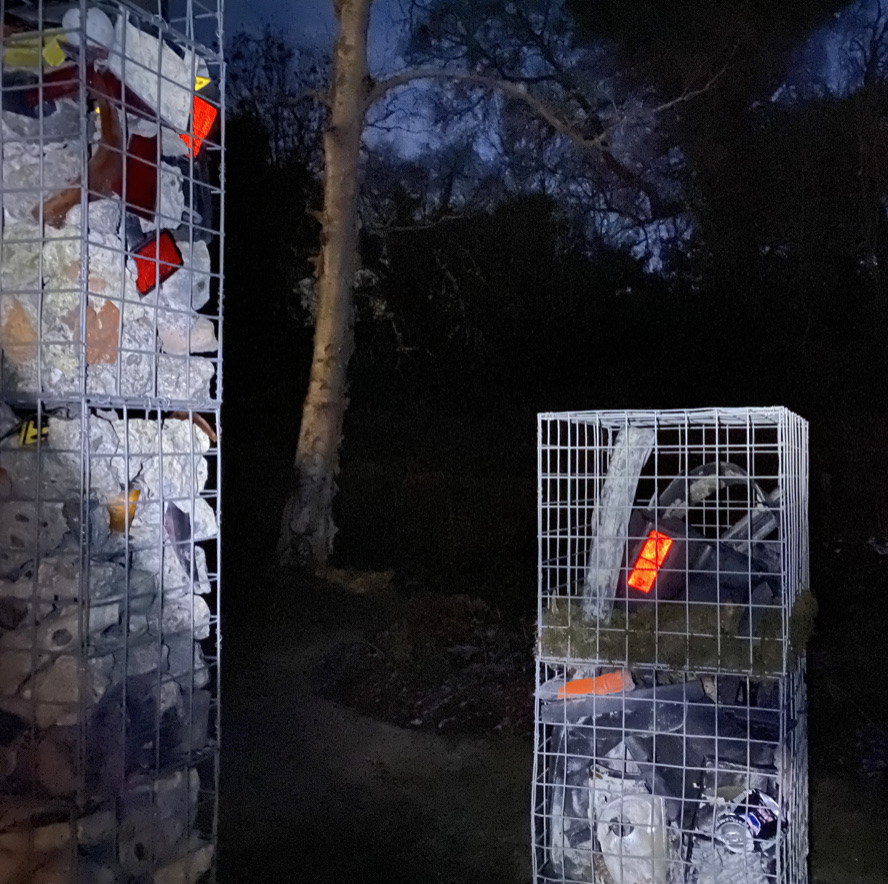
The group exhibition, Beyond the Boundaries, discussed in my previous post, is now fully launched and showing @undertowprojects on Instagram until 21st March 2021.
The exhibition is an entirely online affair. However, the piece I have made for it will stand in my garden for the duration. The work was originally proposed for an urban courtyard space but its current backdrop of garden, brambles and trees suits it well.
Titled Becoming Geology, the work consists of four cuboid structures grouped on a base of pallets. The materials I use here have largely been found on Byway 745 in The South Downs National Park, a location that I have been studying very closely. They are arranged in the proportion 1 part biomass, the moss layer, to 10 parts technosphere, the human-made detritus. This proportion is discussed by geologist Jan Zalasiewicz in his lecture Visualising the Anthropocene and he goes on to claim, in his essay The Anthropocene Square Meter, that “in the Anthropocene almost everything becomes geology” (Zalasiewicz, 2020:42), pointing out that there are 30 trillion tons and growing, of human generated substances on earth, half of that being urban mass, before we even get to artefacts and packaging. Those artefacts will form the technofossils of the future. As Donna Haraway writes, whatever we call this time in which we live, it ‘will be written into earth’s rocky strata, indeed already is written into earth’s mineralised layers’ (Haraway, 2016:102). In this work, the lower layers are built up with chalk, brick, and concrete, and topped with vehicle parts and plastic waste. Each structure, built of stacked gabion baskets, contains a thin layer of moss. The tallest structure contains a terrarium filled with living matter from Byway 745. The gabion basket form is one associated with the engineering of flood defence in the face of rising sea levels. The pallet base provides the stability for the structures that are clamped onto it as well as acting as a formal horizontal link and duck board walkway between them. Not only are the pallets salvaged, but they are also part of the same transport and packaging ecosystem as the litter and discarded objects contained within the gabions.
An online exhibition relies on good documentation above all else. Building the work is only the beginning. The photographs are vital, and with sculpture it can be a huge help for the audience to experience the work via video. For the online launch event I decided to make a 3 minute video that would introduce the work. It was a hugely enjoyable challenge. I decided that I needed to explain where the work comes from, both in terms of materials and ideas, so combined footage I have of the landscape with that of me collecting and building, as well as of the finished piece. I didn’t want to have to use graphics to quote the statistics from Jan Zalasiewicz’s essay, nor did I fancy using my own voice. What I discovered as the solution, a very twenty first century one too, has a poignant and uncanny effect. You can watch the video by clicking the image below.
The online launch event was a new experience for us all, with a few technical problems to put the wind up us. Zoom is not good at streaming videos and there is always the jeopardy of accidental screen sharing to contend with. However, on balance, it was good to mark the beginning of the show with an event. The exhibition will continue @undertowprojects until 21st March. All the work in the show can also be viewed in this zine, created by the artist Noelle Genevier.
References:
Haraway, D (2016) Staying with the Trouble. Durham and London: Duke University Press.
Zalasiewicz, J (2020) ‘The Anthropocene Square Meter’ In: Latour and Weibel (ed.) Critical Zones: The Science and Politics of Landing on Earth. Karlsruhe: ZKM. pp.36-43
Zalasiewicz, J (2019) Visualising the Anthropocene [Lecture at University of Exeter, Global Systems Institute Lovelock 100 Conference] At: https://www.youtube.com/watch?v=zphinkipB9A (Accessed on 26.6.20)
 Liz Clifford