Weaving in the litter

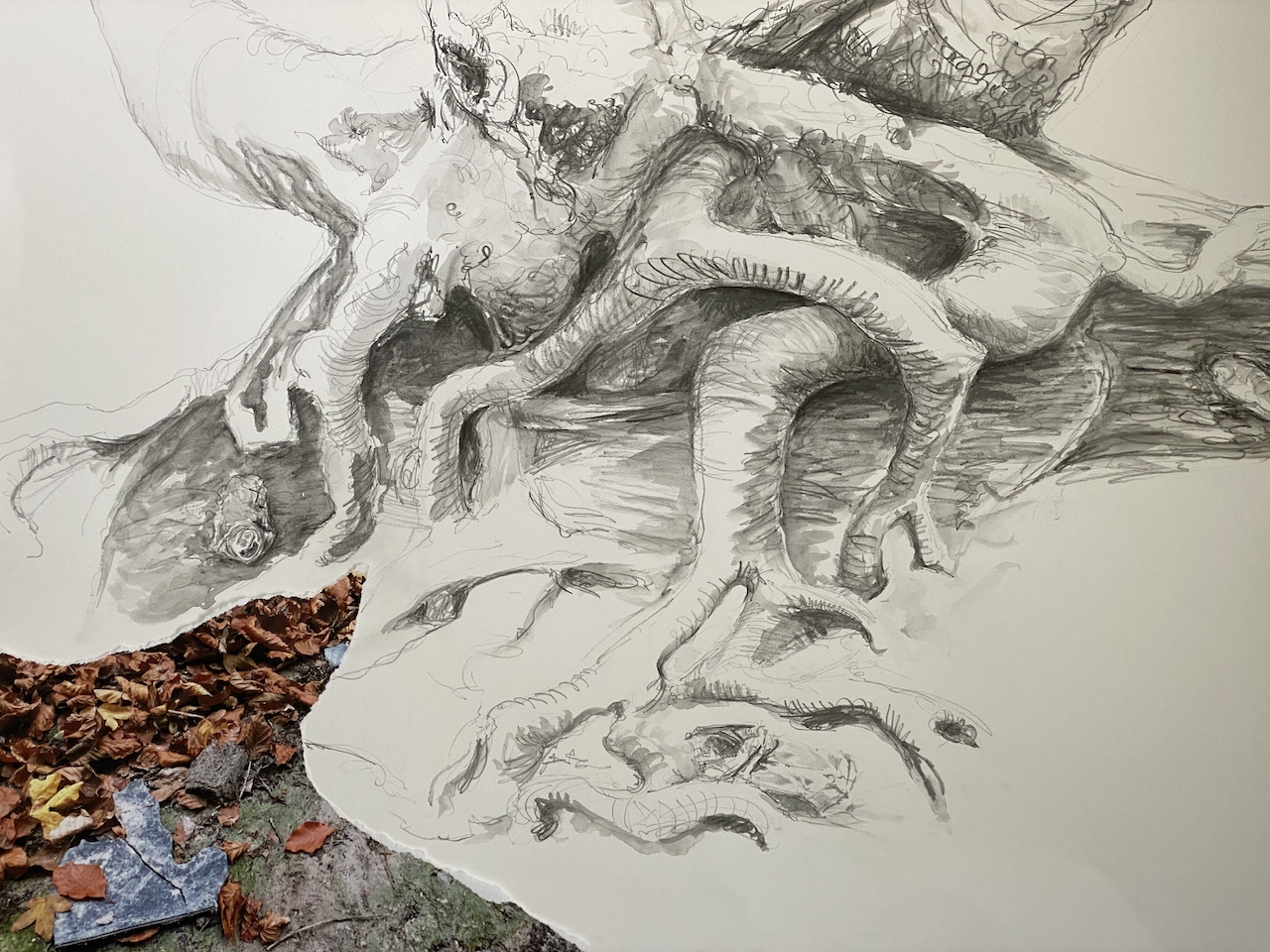
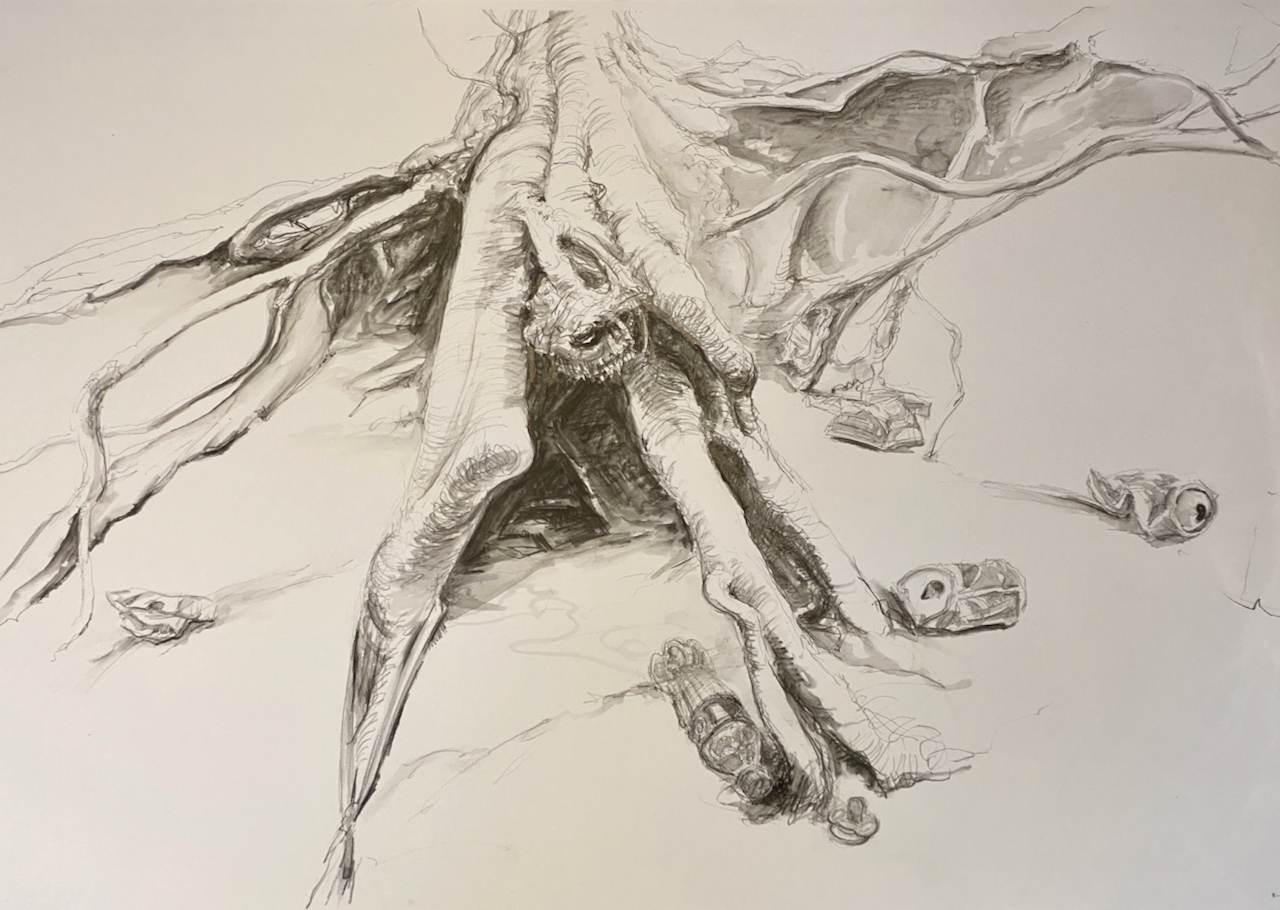
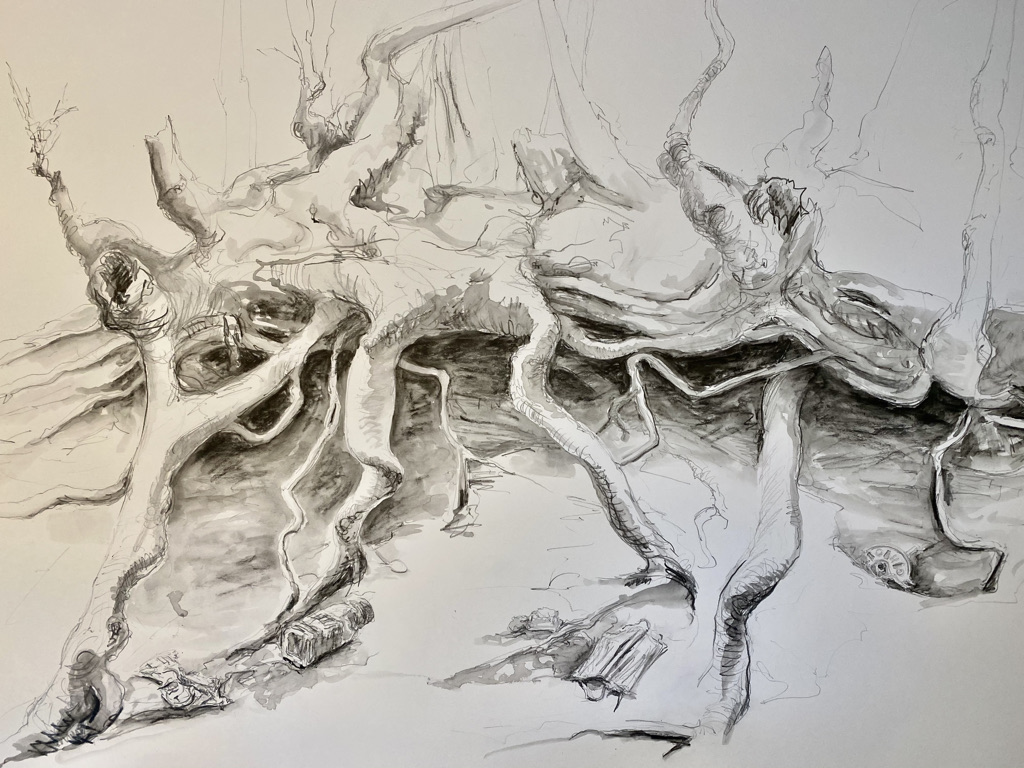
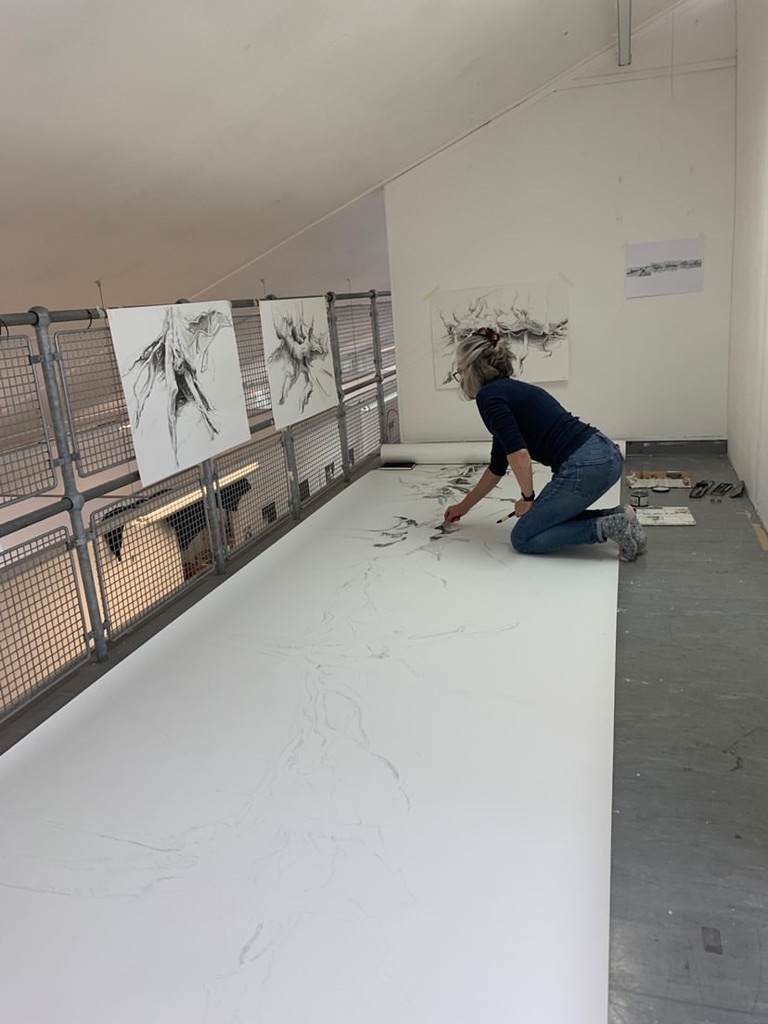
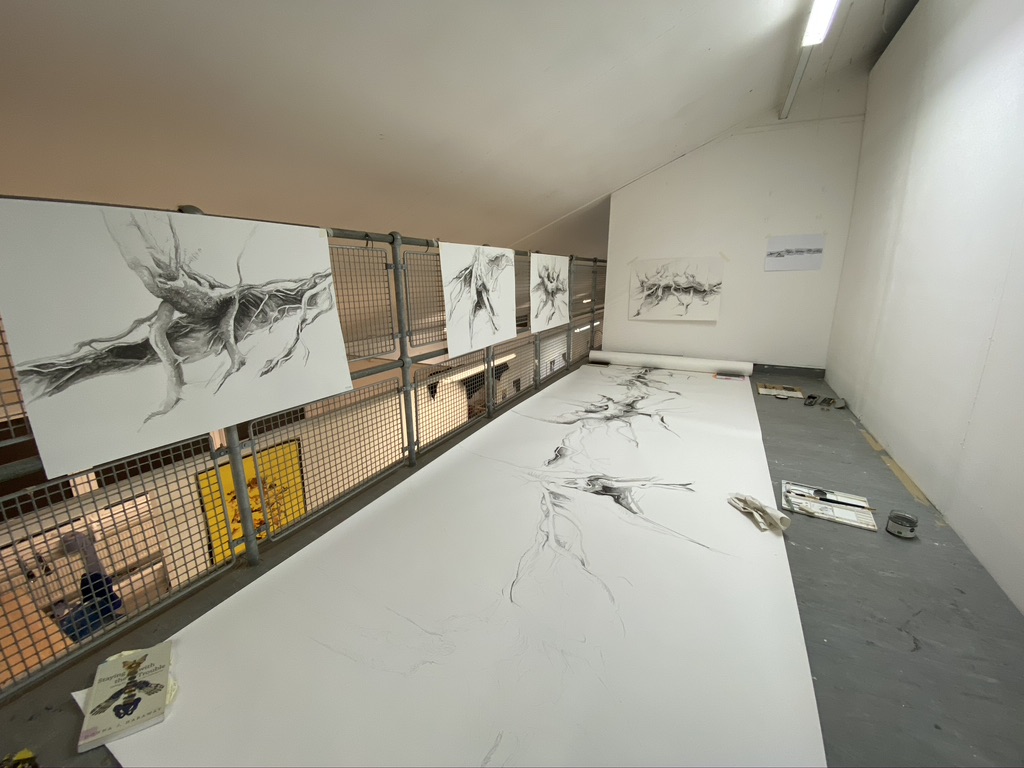
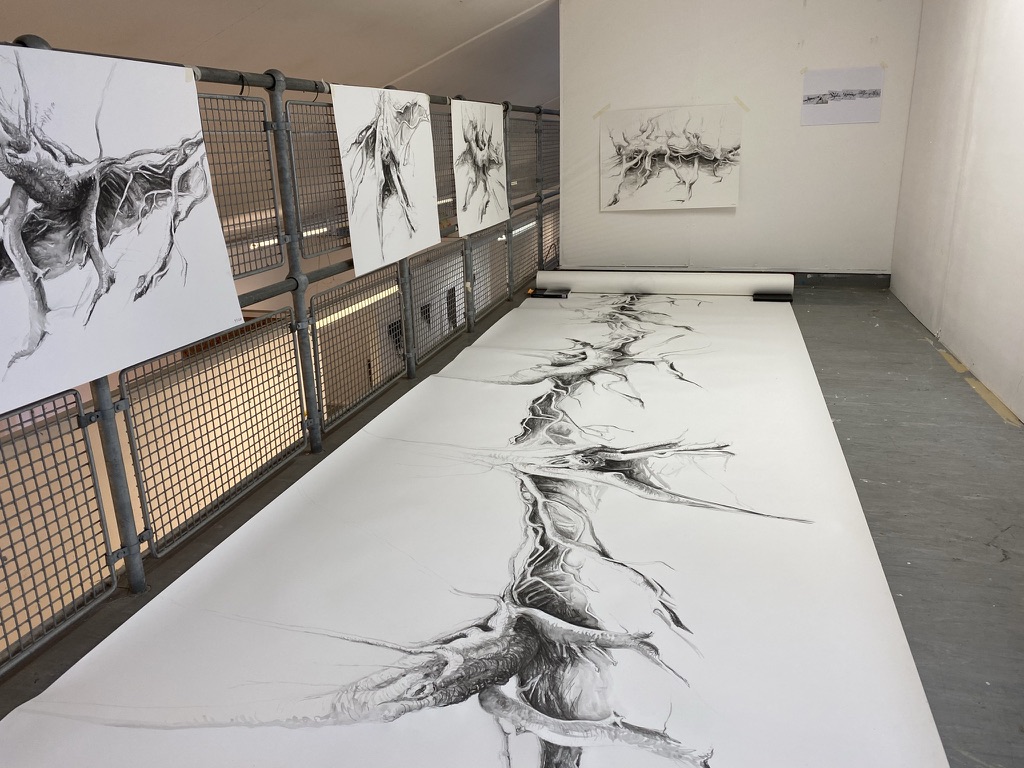
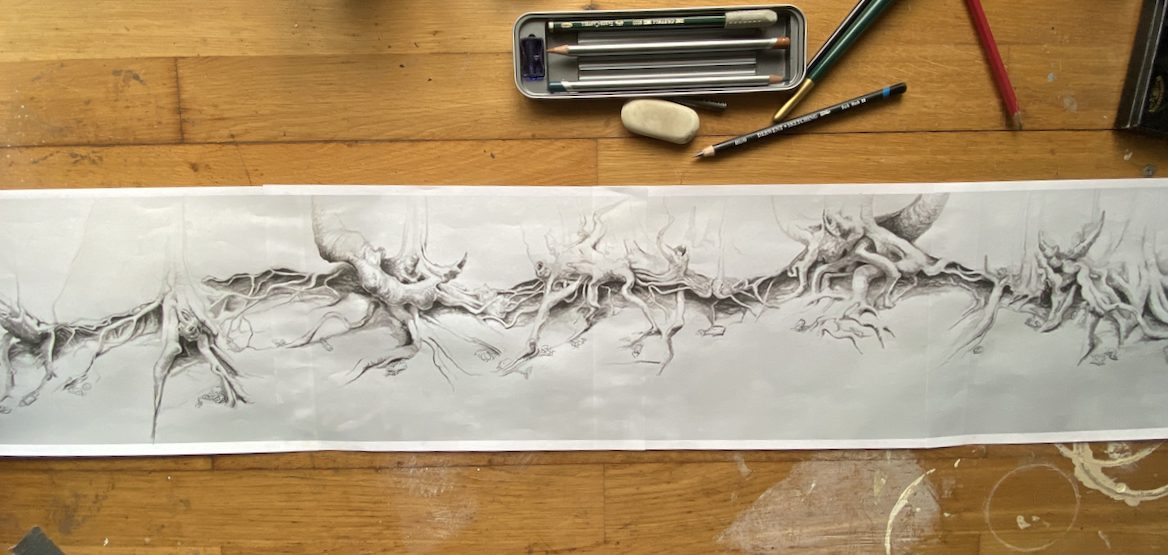
I have a large scale work in progress – a 7 metre long drawing using the line of beech trees that borders Byway 745. I’m in the planning stages of further work on this drawing, considering the various options for weaving imagery of the litter I’ve been collecting from the track beneath the line of trees.
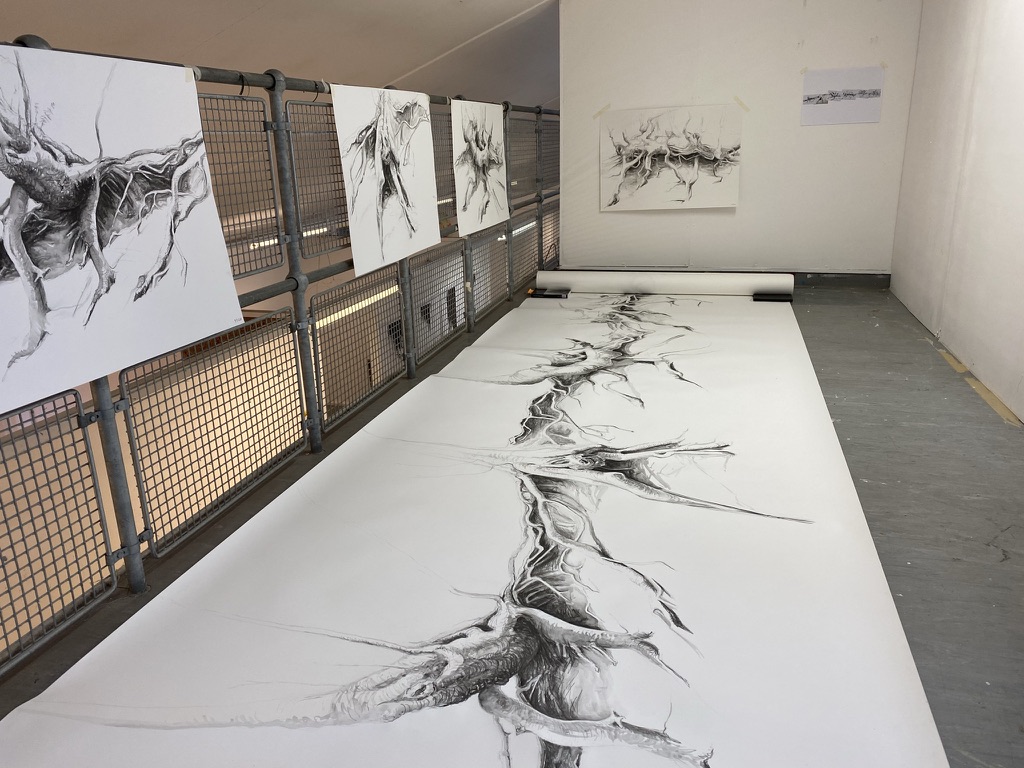
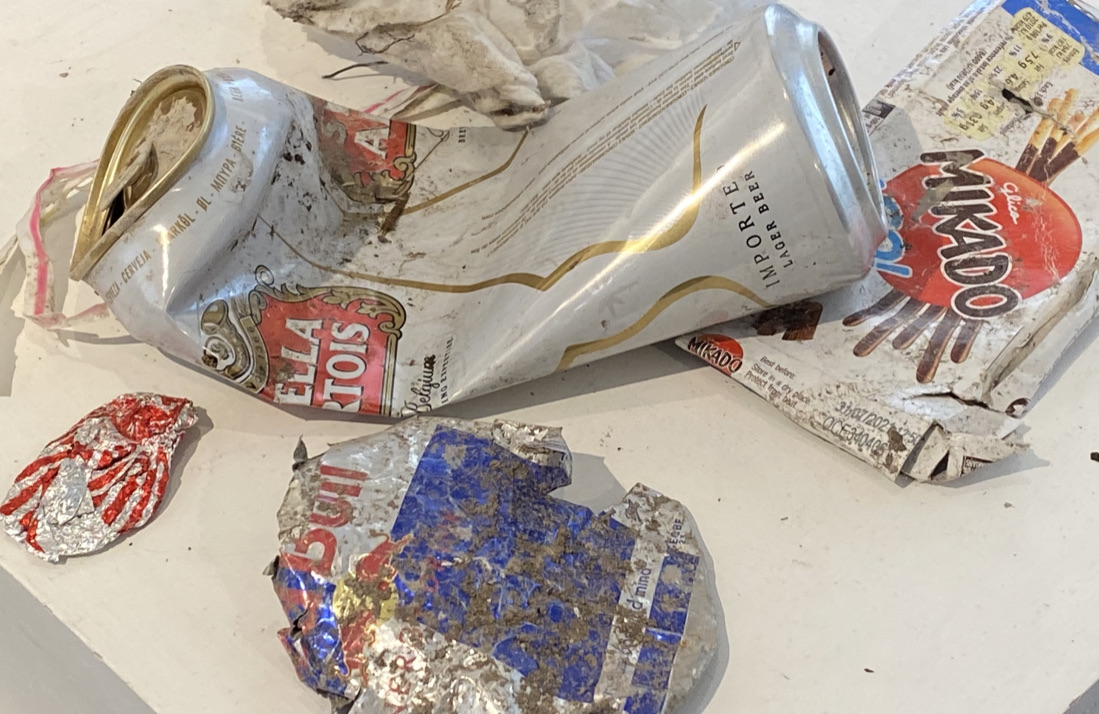
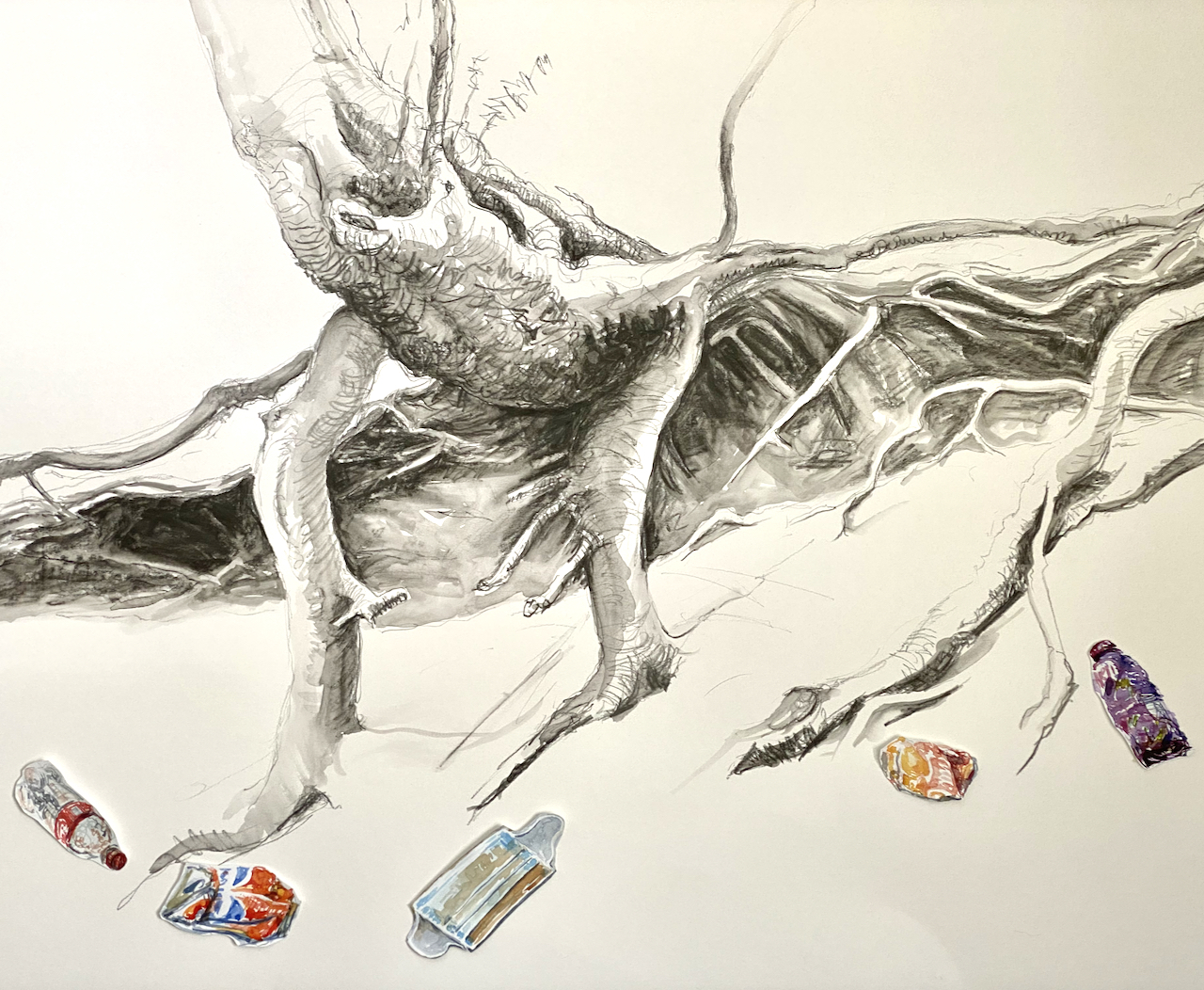
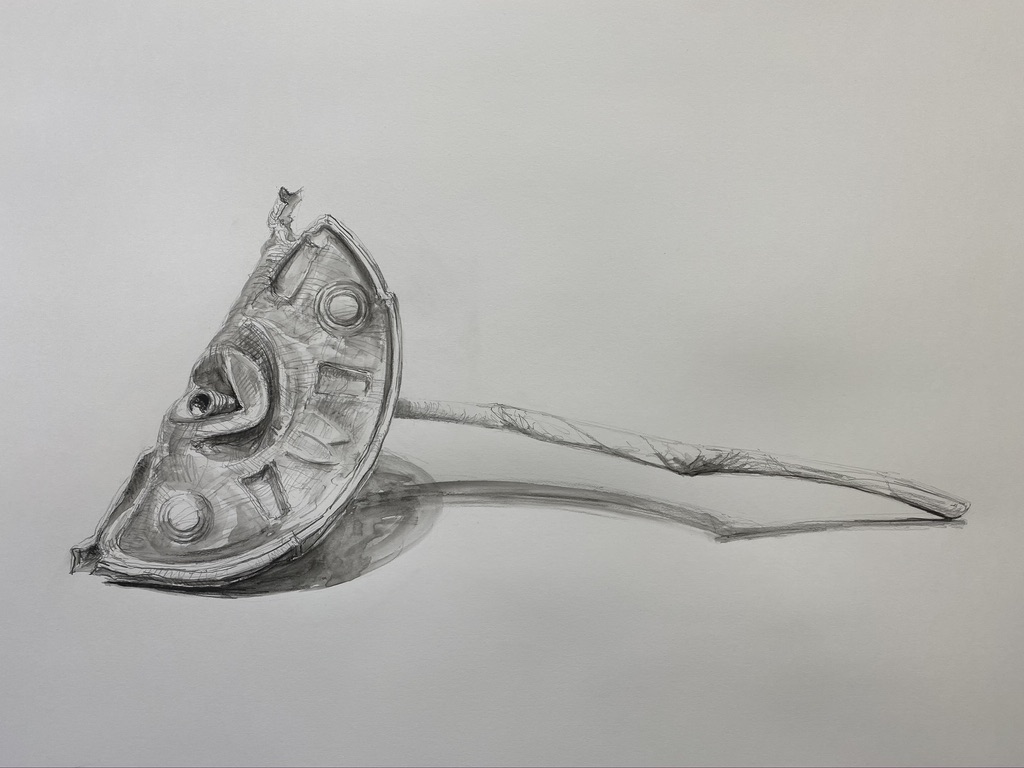
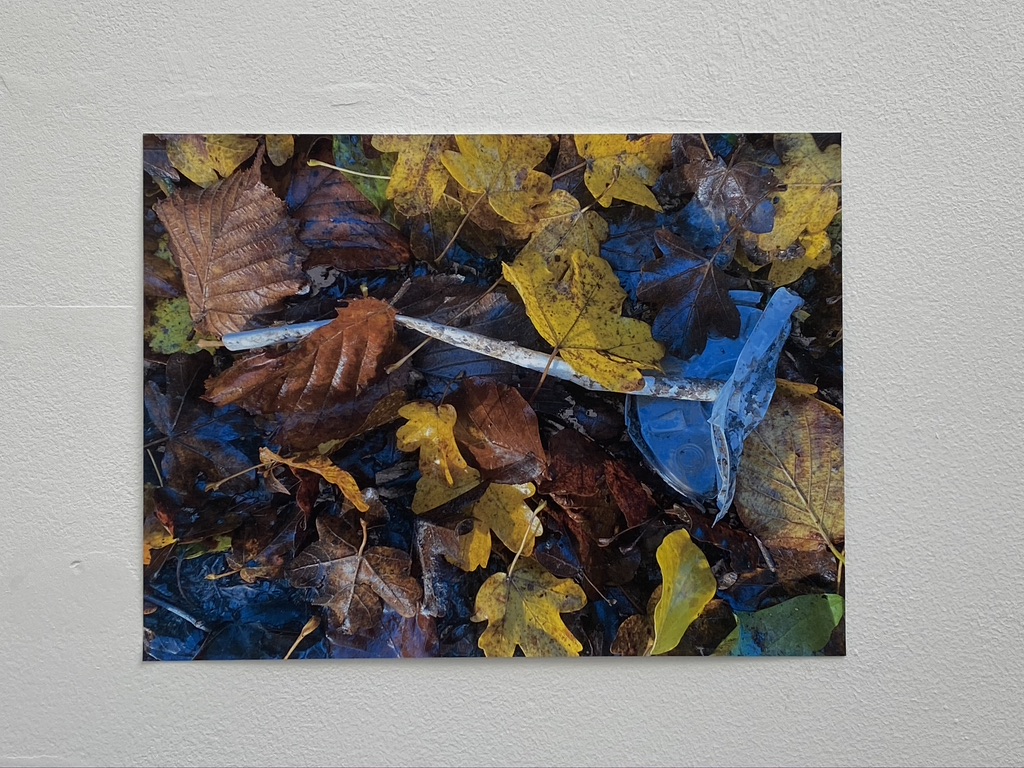
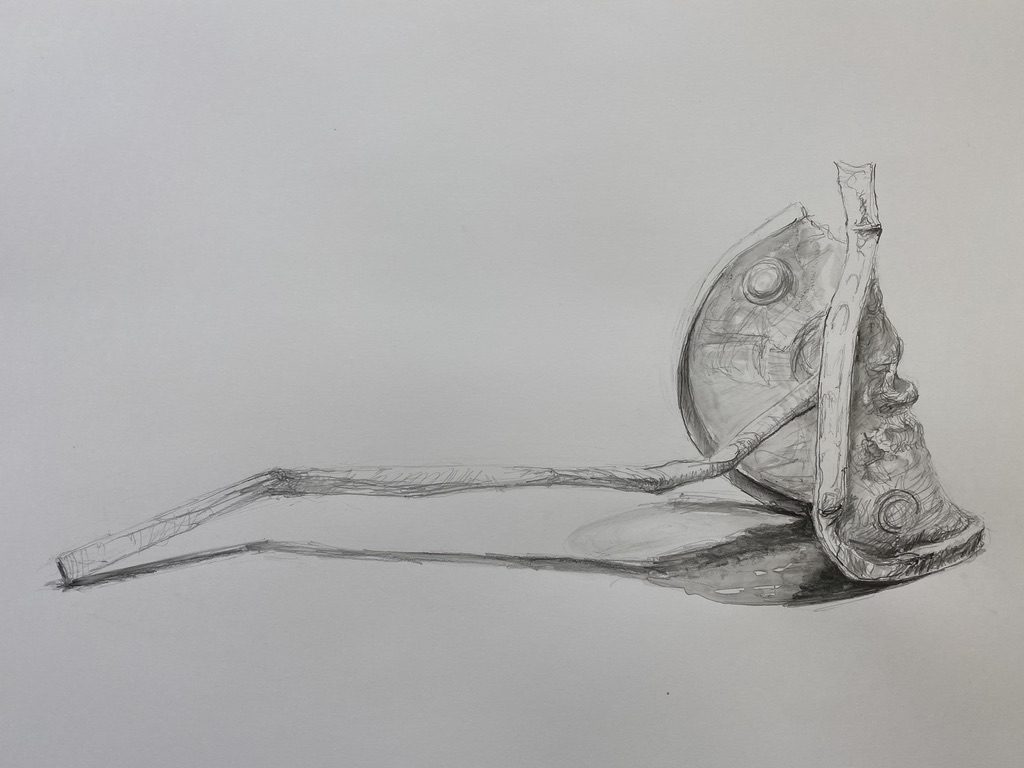
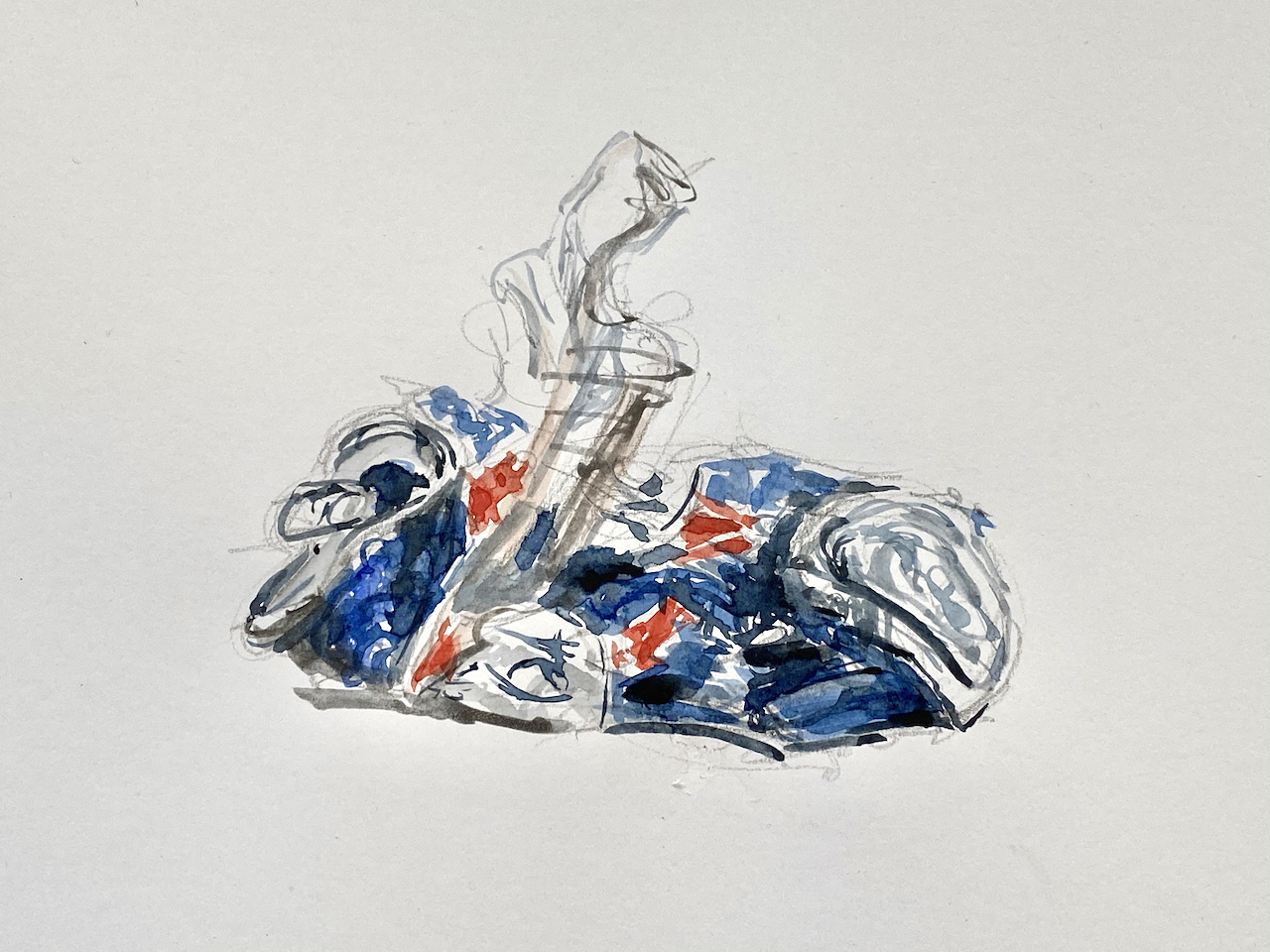
I have been drawing from observation in the studio using graphite and watercolour wash. Drawing directly onto the A1 originals to work out scale and positioning, to be transposed later onto the 7m drawing. The question of colour or no colour is the most vexing. The objects are often instantly recognisable from their colour, the ubiquitous reds of Coca-Cola or Stella Artois and the purple of Ribena, even if they have been crushed and partially destroyed. To help me decide, I have created temporary collages on the original graphite drawings with watercolours of the litter as well as with photographs of it.
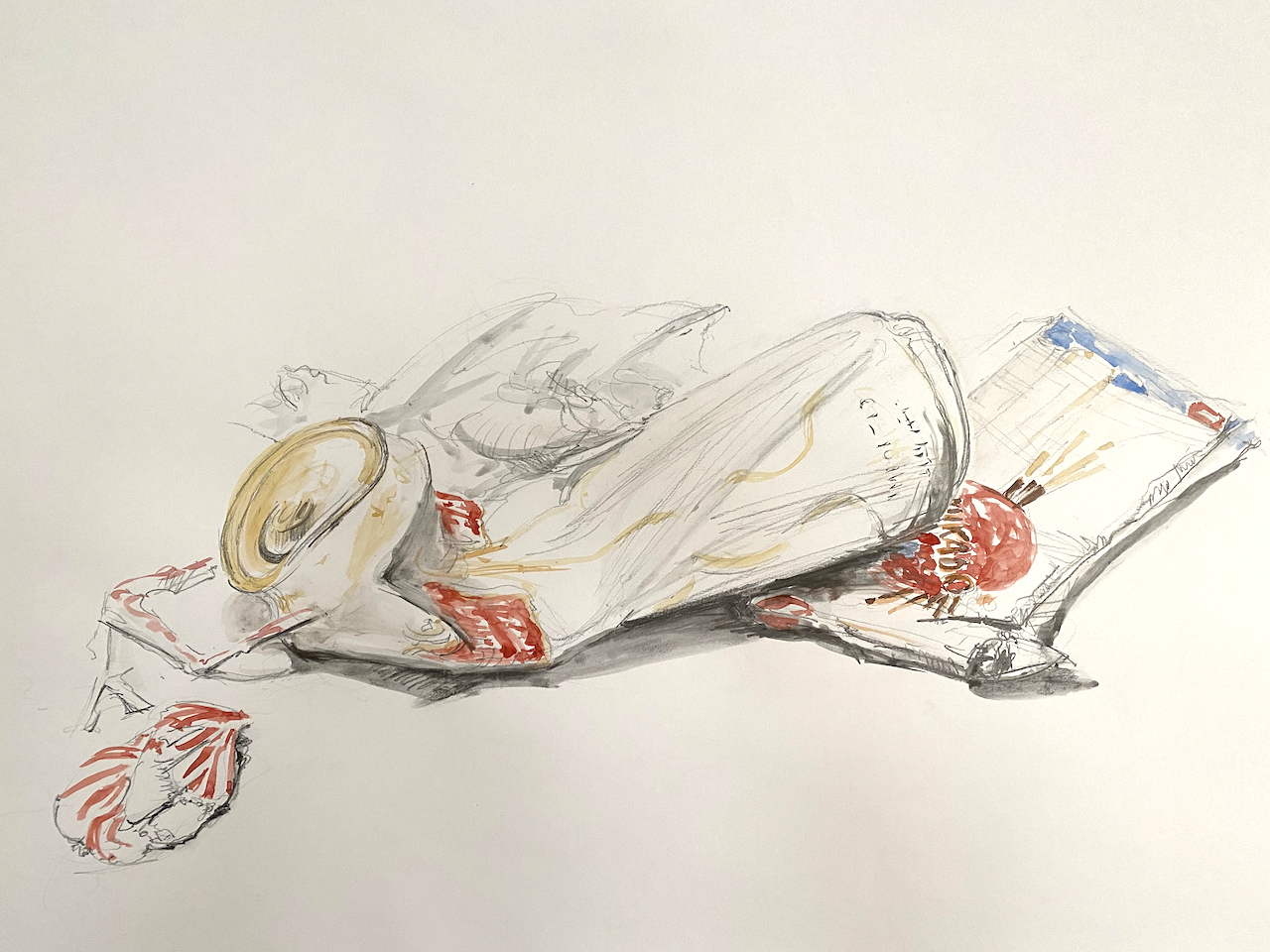
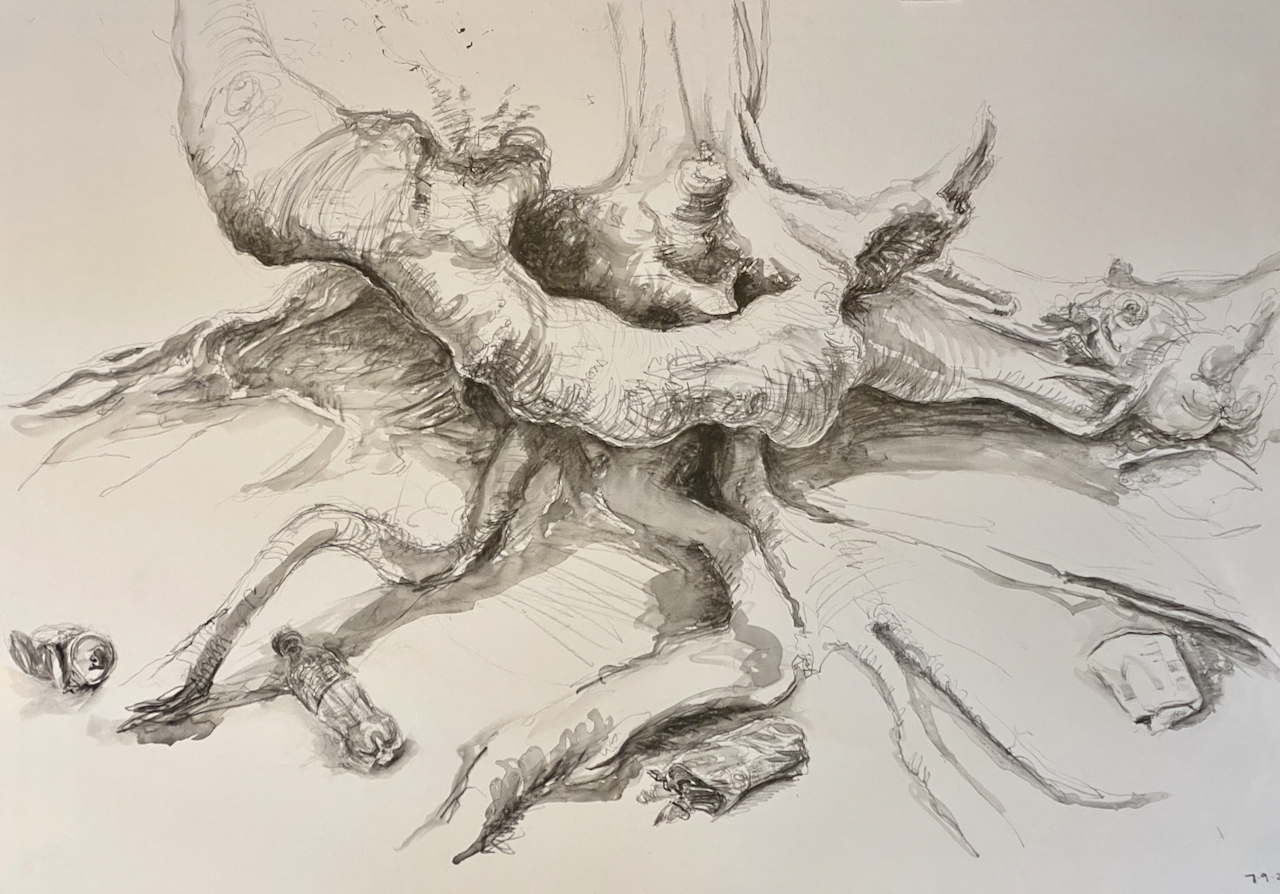
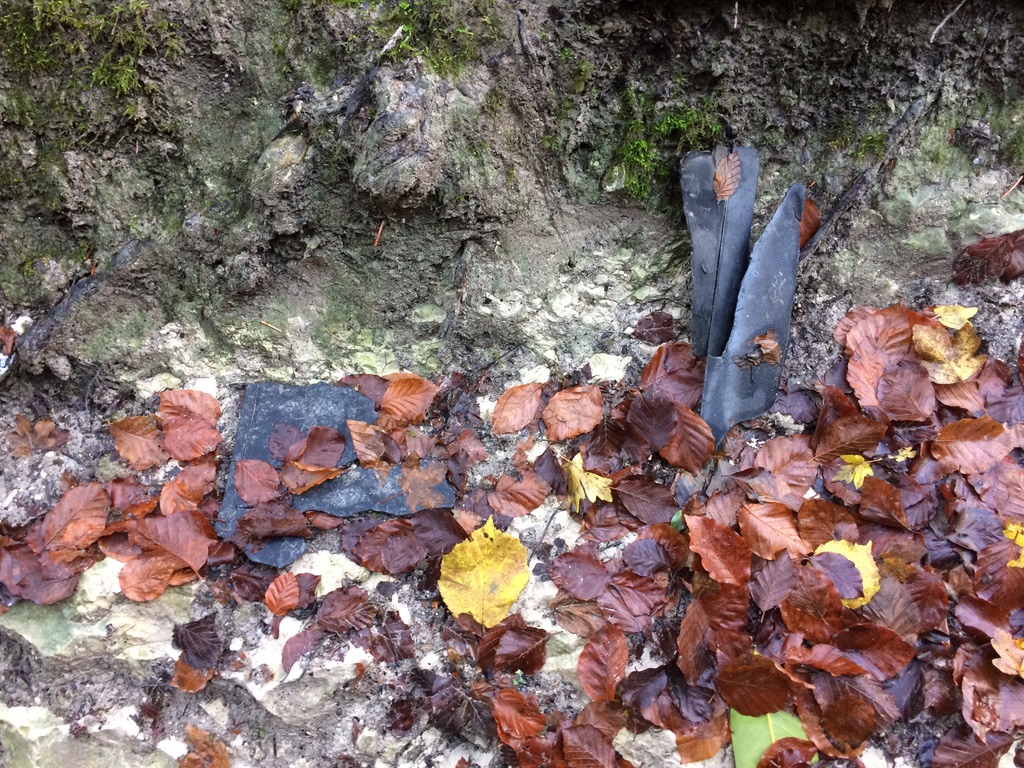
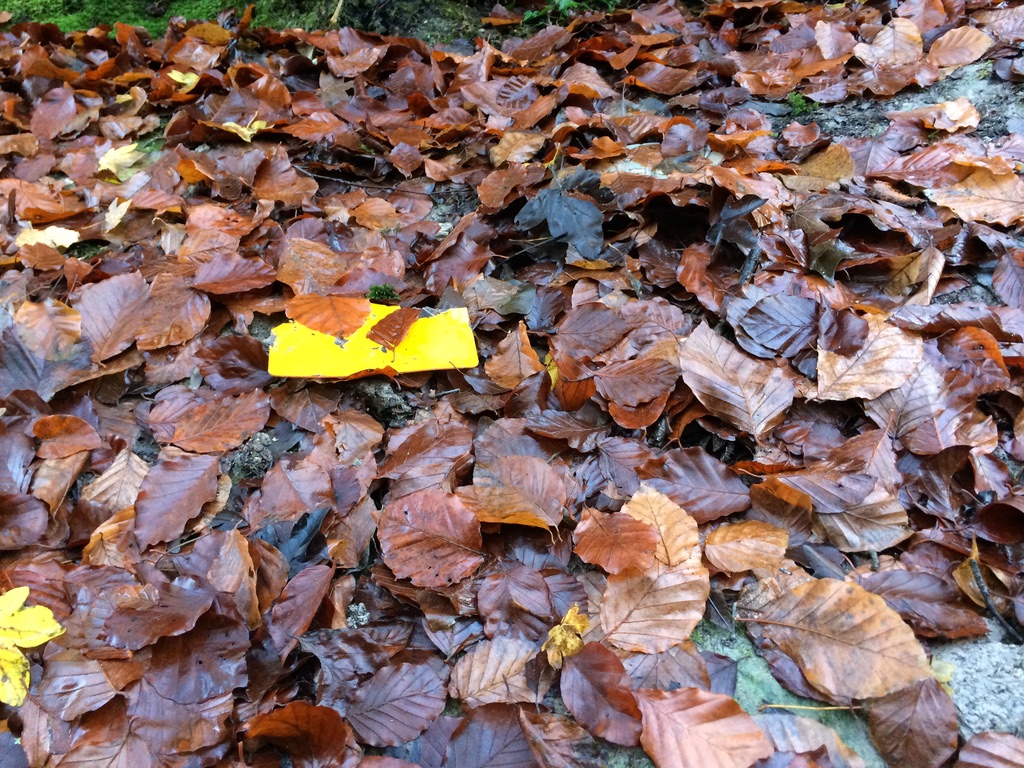
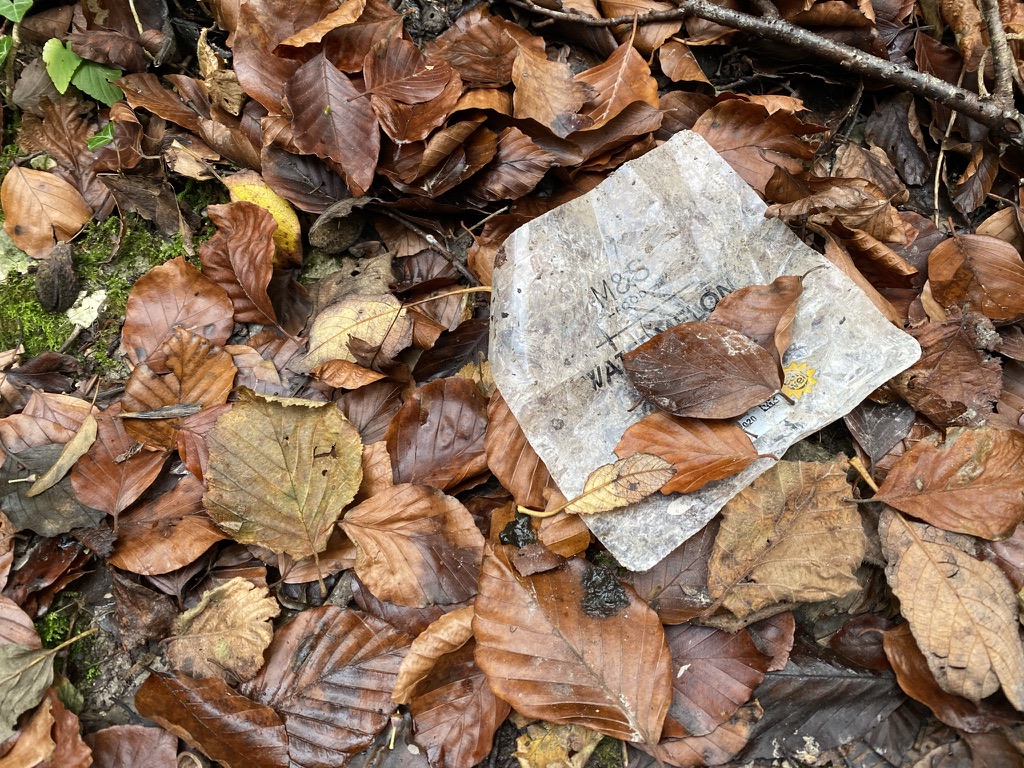
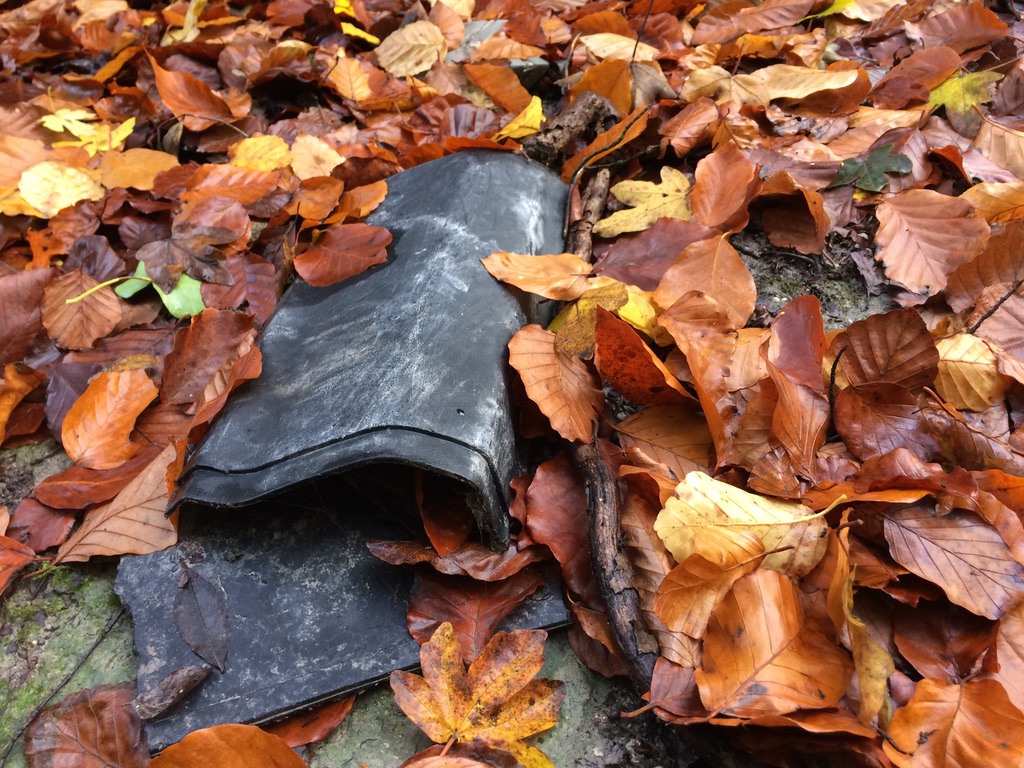
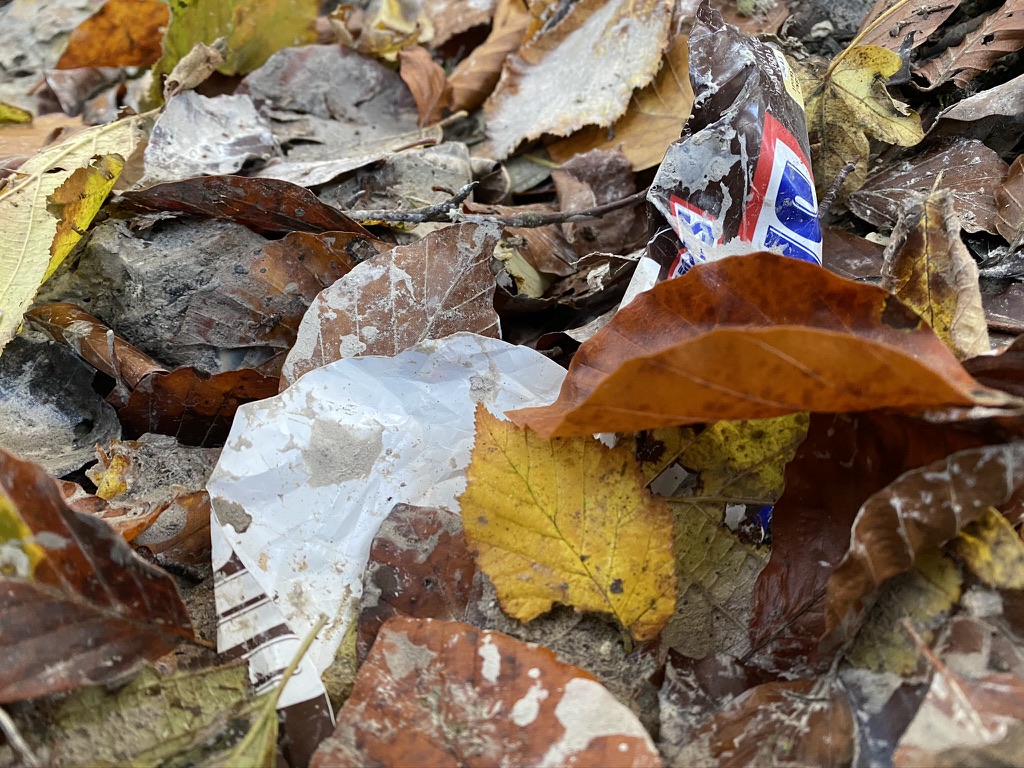
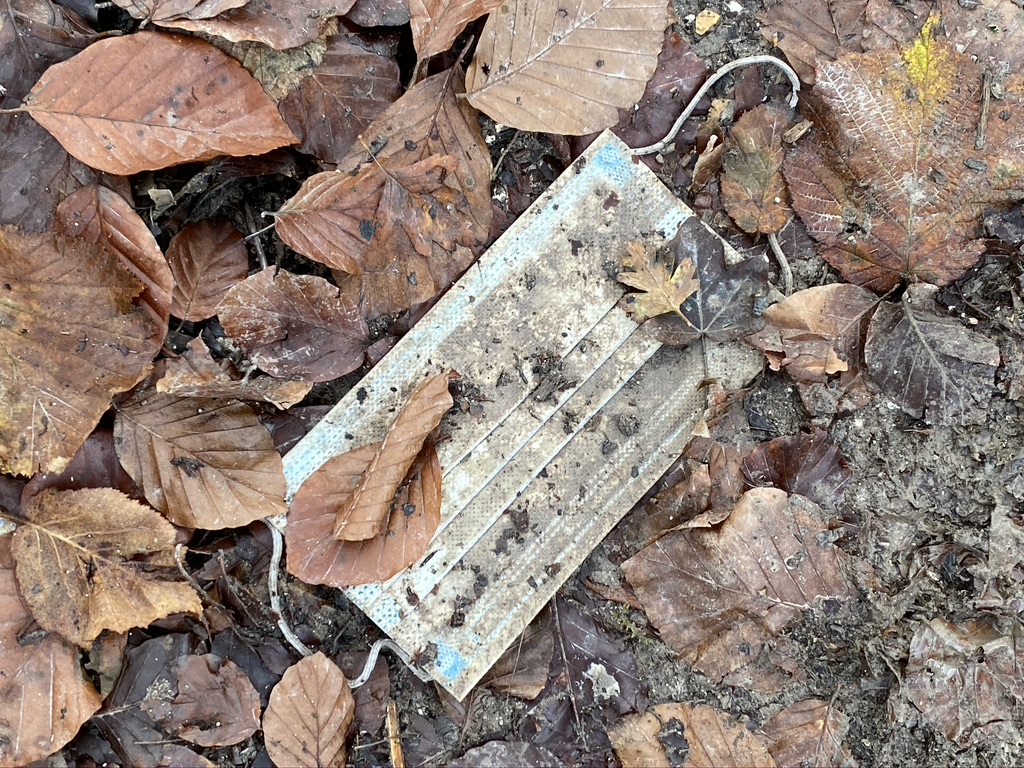
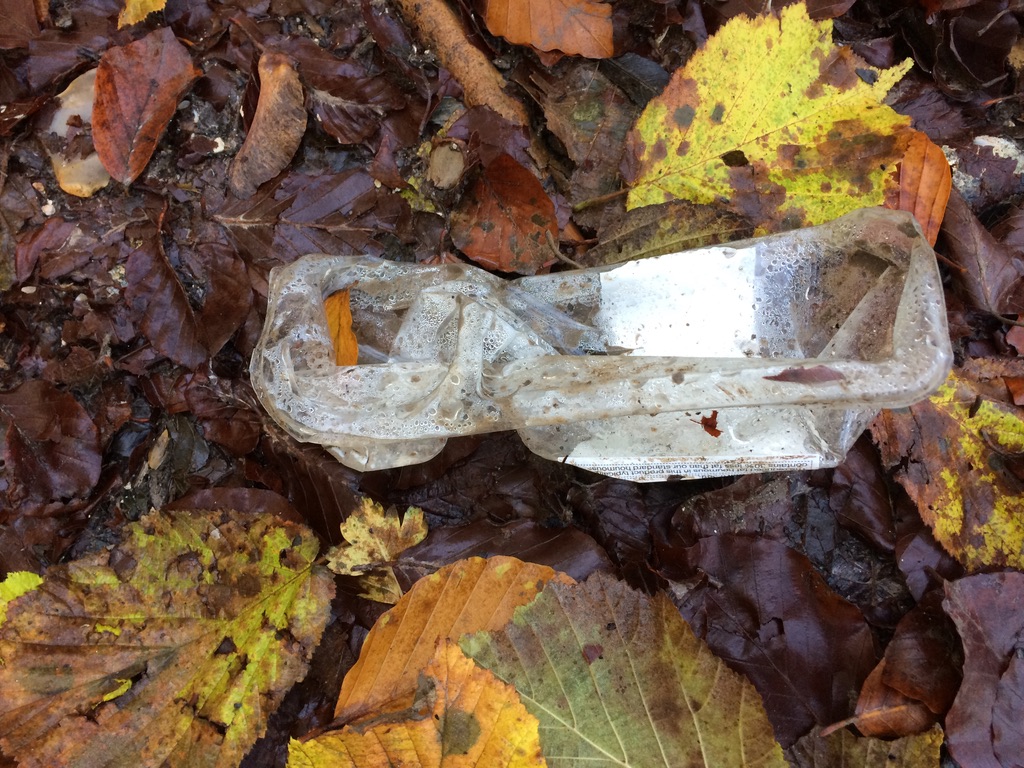
After much deliberation, I have decided to stick to monochrome, using graphite and wash, as I did for the trees, so that the litter is not immediately obvious. As I weave the objects into the large drawing I may be tempted to use splashes of colour here and there but I’d like to treat them as part of the same ecosystem as the beeches. The man made objects that are found under the line of trees have been dropped as people pass up and down the track. They mark a passage of time but they also become stuck in a moment of time. In the city these flows of litter are part of a system, but in the countryside they are outside any system of collection and disposal. As Rosemary Shirley points out in Rural Modernity, Everyday Life and Visual Culture litter in the countryside ‘sits, it decays, and interestingly it sometimes becomes colonised by its new environment’ (Shirley 2016: 60). These photographs show just that happening as layers of leaves and mud cover the objects and moss begins to grow on them.
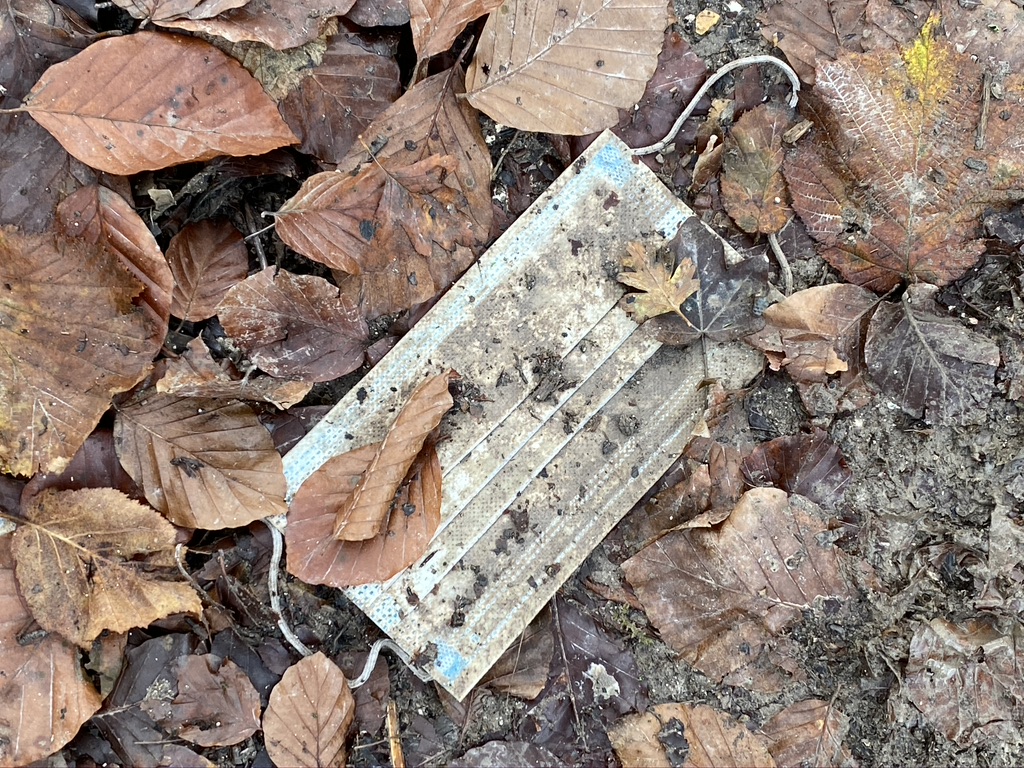
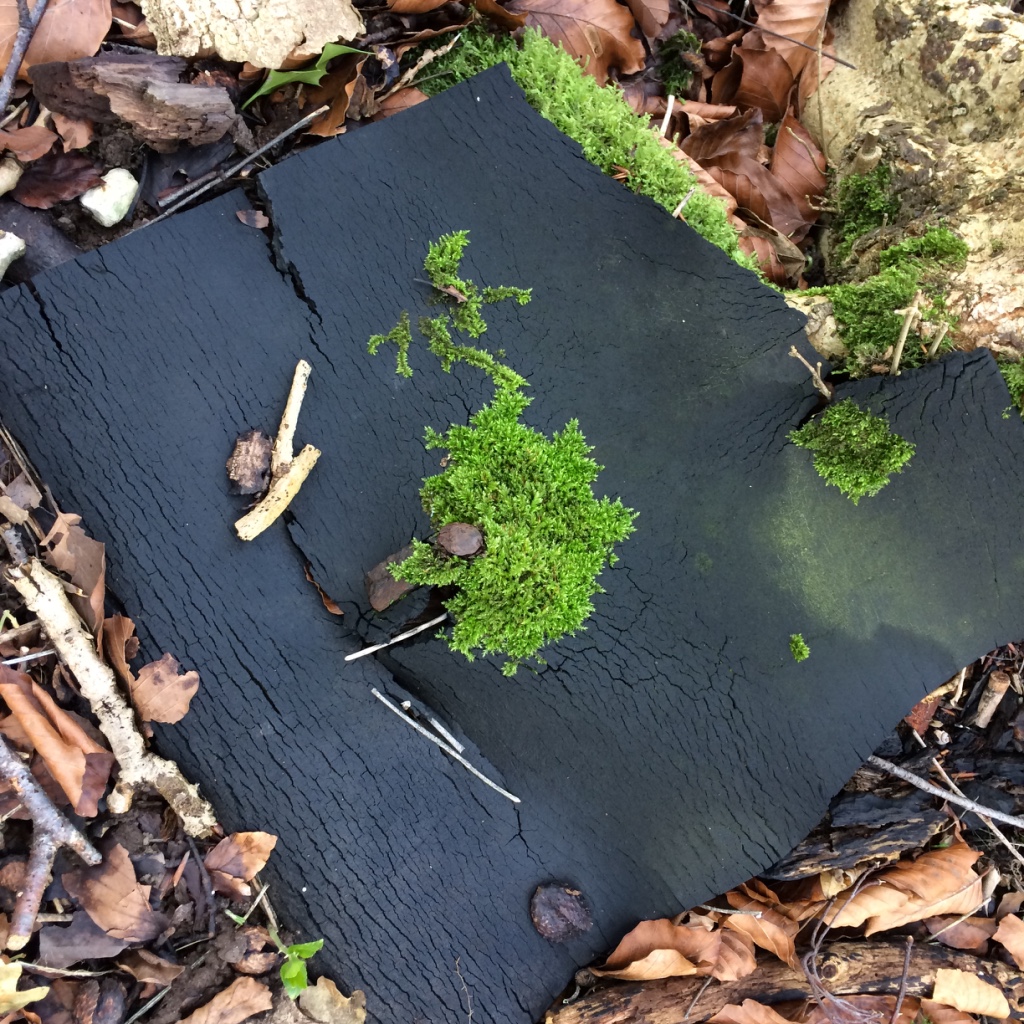
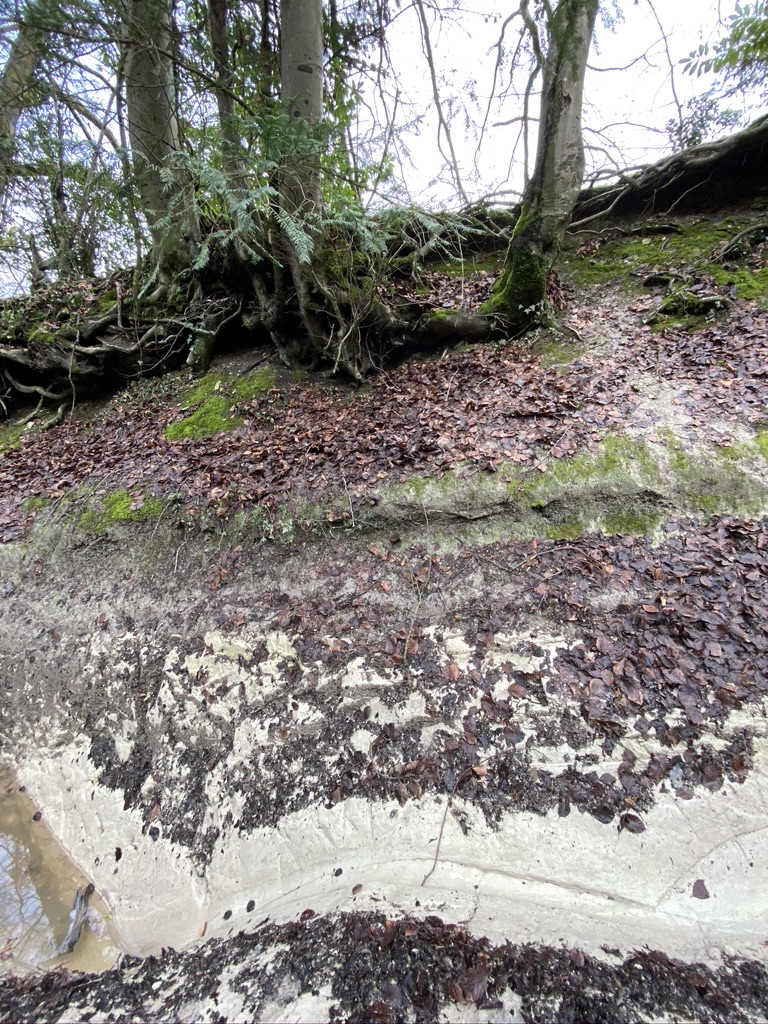
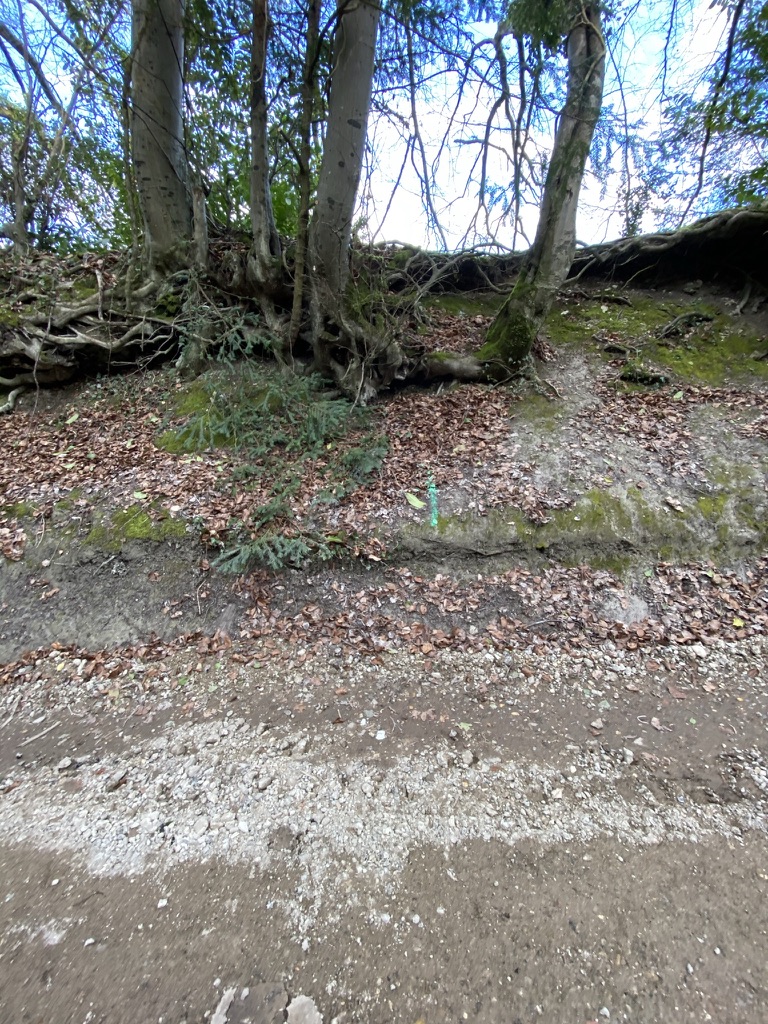
The litter marks evidence of human intervention in this landscape, along with that held in the shapes of the trees, once a coppiced hedge, and the bank beneath it which has been eroded by human traffic. I’m now ready to start the task of weaving a horizontal layer of new drawings across the entire length of the 7 metre drawing at the point where the roots emerge from the bank. I’ve made a rough plan on a photocopy and will have to work in sections on the floor. It is now time to get going with it.
All drawings and photographs by Liz Clifford.

Laying New Ground

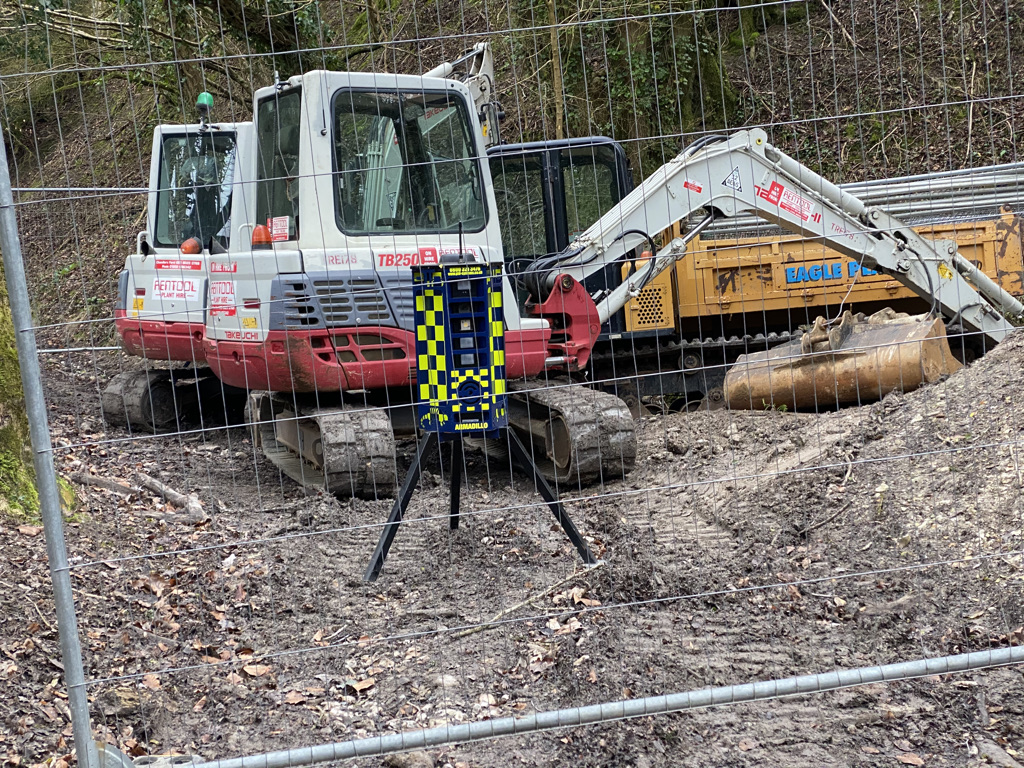
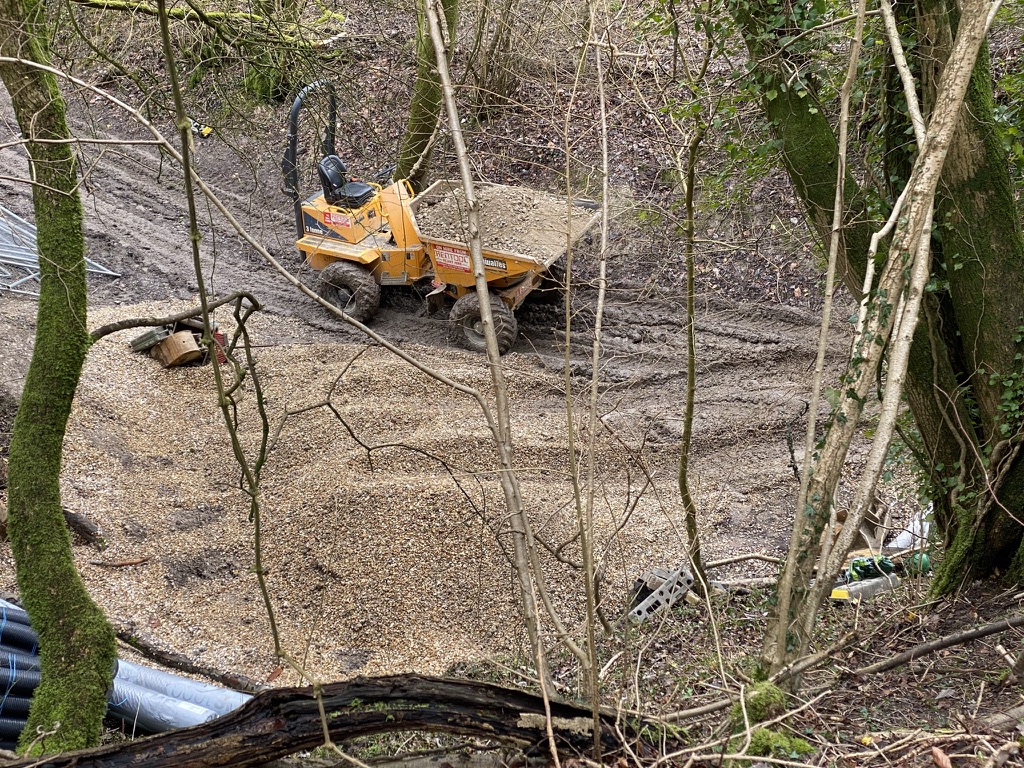
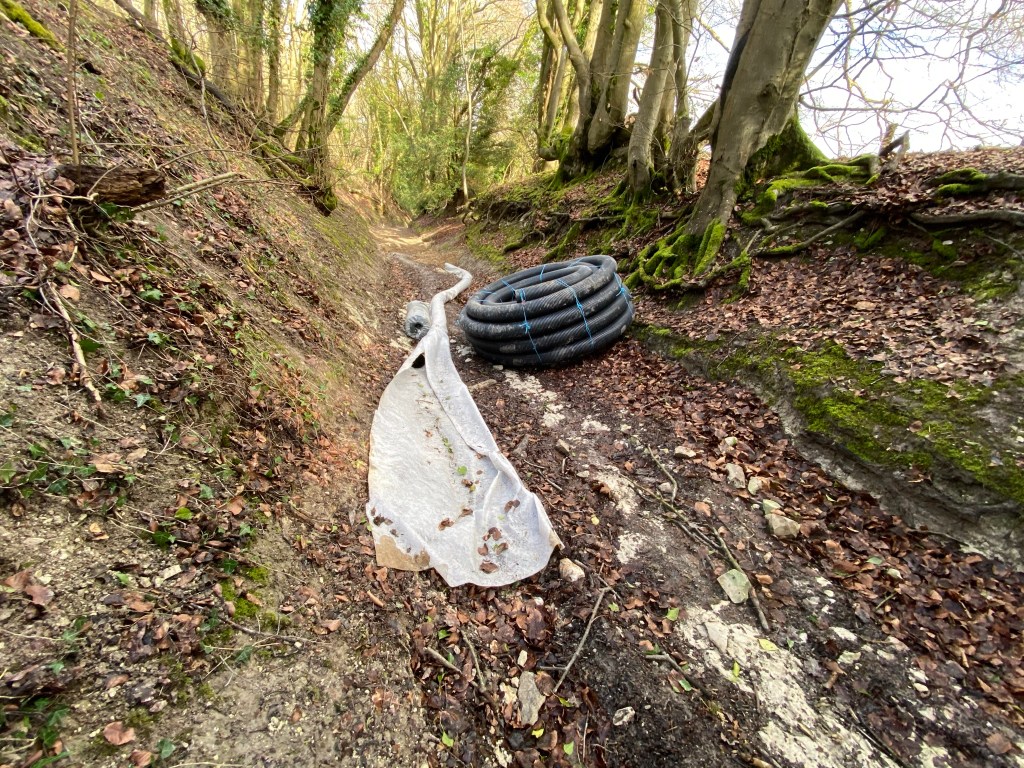
Work has finally started on Byway 745 to stop it becoming more eroded and to allow access to it for a wider cross section of users. The County Council have subcontracted the work to a company who specialise in conservation groundwork. The three workers are setting about installing what is known as a French drain into the eroded groove that runs almost the whole length of the track. Ironically, this is a plastic pipe wrapped in permeable membrane that allows water to seep into it all the way down the hill. It will run into the mud-hole at the bottom which has been a favourite place for 4 x 4 drivers to play in the past.

Once the drainage is in place and packed with pea shingle, hardcore of crushed concrete, brick and tarmac is laid on top to be followed by a layer of limestone. This stone is more durable than chalk and binds together to make a firm surface which should weather down to not look too out of place.

Byway 745 Observatory with materials for French drain. March 2021
Byway 745 Observatory with new hardcore layer. March 2021

The company is not happy about laying plastic pipe but are not sure what else will work. That is one of many ironies apparent in this project which is, in part, about ensuring that all who are entitled use the Byway Open to All Traffic (B.O.A.T.) can do so. It is imposing changes on the landscape by using hefty fossil fuelled vehicles in an attempt to protect that landscape from the ravages of erosion caused to a great extent by similar vehicles. The human generated deposits making up the new ground will find themselves in the Quaternary geological layer, the layer above the bedrock, along with alluvial deposits, landslip and landfill. Although it is hoped that the upgrade to the surface will make the track boring and therefore unattractive to off-road vehicle users, the process of erosion will begin again and fragments of plastic, along the chemicals from the crushed concrete and tar will be washed down the hill, into the lane and then the stream beyond which feeds the River Rother, entering the sea at Littlehampton.

All photographs by Liz Clifford.
Becoming Geology

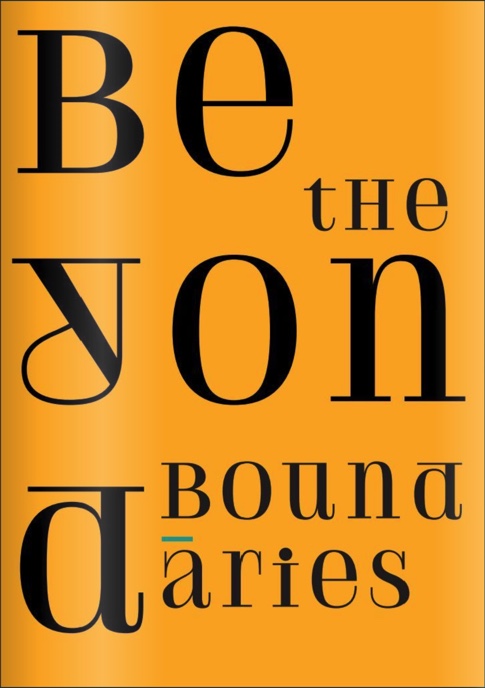
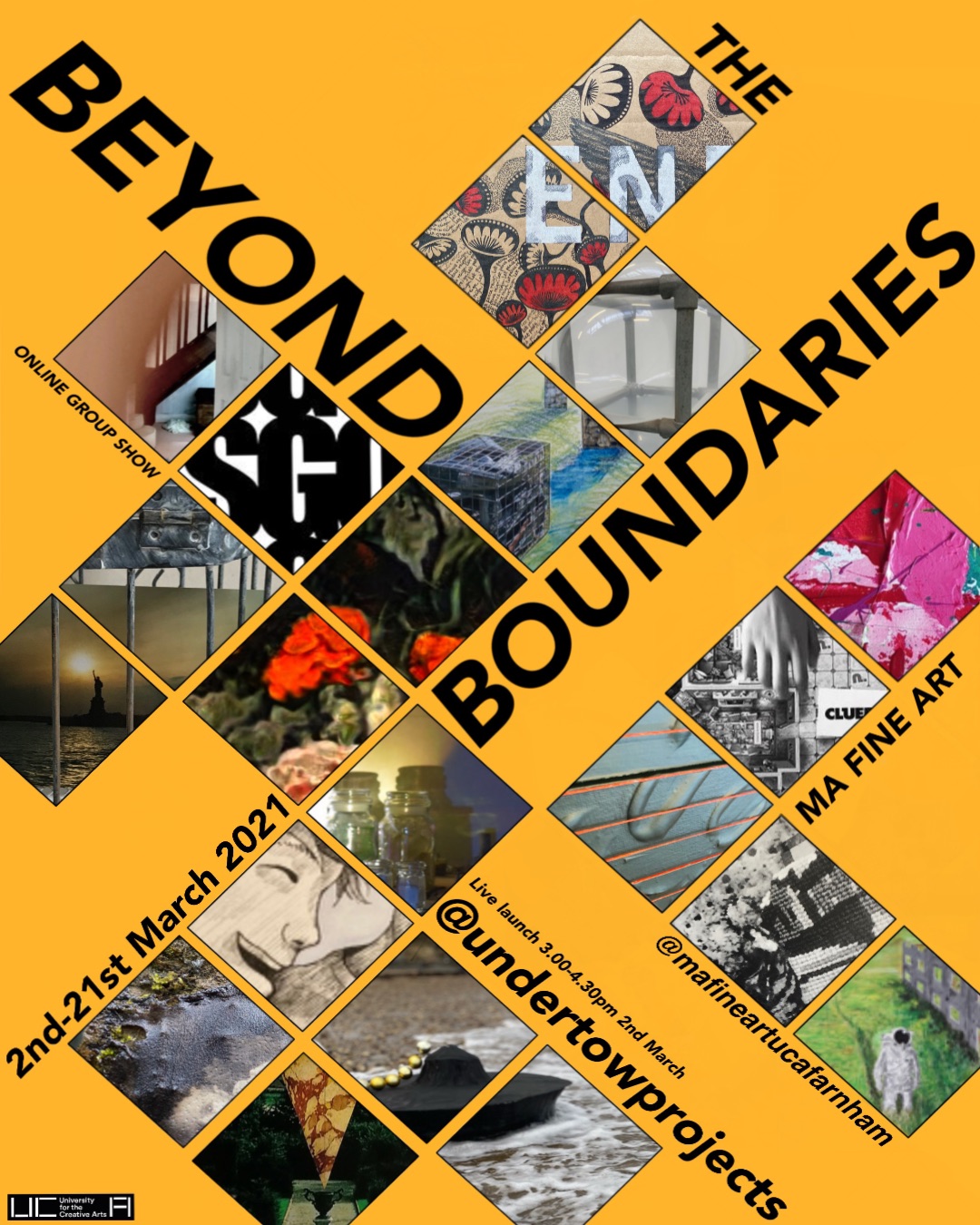
The group exhibition, Beyond the Boundaries, discussed in my previous post, is now fully launched and showing @undertowprojects on Instagram until 21st March 2021.

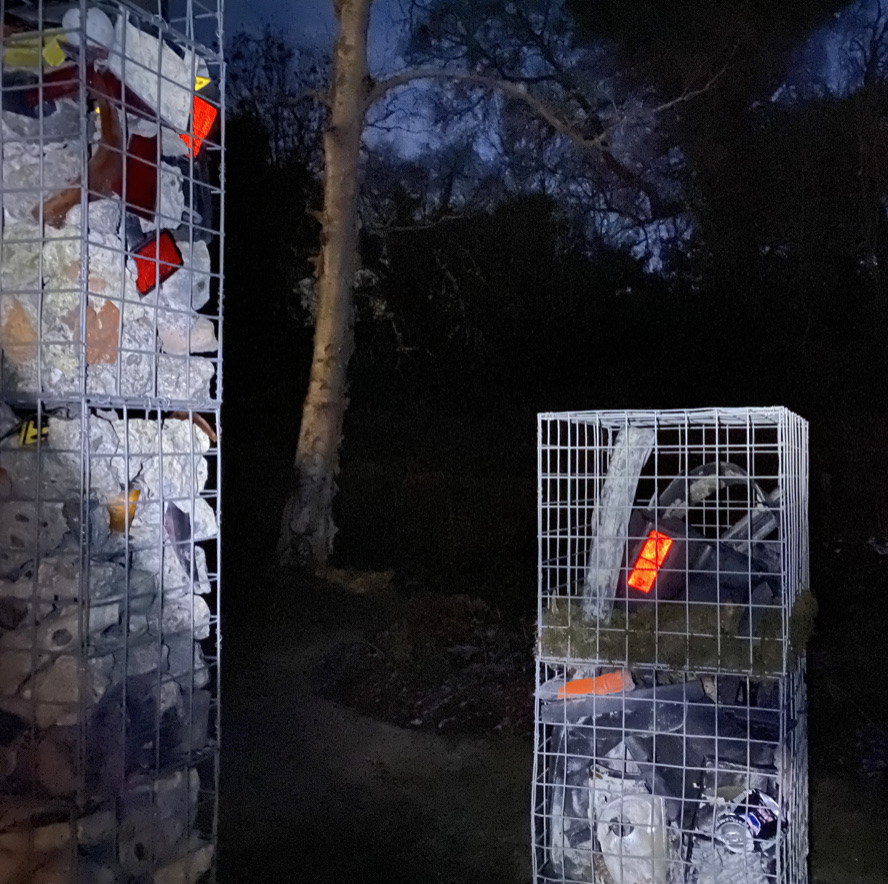
The exhibition is an entirely online affair. However, the piece I have made for it will stand in my garden for the duration. The work was originally proposed for an urban courtyard space but its current backdrop of garden, brambles and trees suits it well.

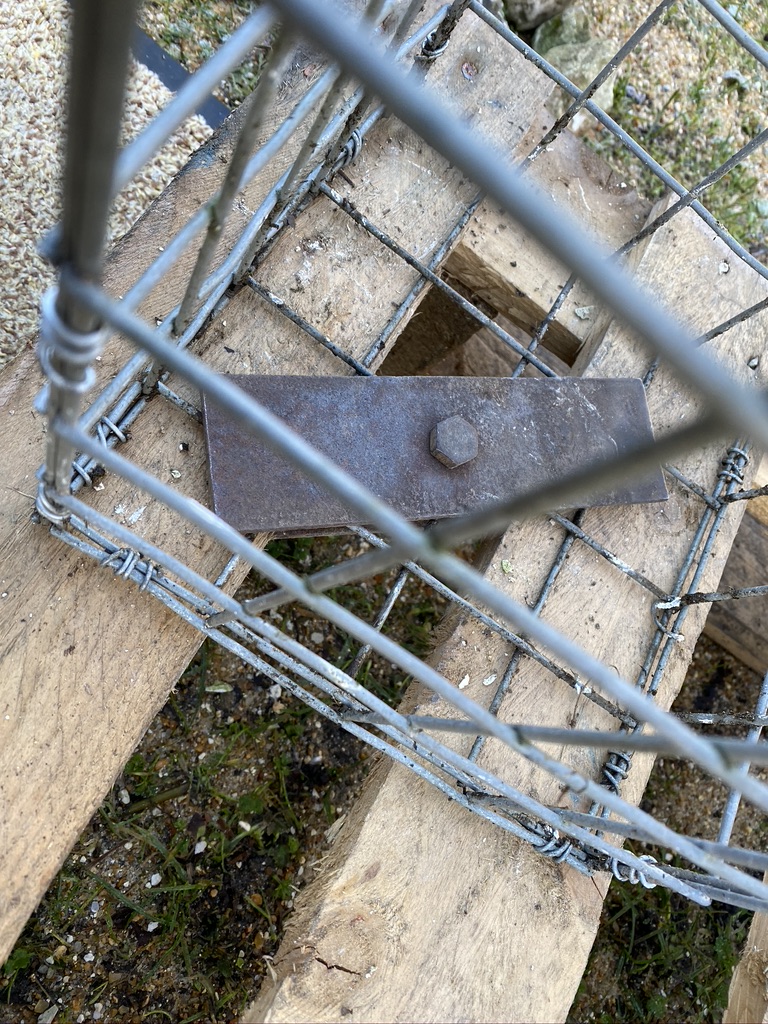
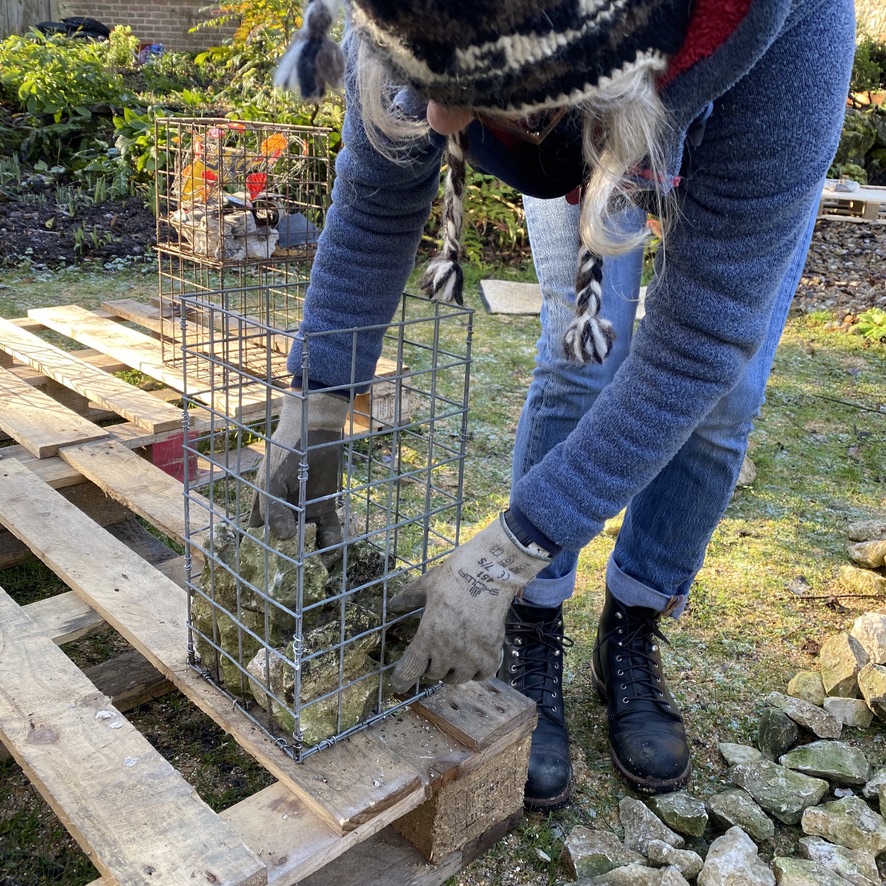
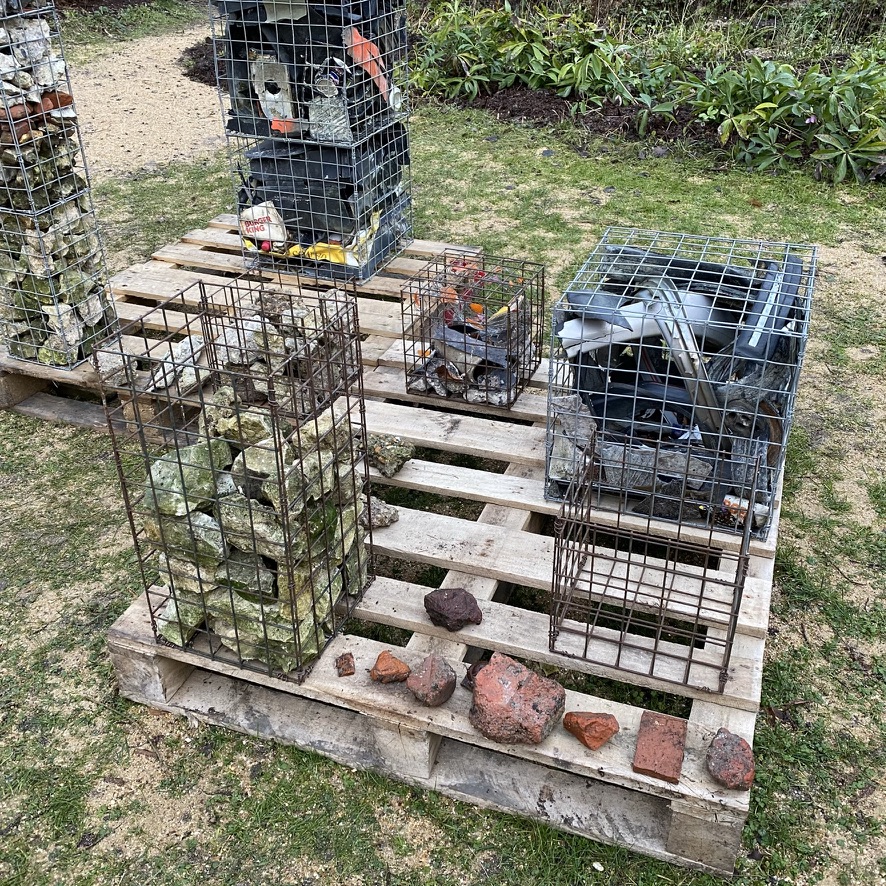
Titled Becoming Geology, the work consists of four cuboid structures grouped on a base of pallets. The materials I use here have largely been found on Byway 745 in The South Downs National Park, a location that I have been studying very closely. They are arranged in the proportion 1 part biomass, the moss layer, to 10 parts technosphere, the human-made detritus. This proportion is discussed by geologist Jan Zalasiewicz in his lecture Visualising the Anthropocene and he goes on to claim, in his essay The Anthropocene Square Meter, that “in the Anthropocene almost everything becomes geology” (Zalasiewicz, 2020:42), pointing out that there are 30 trillion tons and growing, of human generated substances on earth, half of that being urban mass, before we even get to artefacts and packaging. Those artefacts will form the technofossils of the future. As Donna Haraway writes, whatever we call this time in which we live, it ‘will be written into earth’s rocky strata, indeed already is written into earth’s mineralised layers’ (Haraway, 2016:102). In this work, the lower layers are built up with chalk, brick, and concrete, and topped with vehicle parts and plastic waste. Each structure, built of stacked gabion baskets, contains a thin layer of moss. The tallest structure contains a terrarium filled with living matter from Byway 745. The gabion basket form is one associated with the engineering of flood defence in the face of rising sea levels. The pallet base provides the stability for the structures that are clamped onto it as well as acting as a formal horizontal link and duck board walkway between them. Not only are the pallets salvaged, but they are also part of the same transport and packaging ecosystem as the litter and discarded objects contained within the gabions.

An online exhibition relies on good documentation above all else. Building the work is only the beginning. The photographs are vital, and with sculpture it can be a huge help for the audience to experience the work via video. For the online launch event I decided to make a 3 minute video that would introduce the work. It was a hugely enjoyable challenge. I decided that I needed to explain where the work comes from, both in terms of materials and ideas, so combined footage I have of the landscape with that of me collecting and building, as well as of the finished piece. I didn’t want to have to use graphics to quote the statistics from Jan Zalasiewicz’s essay, nor did I fancy using my own voice. What I discovered as the solution, a very twenty first century one too, has a poignant and uncanny effect. You can watch the video by clicking the image below.

The online launch event was a new experience for us all, with a few technical problems to put the wind up us. Zoom is not good at streaming videos and there is always the jeopardy of accidental screen sharing to contend with. However, on balance, it was good to mark the beginning of the show with an event. The exhibition will continue @undertowprojects until 21st March. All the work in the show can also be viewed in this zine, created by the artist Noelle Genevier.

Exhibition zine curated and designed by Noelle Genevier. 2021.

References:

Haraway, D (2016) Staying with the Trouble. Durham and London: Duke University Press.

Zalasiewicz, J (2020) ‘The Anthropocene Square Meter’ In: Latour and Weibel (ed.) Critical Zones: The Science and Politics of Landing on Earth. Karlsruhe: ZKM. pp.36-43

Zalasiewicz, J (2019) Visualising the Anthropocene [Lecture at University of Exeter, Global Systems Institute Lovelock 100 Conference] At: https://www.youtube.com/watch?v=zphinkipB9A (Accessed on 26.6.20)

Making It Public.

It is time to show new work and a great way to do that is in a group exhibition. The opportunity has arisen as part of the Fine Art MA I am doing at UCA Farnham. Having had to postpone a previous show last year because of the pandemic, the group set about planning another in the Autumn. The brief was to secure a London venue if possible. Although restrictions were still in place it had been possible to make visits to a number of sympathetic venues. However, it soon became apparent that the scope was limited and reintroduction of lockdown measures have forced us to adopt an online approach rather than postponing again.

With 19 contributors, finding a title that somehow reflects our diverse practices was the first challenge. A shortlist was drawn up and a vote organised that produced the title Beyond the Boundaries. A compromise, a little anodyne, but somehow, something workable. Each artist needed to make a formal proposal, initially intended to be installed on the university campus. A formal proposal to the university and subsequent publicity material was extracted from these proposals by a smaller working group, of which I was part. Learning new tech has been a theme of the pandemic for many and an effective method for collective lockdown writing of these documents emerged with the use of WhatsApp voice calls in parallel with Google Docs. That way brainstorming conversations and writing could happen simultaneously. This what we came up with……

The Google folder has subsequently proved invaluable for storage of publicity material and photographs and texts from individual artist’s proposals. These form the content of the zine created by Noelle Genevier for the event. It is a kind of catalogue and can be viewed here.

The exhibition is now a series of online events which need to be orchestrated during the period 2nd – 21st March. First is the launch on Zoom, as advertised in the press release and hosted by artist Louise Ashcroft, followed by posting of the work in small batches on Instagram @undertowprojects. There will also be events that allow the participating artists to talk about their work. The university will help publicise these via their website as well as via the @uca_surreygalleries and @mafineartucafarnham Instagram accounts.

The launch date of 2nd March is fast approaching. Although my work has been built and photographed, I still need to make a short video to broadcast at the Zoom event. This is to fill my three minute slot, during which I can reveal my work for the show. This is the formal equivalent of milling around near one’s work at a private view, but with the added advantage of having the audience’s eyes focussed on it for the slot rather than roving around with a general networking/partying sort of focus. I have footage of the work in progress, as well as loads about walking and collecting my materials, to weave together with shots of the work in situ. I aim to give some feeling via the video of what it is like to be in the piece, moving between its components and experiencing its materials closeup.

Beyond the Boundaries will run online in conjunction with @undertowprojects Tuesday 2nd until Sunday 21 March 2021

The online zoom launch will be hosted by Louise Ashcroft onTuesday 2nd March, 3.00 – 4.30pm

Taking Over.

Undertow Projects is a new platform for emerging and established artists to share their art practice on Instagram and beyond. It is an artist-run collective set up by current MA Fine Art students at UCA Farnham, in part as a reaction to the lack of physical spaces available in which to show work, due to the pandemic, but also as a springboard and community that will endure beyond graduation.

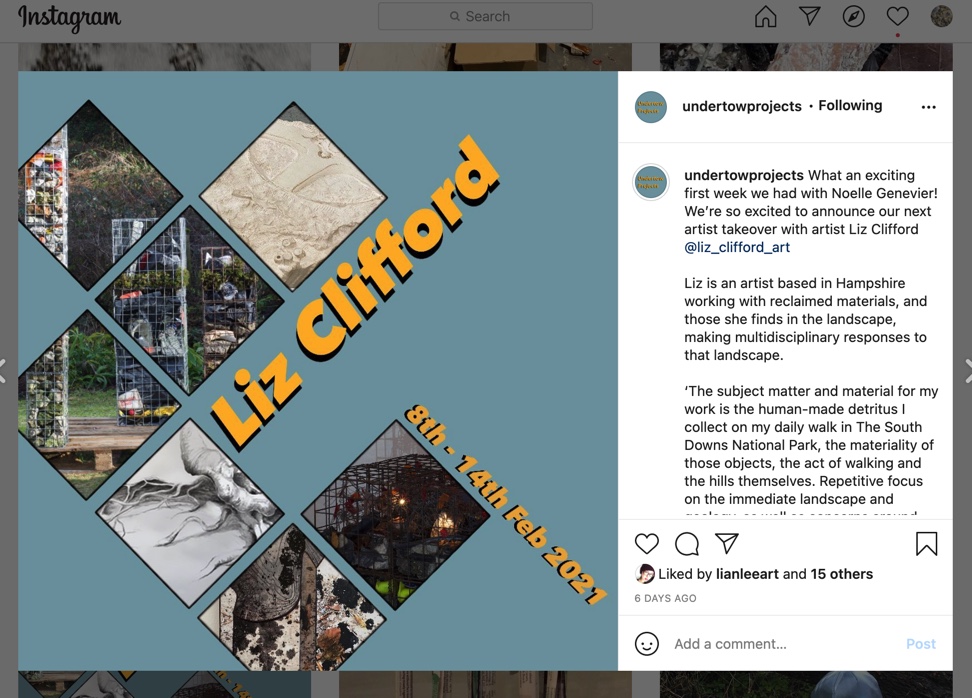
I was honoured to be the second artist in the programme of artists’ takeovers hosted on their Instagram account. This entailed being given access to the account and being free to post on it for a week. I do have an Instagram feed but my usual rate of posting is around once every two weeks, so the prospect of having to post three times a day for five or six days was really daunting. What on earth would anyone want to see? How would I give glimpses of my practice without revealing too much personal detail? These questions were a constant worry.

Planning was a key to getting started. I knew how to post videos and photographs to the feed but wasn’t confident with the ‘stories’ part of the platform. I devised an arc for the week and broke each day up into three possible posts. The first two days were going to very busy with MA symposium presentations so I did some pre-recording on the Sunday to prepare. My arc started with walking in the landscape. I was very fortunate to have landed a week of snow and frost allowing for a variety of atmospheric images and sounds. Video soon felt like the best way to show the processes of walking and picking up detritus. Usually just hand-held footage, but I did also put the phone on a little tripod, that can be strapped to a tree, to film myself squelching through the mud.

The arc was to span walking, collecting materials, observations in the landscape, sorting out materials in the studio as well as preparatory work for sculpture and drawing, and to culminate in pointers towards current work in progress and future projects. I definitely shied away from speaking directly to the camera, partly because I always look at Instagram on silent mode, but also through a reluctance to reveal that much of myself on social media. The discovery of the time-lapse option on my phone’s camera was great for the studio sort-out and drawing in progress shots. In fact, the images are the easy part. Its the words that are much more tricky. It feels like there is an obligation to say something to expand on the image, or perhaps to confuse slightly by suggesting a tangential proposition. It is a space where you can quote from texts that are related to your work, and I did find some opportunities for that. Then there are the hashtags to think about. They do have to be thought about and researched, which takes time. Its really worth visiting any you are thinking of using so as to avoid linking your post to anything inappropriate. Finally, you have to remember to tag in other accounts, including your own so that viewers can find out who might be making this post.

The experience was a very positive one, generating encouraging feedback. I managed to get into a rhythm of daily posting, and in doing that discovered a huge amount about the platform, both in terms of what you can make work through your own phone, but also how other artists and arts organisations are using it. I picked up some more followers to my feed and discovered new artists and arts organisations to follow back. Thank you Undertow Projects.

Viewpoint – point of view.

I have recently been reading artist, writer and film maker Hito Steyerl’s essay In Free Fall: A Thought Experiment on Vertical Perspective in which she charts the rise of linear perspective as the dominant tradition in Western Art and the triumph of today’s ubiquitous aerial view. The view from above has become a norm of the 21st Century thanks in part to Google Earth, Google Maps, drone footage, computer games and feature films. In my own practice I use contours taken from the Ordnance Survey map to help contextualise work made about a specific landscape.

Liz Clifford. Wheatham Hill. Screen print
Following that first piece of reading, I came across Techniques of the Observer in Artforum International Vol.53, Iss. 9 (May 2015). This is a transcript of a conversation between Steyerl and journalist and documentary film maker Laura Poitras. Both Poitras and Steyerl have made films about surveillance and drone strikes. Steyerl’s How Not To Be Seen: A Fucking Didactic Educational .MOV File (2013) and Poitras’ Citizenfour (2014) about Edward Snowden’s revelations of NSA surveillance post 9/11. In this conversation they are speculating about Poitras’ forthcoming installation Astro Noise at the Whitney Museum of American Art in New York. Poitras asks ‘What is the relationship between that museum context and the public? How is political content contained in a museum context? How is it different from a movie theater?’ She is looking forward to being able to move away from narrative filmmaking and to let the audience participate more in the process. Steyerl had already experimented with the curation of her films in art spaces. At the time of this conversation her work was showing at Artists Space, New York for which she had built a series of viewing set-ups including a kind of half pipe you might find in a skate park and a barricade you could use to prevent flooding or to take cover behind. She appears very aware of the challenges of not having a captive audience. In a gallery the audience abandons longer work.

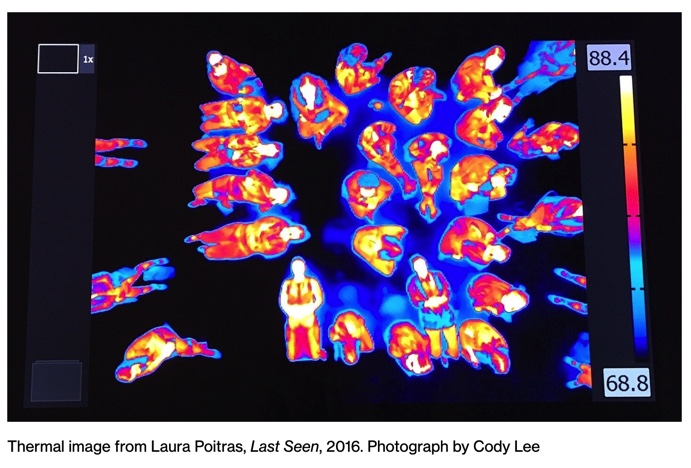
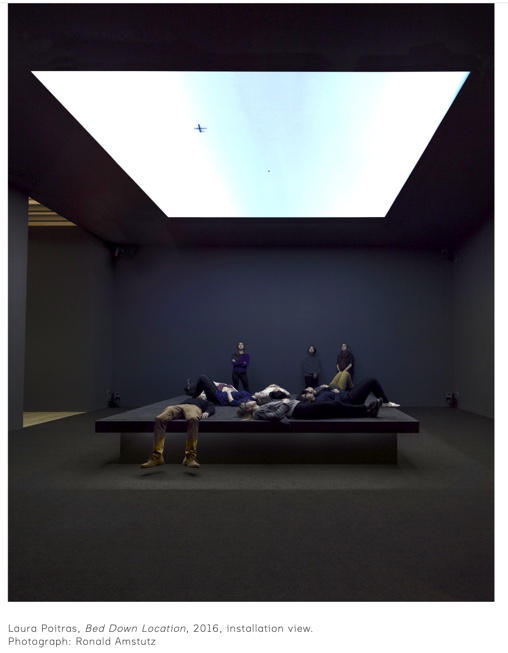
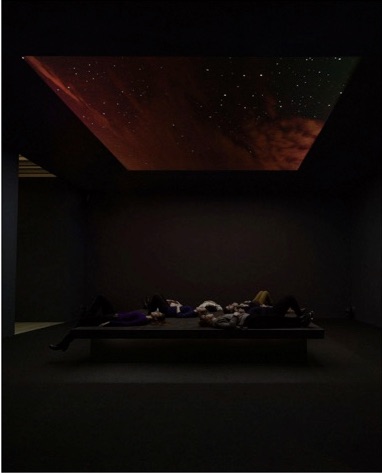
In Astro Noise Poitras employed a variety of curatorial techniques to pull the audience in, including double-sided projection, viewing cracks and in Bed Down Location a platform on which to lie down and watch the night sky. Not just any night sky but that over Pakistan, Yemen and other countries where U.S. military drones may regularly hover. The artist is asking the audience to empathise with those for whom the likelihood of a drone strike is a reality and lying down in public is a way to feel vulnerable. The audience may be lulled by the night sky images but feel that vulnerability when the sounds of overhead drones start up. In the last room of the exhibition the visitors were confronted with thermal images of themselves as they lay down to watch the night sky, the thermal imaging equipment having been part of the installation. See top image, Laura Poitras’ Last Seen (2016).

Liz Clifford. Byway 745 – Observatory. Video still. 2020
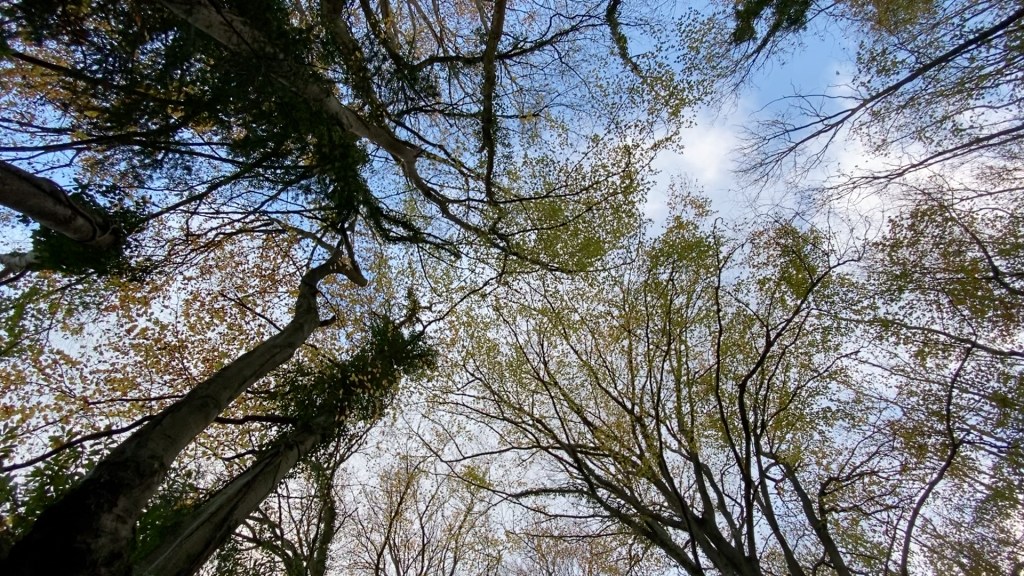
This work is fascinating, as well relevant to the video piece I am developing to go with Byway 745 – Observatory. Looking up from the ground at the canopy rather than adopting the traditional viewpoint of passing through or observing from a fixed vertical, linear perspective. A year of changes is observed from that viewpoint and questions of how curation of the video will work need to be considered carefully. Will the audience perhaps lie down to view it? How will their attention be held? Should they be required to engage with each other? Possibilities are suggested by Steyerl’s and Poitras’ curations of film work but I will need to research many others.

Not only is this viewpoint at odds with the traditional view onto the landscape associated with landscape painting, often an idealisation, but it is also associated with the reality of looking at the landscape from above. As the camera looks up into the canopy satellites and aircraft pass over head, 4 x 4 drivers search Google Earth for good off-road tracks and experience this landscape from their vehicles with the help of Sat Nav. The after effects are felt on the ground, in the spot where I have placed the camera. The erosion of the chalk, the air pollution and the detritus that is left in the vehicles’ wakes.

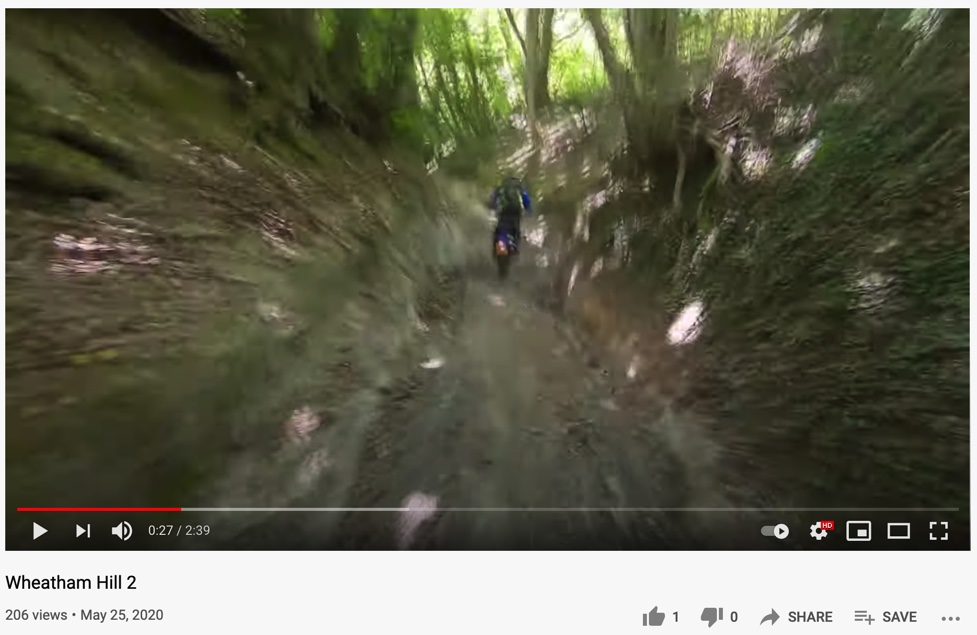
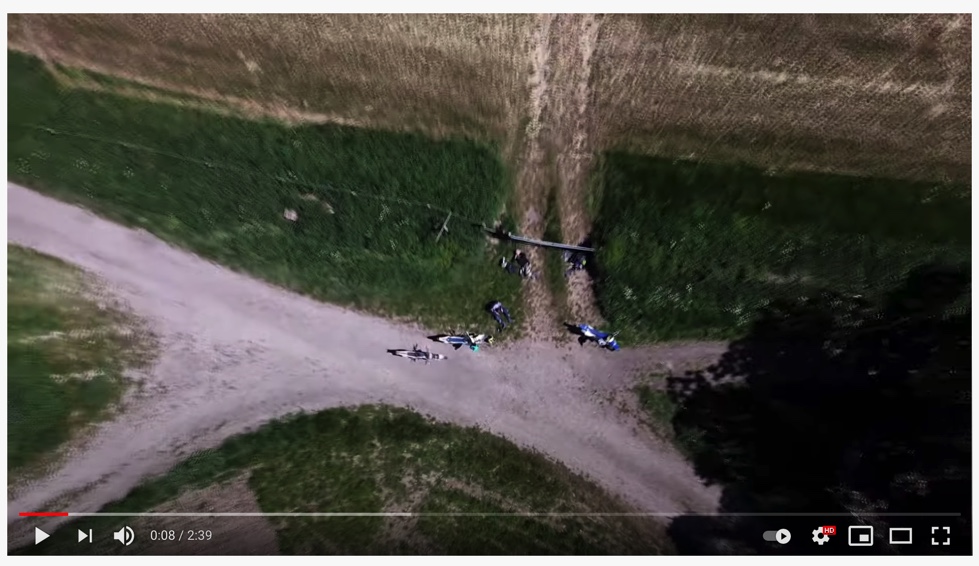
For many the landscape is experienced through a screen. For some it is relived through a screen. The stills above show those 21st Century viewpoints of GoPro ‘point-of-view shot’ and ‘the-eye-in-the-sky’ drone shot. The recreational activity of dirt-bike riding in the countryside can be visited over and over without the need to venture out thanks to this video posted in May 2020.

.

Limited Access.

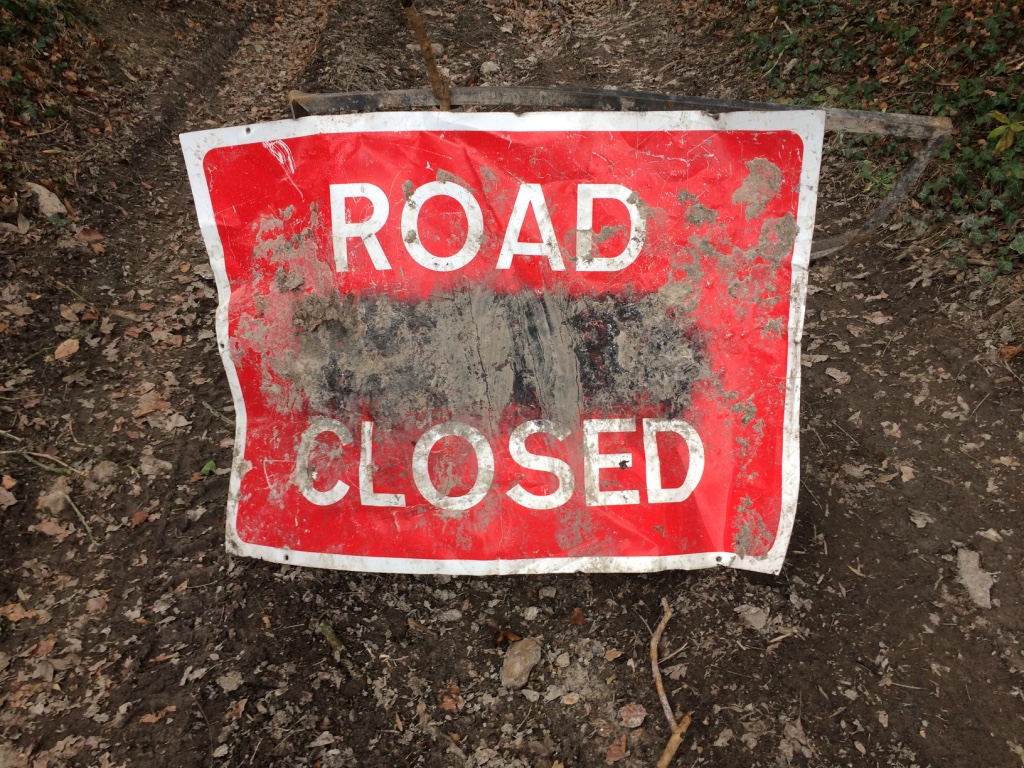
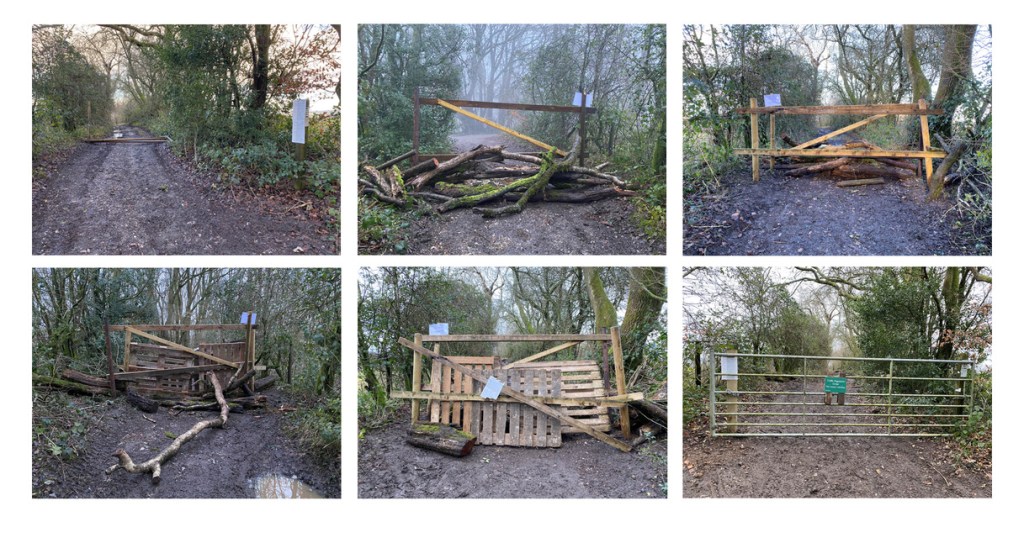
Notice has been given that Hampshire County Council’s Countryside Access Team is going to ‘repair’ Byway 745. Only walkers and cyclists are allowed to use it until the work has been completed. To allow this to happen it has been closed by a barrier at either end. Over the past month I have witnessed a war of attrition between those whose job it is to keep the lane accessible to all and those who particularly relish rough terrain for their leisure pursuit. As the images below show, barriers have been repeatedly erected and broken down, becoming more substantial each time.

Liz Clifford. Barriers, Byway 745 2021
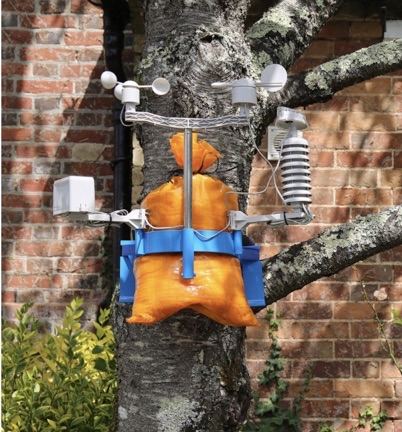
Witnessing this stand-off has led me to think back to a conference I attended in summer 2020 keen to discover a network of artists working in a rural context. More Than Ponies is an artist led programme that seeks to invigorate the New Forest as a site for contemporary art engagement, discourse and practice. Their conference Art and The Rural Imagination was convened by Dr Colin Perry of Arts University Bournemouth. Speakers were both academics and artists, with some artists commissioned to make work for the event. Delegates were also from both communities and largely operating outside London. Papers debating what can be defined as ‘The Rural’ were presented alongside specific projects by practising artists. Artist Adam Chodzko’s paper The Hostile Environment pointed to the term being required to be understood by those applying for permanent residence in the UK. It is, however, very difficult to define as it means so many different things to the different communities who inhabit it. Writer Rosemary Shirley prefers to use the term ‘non metropolitan’ to counter the nostalgic idea of the countryside. Julian Stallabrass from The Courtauld Institute talked about his project in Epping Forest examining that edge of the city. The Forest is urban, suburban and rural all at once. It harbours rubbish dumps, fly tipping and crimes as well as grazing animals and is a public recreational space. He created a photographic slide show called Borders in 2016 mapping the 12 square miles of forest that he described as mapping Brexit at the same time, Epping Forest creating the border between Remain London and Leave Essex. Amongst the artists commissioned to make work for the MTP event was Harry Meadows, whose work Parasite was installed on a roadside tree at South Baddesley in the New Forest. His work uses the data and aesthetics of roadside weather station instruments to critique the way we engage with our environment via that network of roads and comments on the loop created by climate agent and climate sensor in the microclimate of the road.

Harry Meadows. Parasite 2020

In the plenary session it was acknowledged that many more artists are based outside the cities now but it is a very slow process changing the way contemporary art is received with there still being a perception amongst ‘local’ artists that urban artists are helicoptered in for more prestigious projects. Some of this hostility even showed itself during the Q & A at the end of the conference, the perception being that the more academic approach to the subject of The Rural Imagination was also the more metropolitan.

Rosemary Shirley’s statement that ‘The ancient and modern are simultaneously experienced aspects of the non-metropolitan everyday’ (Shirley, 2015:19) very much chimes with my own experience as an artist living and working for many years outside the city. Byway 745 is both an ancient Bronze Age right of way and also a track used for 21st century fossil-fuelled leisure pursuits. The very contemporary phenomenon of plastic waste is abundantly evident beneath the line of undercut beech trees that around 100 years ago formed a pristine laid hedge marking the boundary between public and private access.

Shirley, R. (2015). Rural Modernity, Everyday Life and Visual Culture (1st ed.). Routledge. https://doi-org.ucreative.idm.oclc.org/10.4324/9781315607184

Sarah Sze in Paris.

In these times of pandemic and the accompanying restrictions it seems that any art event is only as good as its website. Faced with the challenge of putting on a show that may have to close to the public at short notice some galleries have been more successful than others in reaching an online audience. The upside to this situation is that we now can visit a show virtually which would have been difficult to visit physically even in good times, due to time and cost considerations.

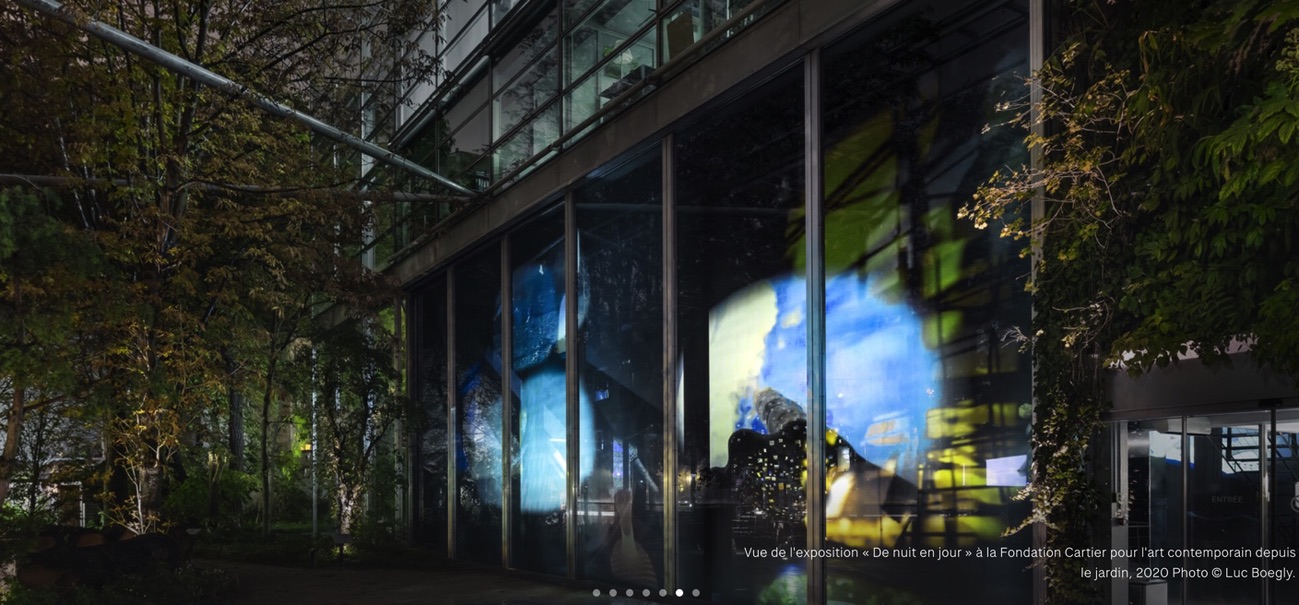
One such show is From Night to Day by Sarah Sze at Foundation Cartier pour l’art contemporain in Paris. The artist has made two installations for the ground floor of the iconic glass and steel 1994 Jean Nouvel building that change as the light fades and become increasingly visible from the outside as night falls. A great show for winter in the Northern hemisphere. The two pieces Twice Twilight and Tracing Fallen Sky form part of the Timekeeper series started in 2015 and revisit the starting points of planetarium and pendulum explored in her Triple Point installations for the Venice Biennale in 2013.

Sarah Sze. Twice Twilight. 2020
Sarah Sze. Tracing Fallen Sky. 2020

The Foundation Cartier website allows the online visitor to experience the work with the help of a youtube link to four excellent videos. The first two take each installation separately and the third connects them with the building. The viewer glimpses the artist walking through the space but there is no commentary – simply the ambient sounds that accompany the installations. These very short videos use shots that span a day so as to show the light changing. This same approach is used in the third video in which the viewer experiences more of the building and external sounds of the street. The forth video is 50 minutes long and consists of an informal walkthrough of the show and chat about the work between the artist and Bruno Latour who included her installation Flashpoint (Timekeeper) 2018 in the Critical Zones exhibition at ZKM Karlsruhe.

The Twice Twilight installation is particularly fascinating for its apparent fragility and flux expressed by the fleeting nature of the moving projections onto it, together with the lightweight scaffold structure and flimsy paper screens. The projections emanate from a revolving stack of projectors so are cast across and through the installation, being thrown out into the space that surrounds the structure. That space also stretches beyond the glass walls to the Paris street. After dark, car headlights penetrate the building and the installation is bounced back in reflections amidst the moving images. I am hugely drawn to this work and would rush to Paris to see it if I could. The next best thing is to be able to watch the videos of it and to hear the artist talk about her work.

The exhibition is at Foundation Cartier pour l’art contemporain, 261 Boulevard Raspail, 75014 Paris until 7th March 2021.

Drawings, photographs and litter.

Drawing from observation is part of my art practice. This is undertaken in the landscape as well as in the studio. Drawings are made from natural forms and from the found objects that appear in my three dimensional work. I am currently experimenting with ways of reconciling this 2D part of my practice with the 3D, photographic and time based elements in an attempt to create a wholistic curation that brings the outdoor site into a gallery space, drawing on the writings of Robert Smithson as well as on contemporary curation. The site is Byway 745 Observatory, outlined in my previous blogposts, visited almost daily and the source of subject matter and materials for my art practice.

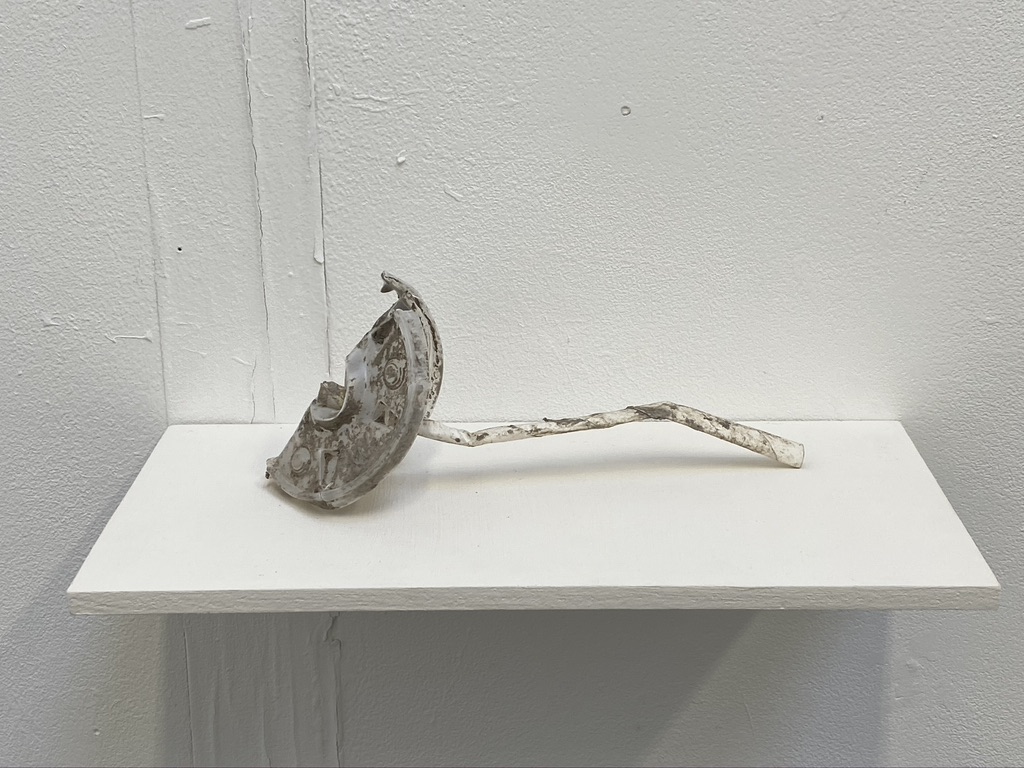
I recently presented graphite and wash drawings of detritus alongside a photograph of that same detritus in the landscape, and the object itself. The object was a discarded McDonalds drinks lid and straw, crushed and muddied. Ubiquitous and abject, as any litter that has had body fluids pass over it is in these times of global pandemic. The effect of showing large, formal drawings of that object is to elevate it so that it is not immediately recognised for what it is. Those commenting on the curation all said that they saw the drawings first followed by the photograph, perhaps drawn in by the colour, and finally the object on the shelf. With hindsight I feel I should have placed the object further away from the drawings, perhaps at a much lower level or even on the floor. The drawings measure 59 x 84 cm but could have been bigger still, creating a greater contrast. To have had that greater space between drawing, photograph and object might have led away from the comparison with Joseph Kosuth’s 1965 One and Three Chairs.

Following this work, I have been encouraged to revisit my earlier series of drawings of the ancient beech hedge that borders Byway 745, embarking on a large drawing in the studio that incorporates all six into a 7metre long frieze. This echoes the horizontality of the form as it overhangs the sunken lane and the logistics of working on the floor rolling out a section at a time also embeds the horizontal into the work.

I intend to juxtapose photographs and objects with this drawing as well. I have a huge collection of photographs of detritus dropped as people pass beneath these trees that form the boundary between public and private land. It is a record of human movement along the public Byway, the same movement that is causing an acceleration of the erosion that undercuts the trees ever more rapidly. The litter is tidied up by me and no one else, becoming a form of hoard. It is predominantly made of plastic which will photodegrade but not biodegrade. Plastic gets smaller and smaller but does not turn into something else and fragments of it discarded in this landscape will eventually find themselves in the sea and in future rock strata. As Heather Davis writes in her 2015 essay Life and Death in the Anthropocene: A Short History of Plastic it exists ‘outside of death and life. It seals off the cyclical mechanisms of circulating matter, clinging desperately to an identity that reaches far beyond biological time into geological time.’

By placing these images in some form of horizontal arrangement below the formal drawing of the stately trees, I intend to make a link between the use of this specific landscape and the wider issues of plastic waste and abuse of the environment. My hoard of abject litter can also be incorporated into the final curation – an area needing much more thought and research.

Cubic Measure

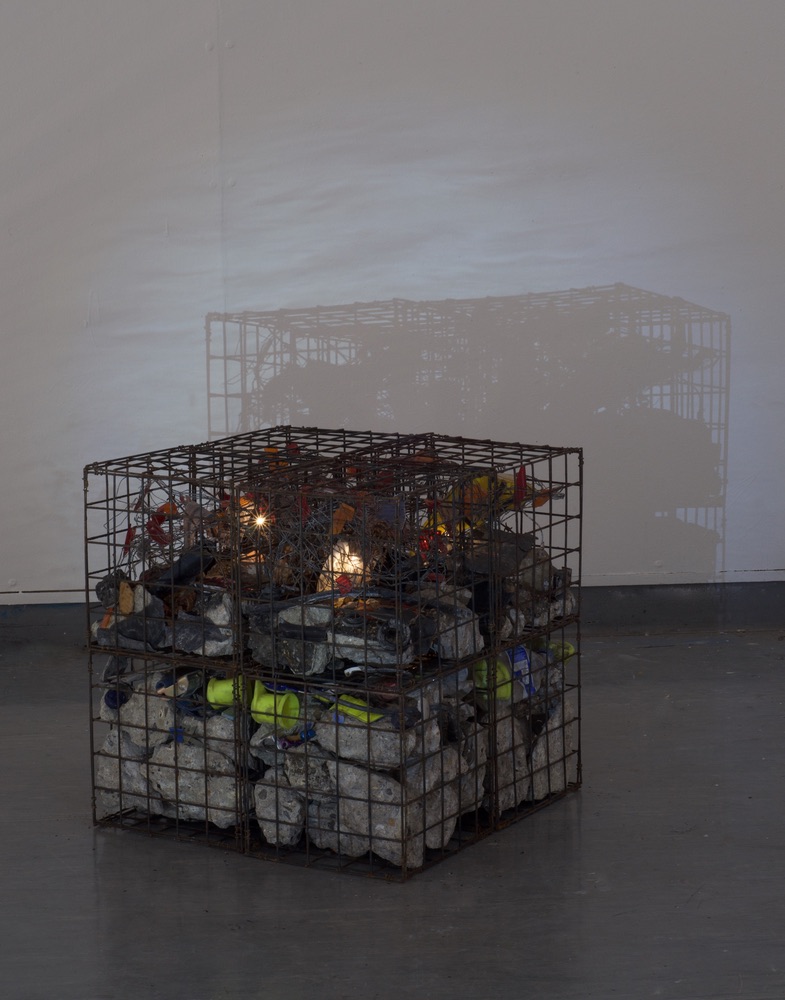
This work is a response to a description of a measure of the Anthropocene, the period since the beginning of the twentieth century during which human activity has triggered irreversible change on Earth, outlined by geologist Jan Zalasiewicz in his lecture ‘Visualising the Anthropocene’. This was delivered as part of the Lovelock 100 conference at the University of Exeter in 2019 and again at the opening events for the Critical Zones Exhibition still running at ZKM Karlsruhe in Germany. He describes a cubic entity in which some elements are growing and others diminishing. It is half full of the stuff of our cities, most significantly the new form of rock – concrete. Compounds like aluminium and plastics coat it and carbon dioxide and ash particles are filling up the spaces between. A continuously burning lightbulb is gently heating everything around it. This is an analogy in four dimensions – depth, mass, volume and time. The diversity of technofossils, human-made artifacts, is growing to beyond 1billion different types just as biodiversity is reducing. Water from ice-melt and the volume of plastic is growing all the time.

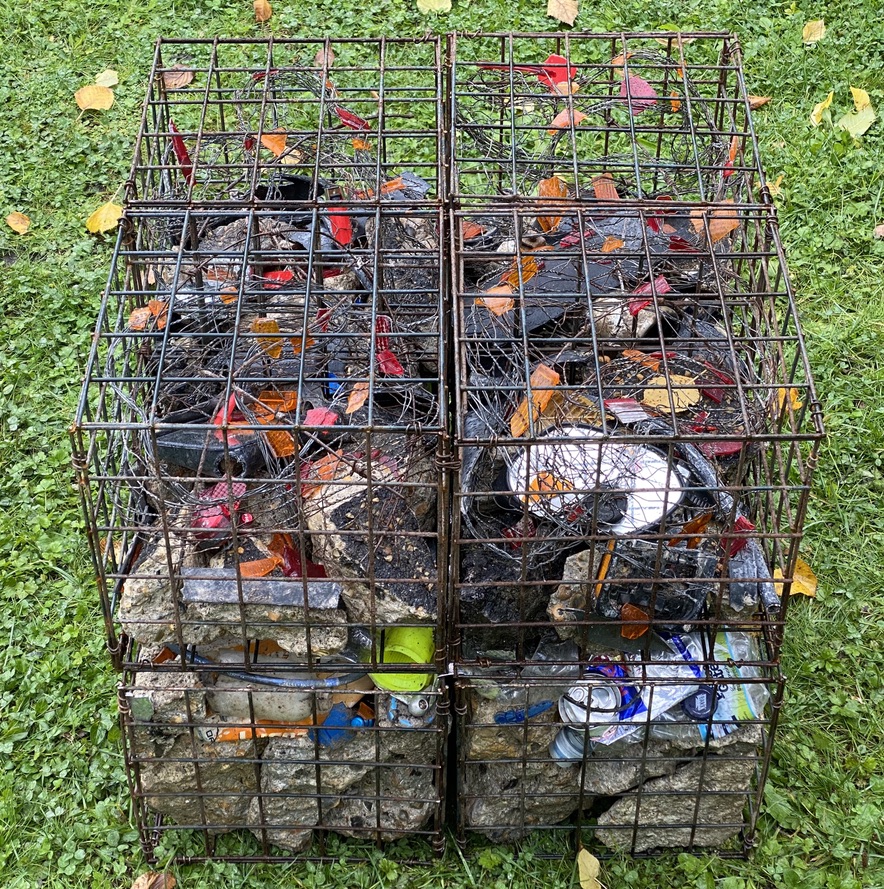
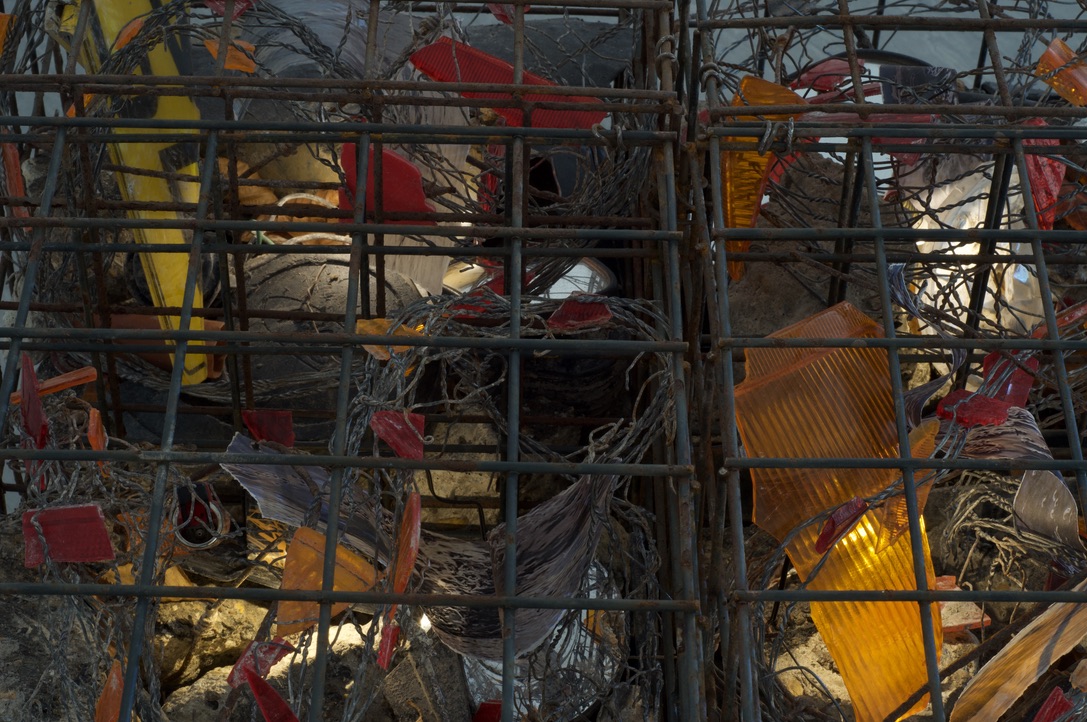
Hearing this description, which is intended to stimulate us to understand the enormity of what confronts us, prompted me to attempt my own visualisation. I have worked with the cube, or rather 8 cube formed gabion baskets. It is roughly half the size envisaged by Jan Zalasiewicz. The stack of them make a 53 cm cube, more than half filled with salvaged concrete. The remaining materials have all been found discarded in the area of The South Downs National Park I have been studying. These are wire, plastic, cans and car parts. A small amount of biomass is present in the form of autumn leaves.

Liz Clifford. Cubic Measure. 2020. 53 x 53 x 53 cm
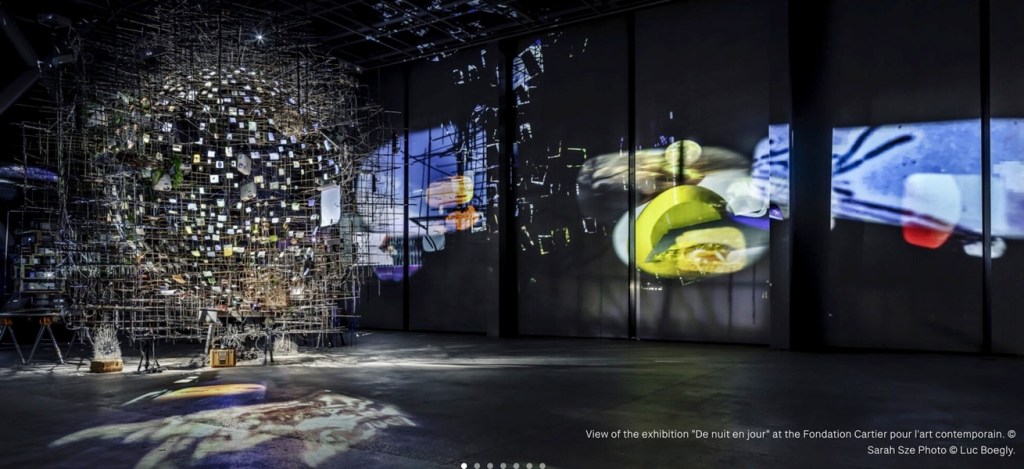
The first iteration of the piece was made and recorded outdoors. The elements of rain and wind, as well as falling leaves became part of the piece but there was no resolution for the idea of warming or water levels. I have since been experimenting with the possibilities for curation indoors and specifically with the effects of lighting and projection prompted by seeing the work of Sarah Sze. Her work is currently part of the Critcal Zones Exhibition and is also in Paris at the Foundation Cartier in a show called De Nuit en Jour. I’m interested in how she uses multiple video projections, photographic images and lighting in her installations. The audience becomes part of the piece as they walk across the projector beam or get picked up by a camera. The outside is brought into the space and shadows and light are cast to the edges of the space. Disparate things meet. Although the Foundation Cartier is currently closed due to Covid-19 their website has a fascinating video tour in which she talks about the work with Bruno Latour.

Sarah Sze. Flash Point (Timekeeper) 2018. Exhibition view. Critical Zones ZKM Karlsruhe 2020 – 2021

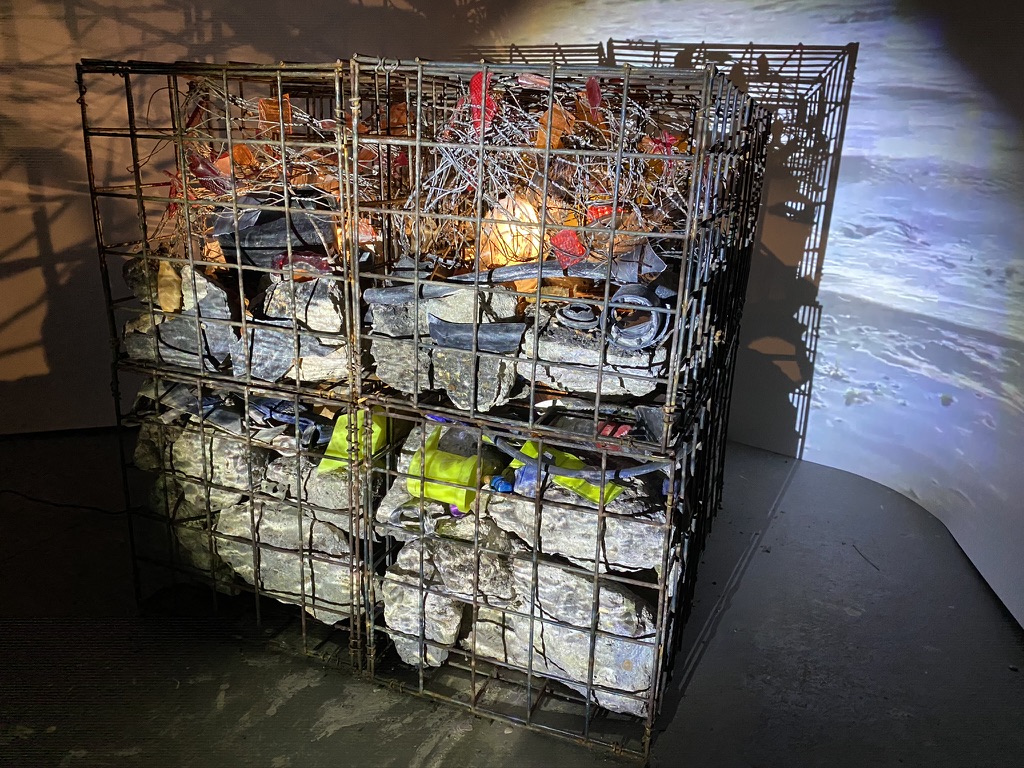
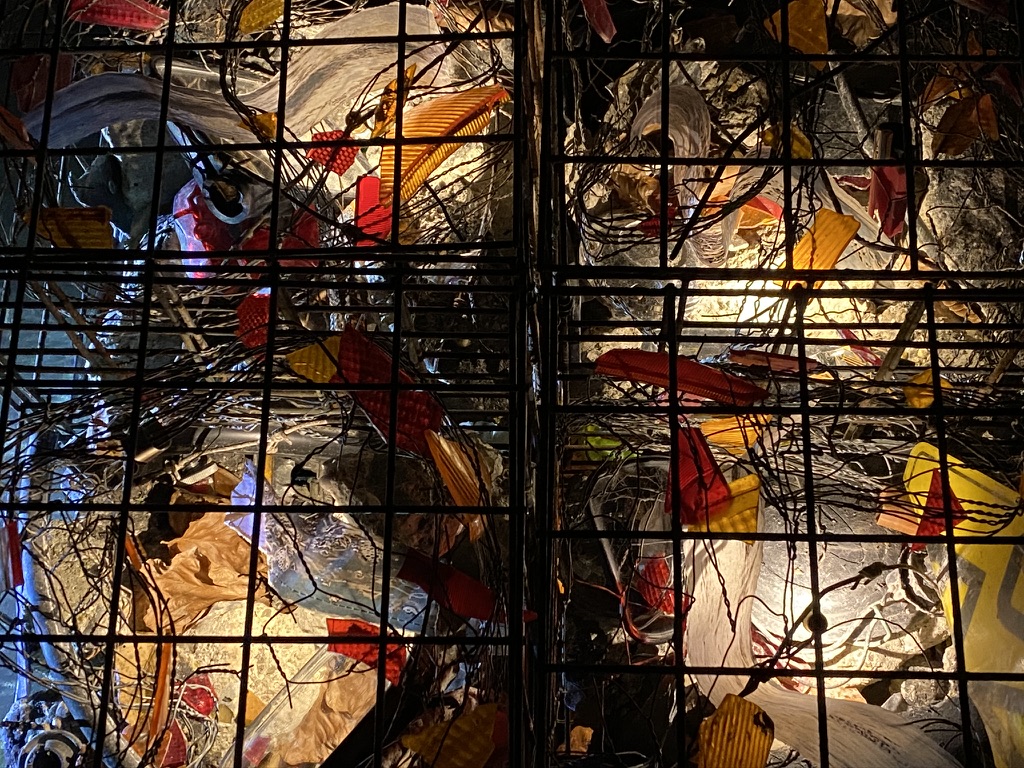
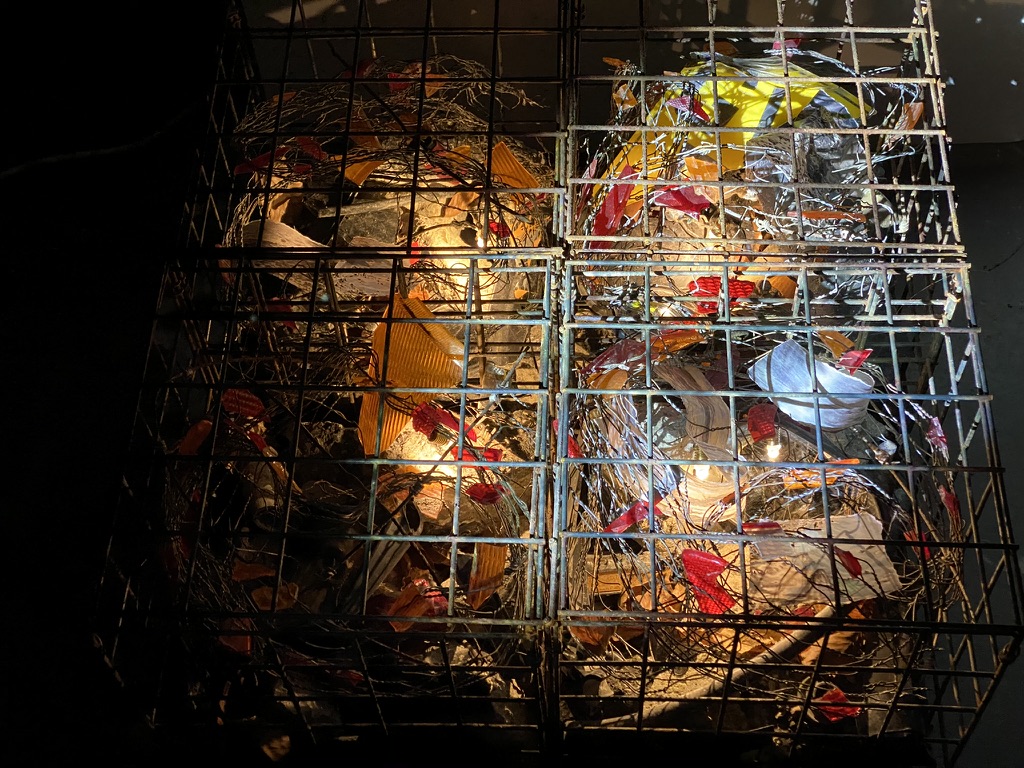
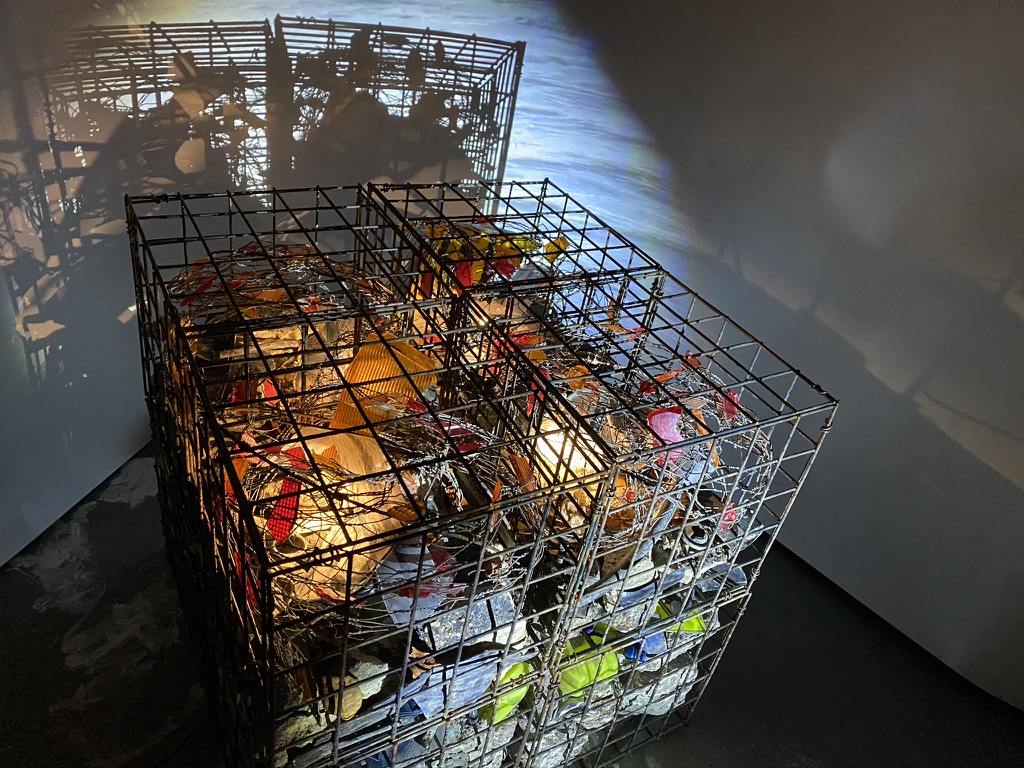
For Cubic Measure I’ve placed LED lights within the structure. The ‘continuously burning 1 watt bulb’ referred to by Jan Zalasiewicz in his lecture. These make the plastic vehicle reflectors more gem-like and also illuminate scraps of printed imagery. This printed imagery is the same as the projection I have been working with. Water lapping the shore. A still from the footage, printed on tracing paper and torn is placed in the upper level of the work. The water is growing and so breaks the bounds of the structure.

The water footage is accompanied by audio of a gentle lapping of waves on the shore. Keeping the projector low and adding a filter to soften the image into an oval concentrates it around the object but also allows shadows to be cast out into the space. Interesting secondary images are thrown out from the wing mirrors in the structure. I will experiment with additional projected images from different angles so the piece really expands into the surrounding space.

Liz Clifford. Cubic Measure. With lights and projection. 2020. 53 x 53 x 53 cm

The installation of the piece in the image above and in the video link was made in a totally dark environment but I have also worked with the piece in a semi-dark space. In that environment the drama of the cast shadows is reduced but the projected light is also less harsh and the elements within the gabion baskets can be more easily read. Having more space to move around the object is useful and using several projections has more potential for the audience to become part of the work as they cross the beams of light. The time based media of video and audio add that fourth dimension to the work and the movement creates dynamism and fragility that I’d like to pursue further.

Liz Clifford. Cubic Measure. With lights and projection. 2020. 53 x 53 x 53 cm