Daily walking, drawing, collecting, and assembling. Repetitive focus on the immediate landscape, exploring geology, boundaries and the materiality of detritus.
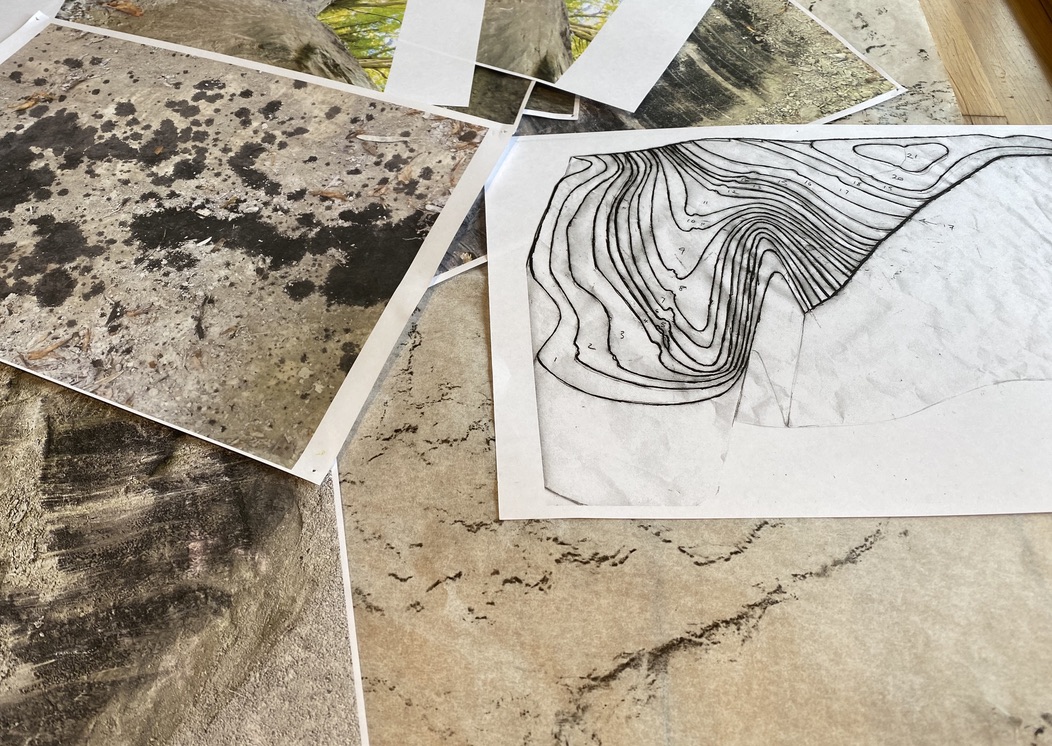
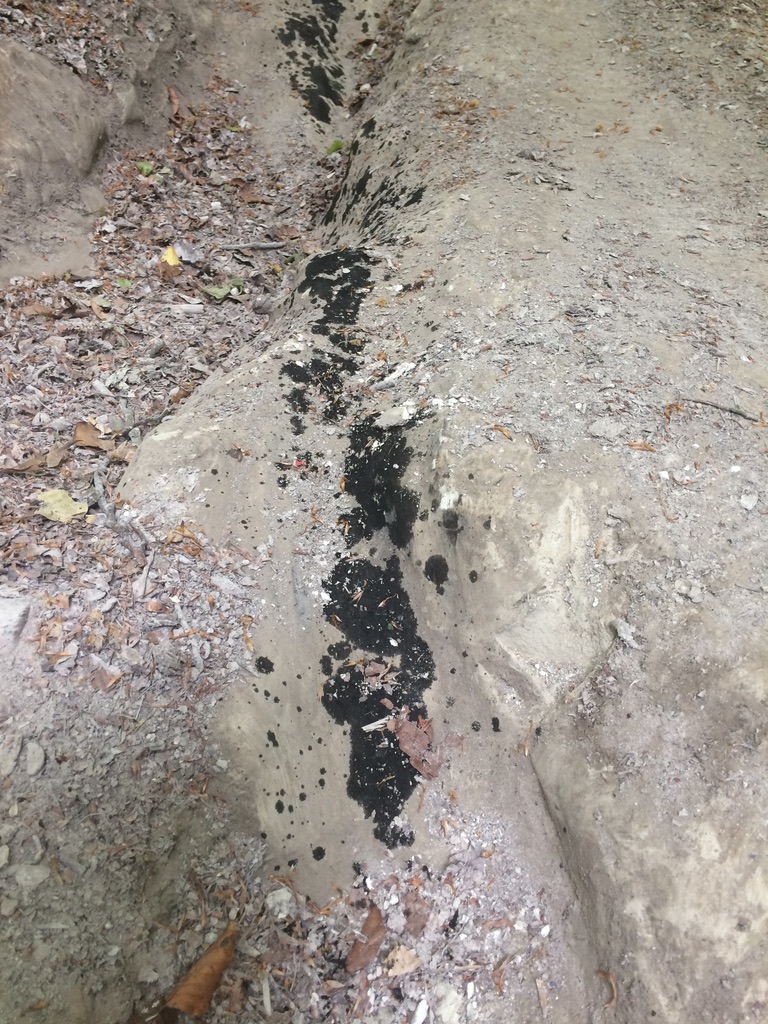
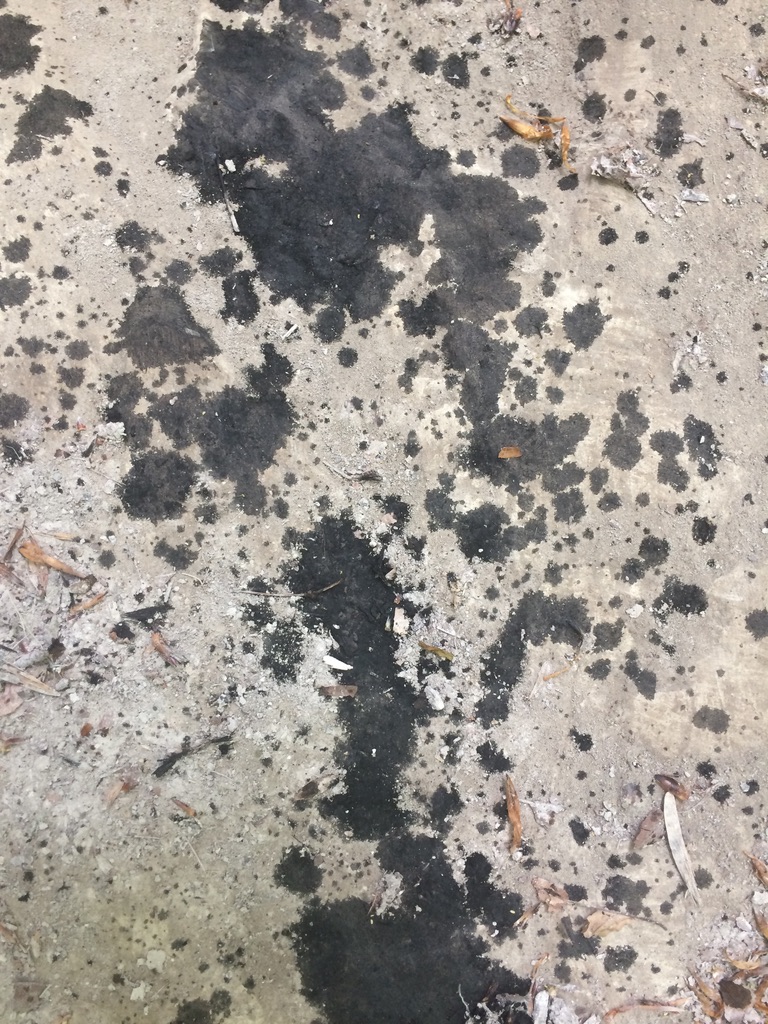
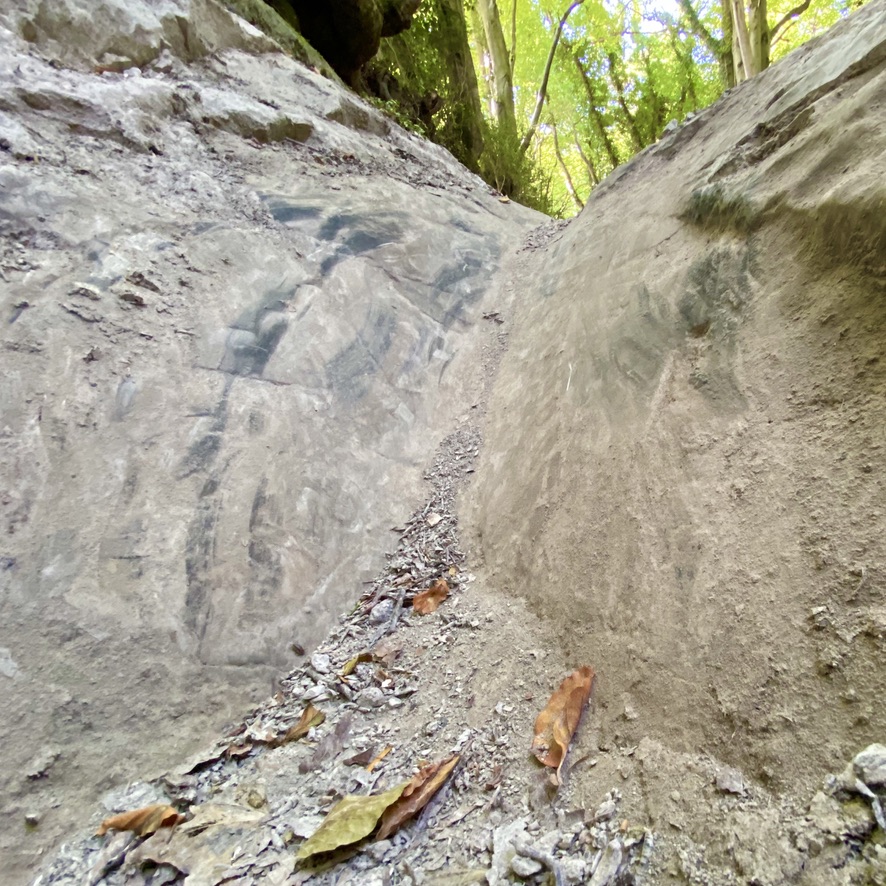
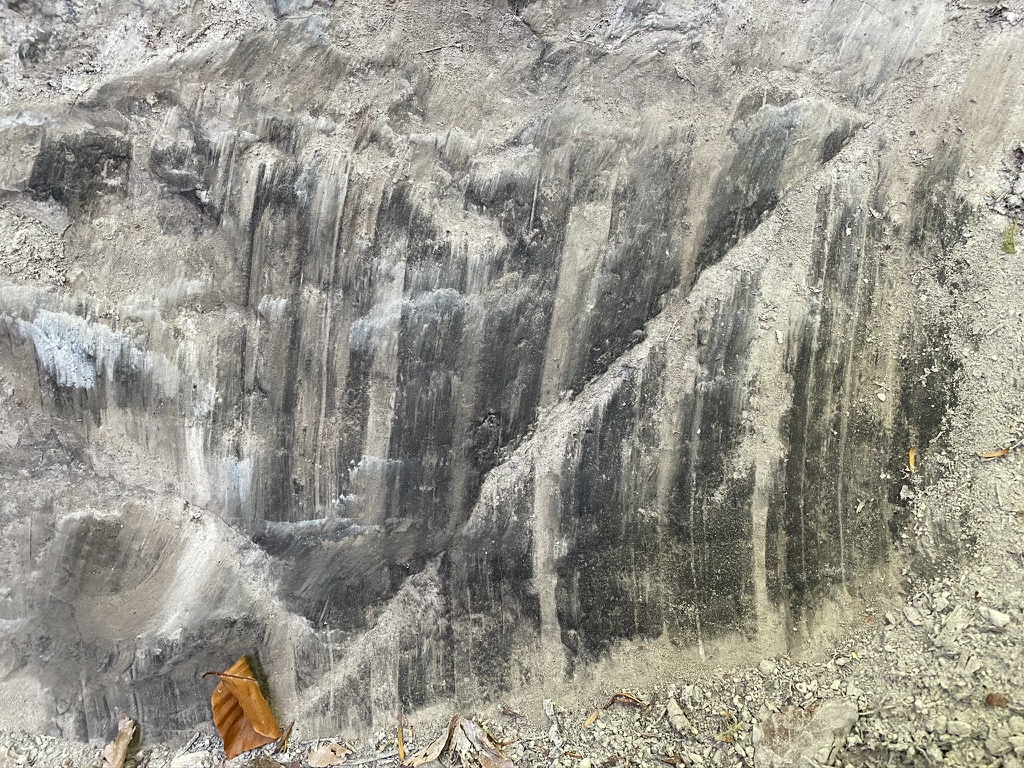
I have been tackling the growing pile of 2D work relating to Byway 745 Observatory. This includes contour drawings used to build 3D work, numerous photographs, frottage and observational drawings made on site. A great prompt to get on and use some of this material to create stand alone work has come through an MA project focussing on collage. With only a few days to produce a piece for a group exhibition, it was important to be decisive. The photographic images selected to work with were of an oil spill on the chalk, tyre scrubs of 4x4s on the same chalk, and a deep rut viewed from a low viewpoint giving it a sense of the corporeal.
These images chart an abuse of the landscape through the residues carelessly left in it by humans.
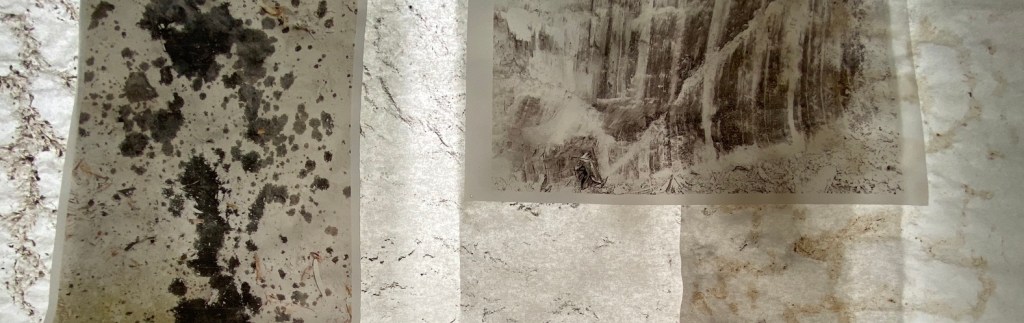
Work in progress. Rock frottage, tyre track mud monoprint and photographs on tracing paper.
Layers of frottage and tyre track mud monoprint on translucent greaseproof paper and photographic prints on tracing paper allow daylight to pick out detail when mounted against a window. The tyre scrub photograph was converted to black and white and given greater contrast. The scale of the photographs needs to be kept smaller than that of the frottage and monoprint or they will dominate. However, more experimentation is needed with this piece, in terms of how the layers are fixed to each other, the formats of the respective elements and the quality of the edges.
Liz Clifford. Tyre Scrub on Chalk Hill. 2020 collage 21 x 30 cm
The photographs on tracing paper were then laid over the contour drawing to allow the connection to be made between macro and micro. The topography of the hillside and the examination of a tiny part of its surface. An assault on the rock by over 4000 years of human passage, made all the more violent by recent mechanisation.
Liz Clifford. Oil Spill on Chalk Hill. 2020 collage 25 x 26 x 3 cm
Taking two different photographs, one colour and the other black and white, the final piece made use of tonal qualities to play with the formal elements of the original drawing for sculpture. By cutting it out and mounting it 3 cm off the wall the aim is to hint at a 3D outcome through its physical nature. This can be further emphasised by top lighting to achieve a cast shadow. The images also connect to each other through their depiction of surface and reference to the geology of the chalk hill. This work establishes a possible way of connecting the multiple layers that are making up my ongoing visual research in the landscape.
How to curate living elements in sculpture is a challenge Danh Vo has risen to in his current show at White Cube, Bermondsey. The visitor is greeted in the space outside the gallery by a pavilion bedecked in makeshift wooden planters while in one room of the interior space plants dominate the display, grow-lights suspended over the works. In the video interview and gallery tour on the White Cube website the artist talks about his recent discovery of gardening and his desire to do more “gardening with sculpture”. The show owes its title to time recently spent in Mexico – Chicxulub is the name of a crater and area of the country where an asteroid struck Earth 66 million years ago and is believed to have set off the chain of climate events that lead to mass extinctions, including that of the dinosaurs. The nasturtiums and other fast growing plants that inhabit the works in this room trail across fragments of ancient stone carvings acquired by the artist, fixed in juxtaposition with banal everyday materials and repurposed utilitarian machines, notably fridge units. The clean aesthetic achieved allows the work to breathe although there is a huge amount going on. It is the lighting that, to a great extent, allows this. The grow lights hang low over the works, isolating them, the wires descending from the ceiling, rather than trailing across the floor in most cases.
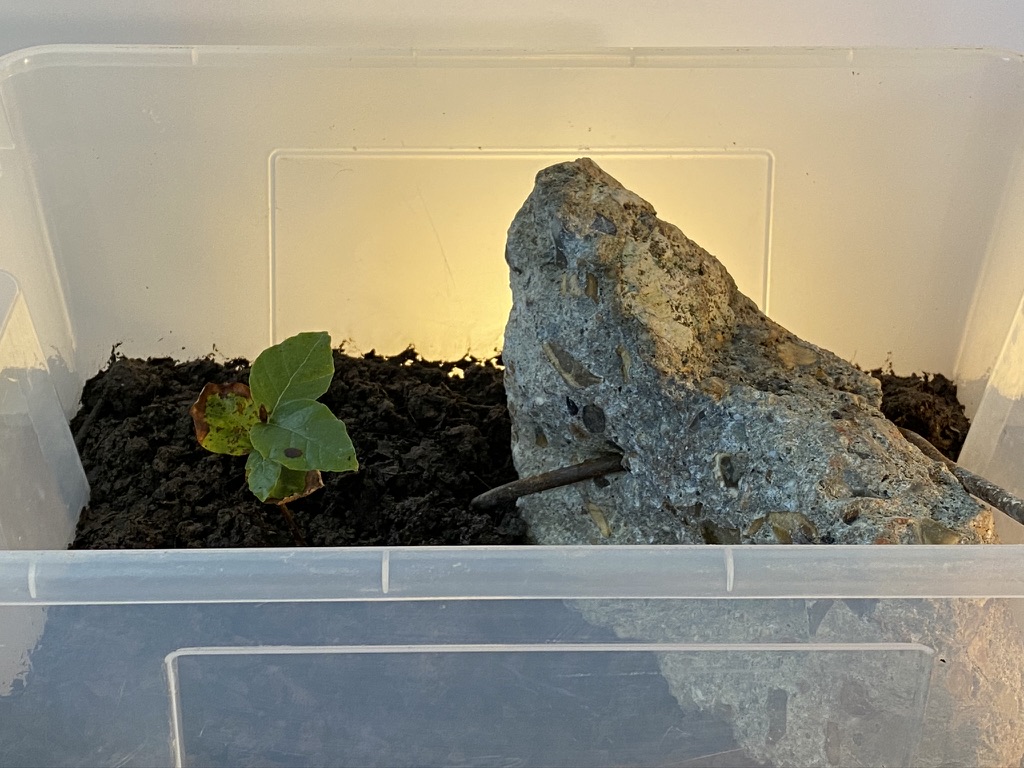
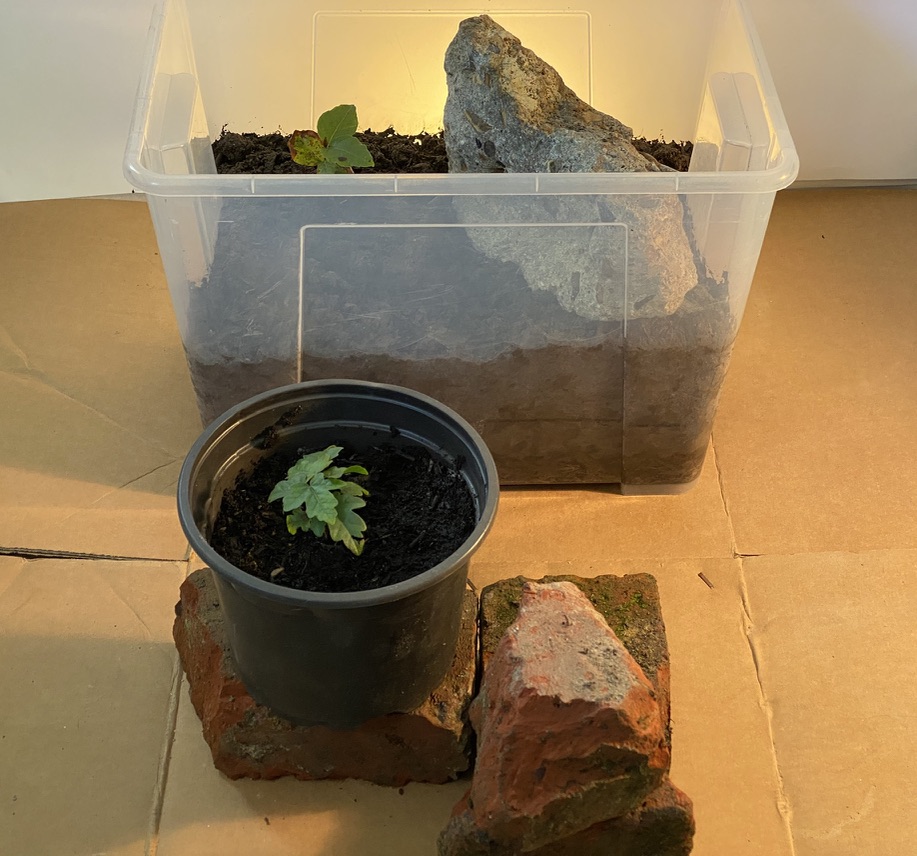
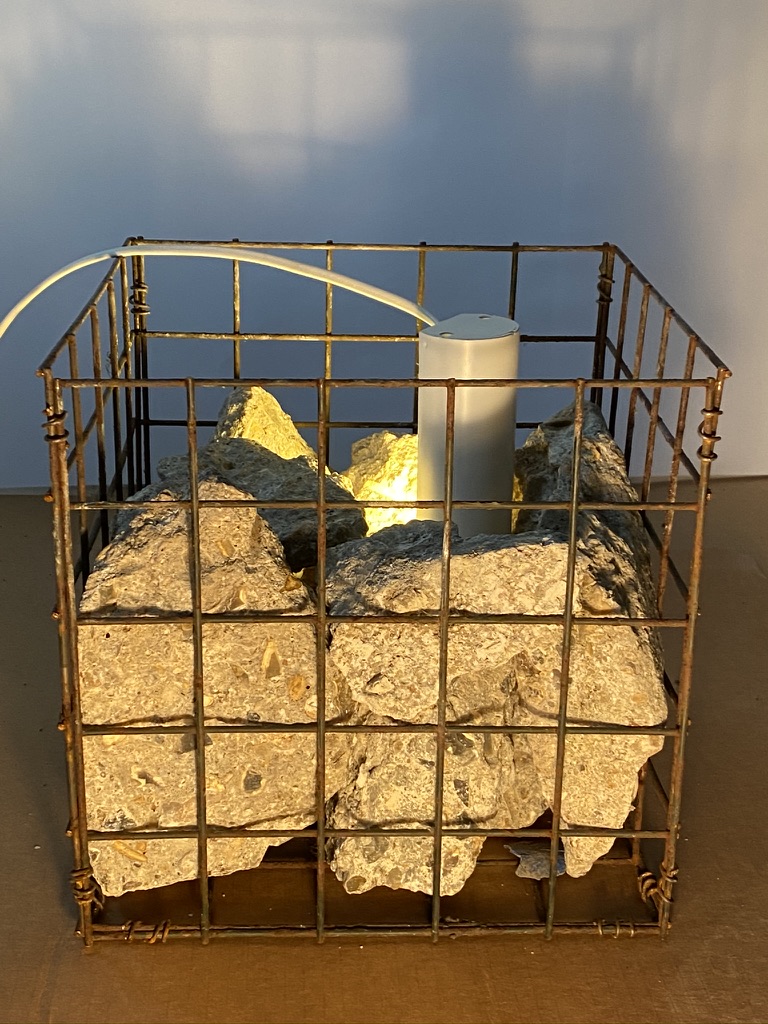
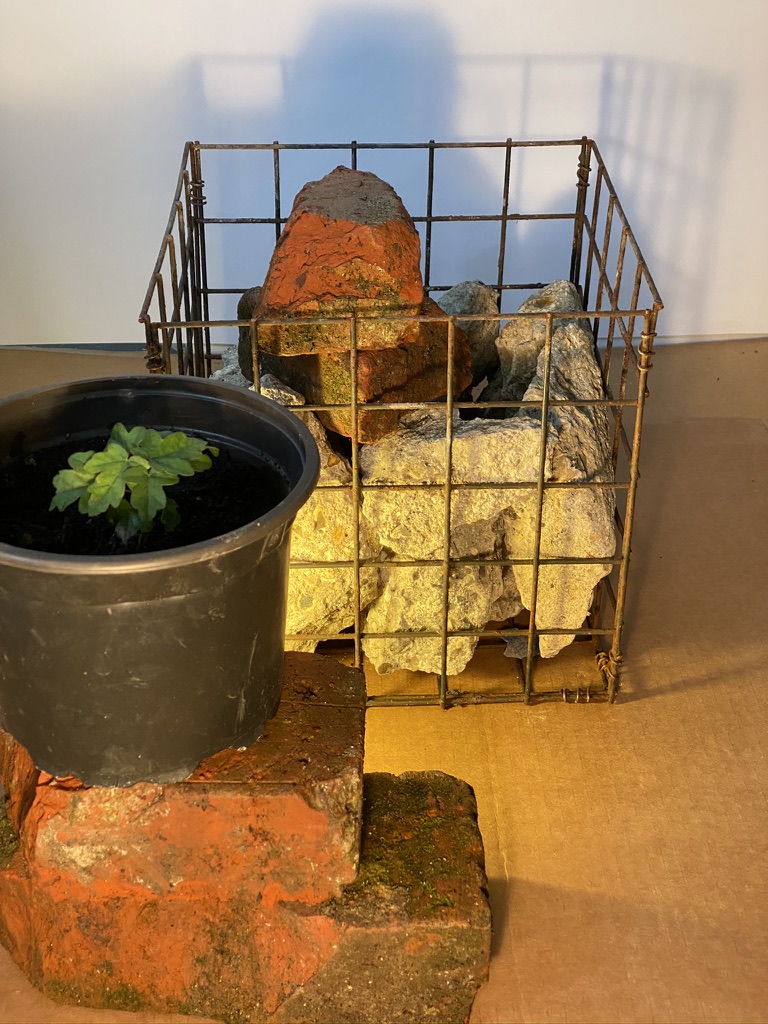
I have been prompted by seeing this work to try out some different juxtapositions of materials, as explored in the images above, along with the placing of objects and light sources. In the images below, the light source has been placed within the structure to produce a steady glow through some of the more transparent materials.
The tree seedlings nurtured since the spring, my Covid-trees, rescued during lockdown are making appearances within my current work. For that work to be viable indoors, I need to experiment with grow lights as I do for the pieces that include terraria and moss.
Liz Clifford. Work in progress. 2020.
Seeing Danh Vo’s work with plants has encouraged me to pursue this strand in mine. The living plants connect directly to the provenance of the other materials I use, in that they have inhabited the same space in nature completely by chance. Taken out of that space, each element continues to grow and be reconfigured. The ephemeral could be encouraged to take over the concrete, literally.
“Nature in time takes over” says Danh Vo when describing the beautiful triangular shaped mountains he had seen in Mexico, that are in fact pre-Columbian pyramids that have not been excavated. The traces of a lost civilisation.
Having set myself the challenge of making observations in the landscape over the summer, I now return to the problem of curation of that information. I have a collection of rubbings, drawings, photographs, videos and collected materials. I also have graphic information relating to the geology and contours of the site which has been realised in drawing and print but not resolved and needs to be developed further.
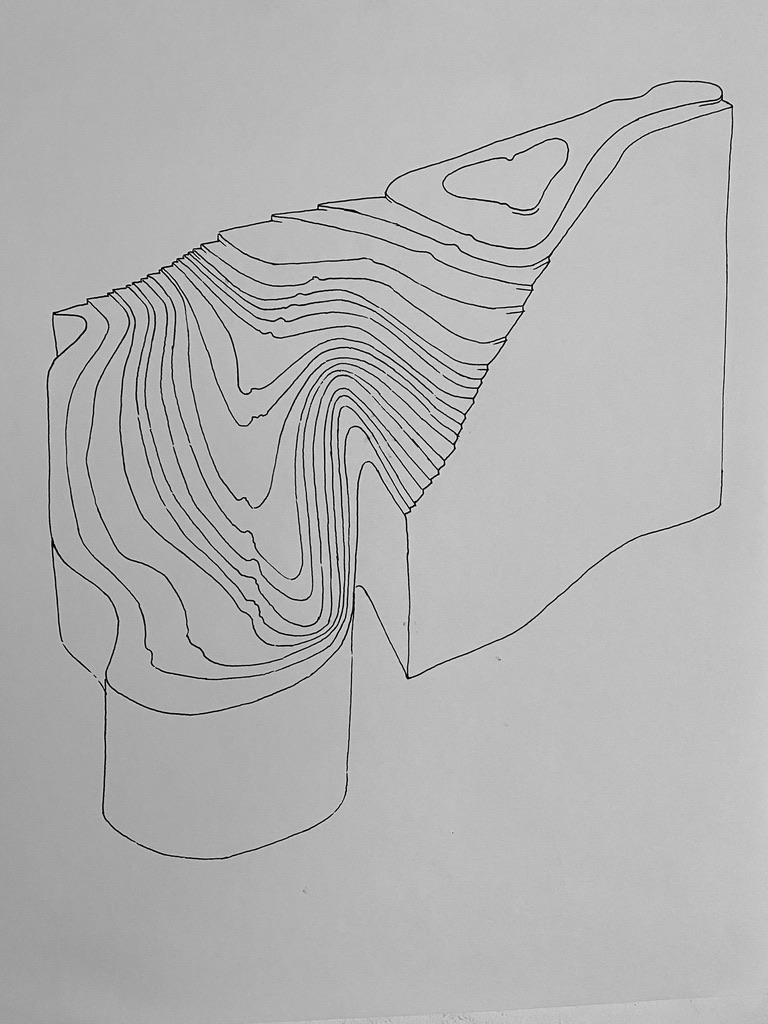
Taking my cue from Alexandra Arènes and Souheil Hajmirbaba at the Critical Zones Exhibition at ZKM Karlsruhe, I have recently completed a three dimensional piece of work intended to help contextualise the various strands of my research. A free-standing representation of the hill on which Byway 745 is located.
Liz Clifford. Contour Drawing – Wheatham Hill. 2020. 38 x 29 cm
Liz Clifford. Work in progress. 2020.
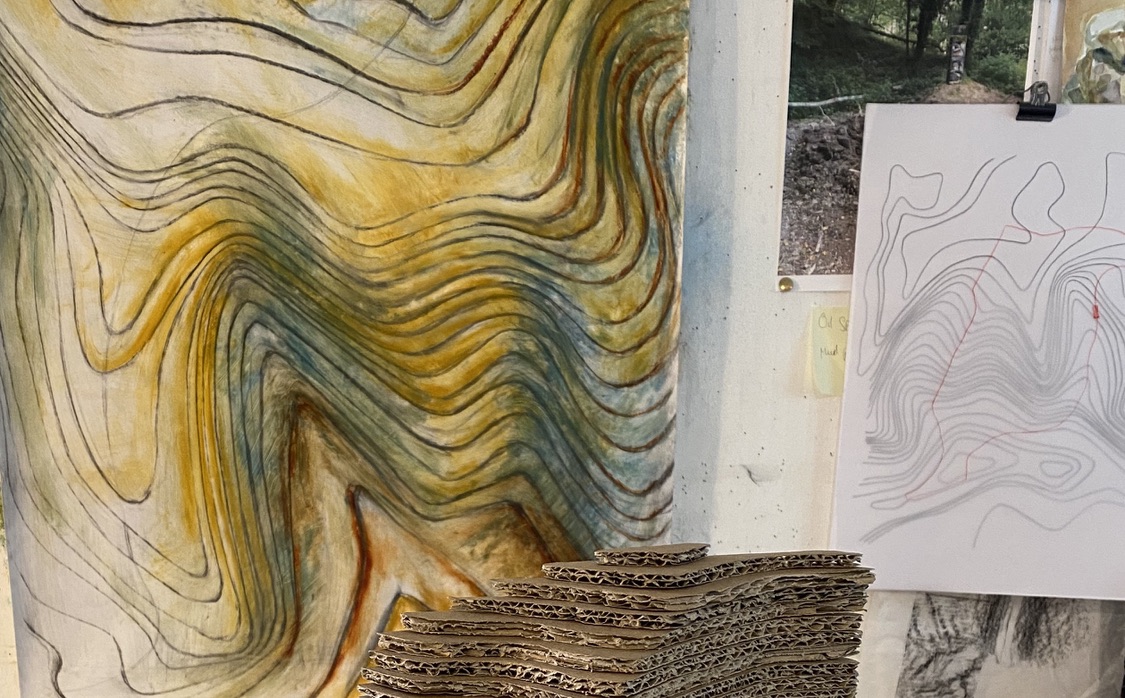
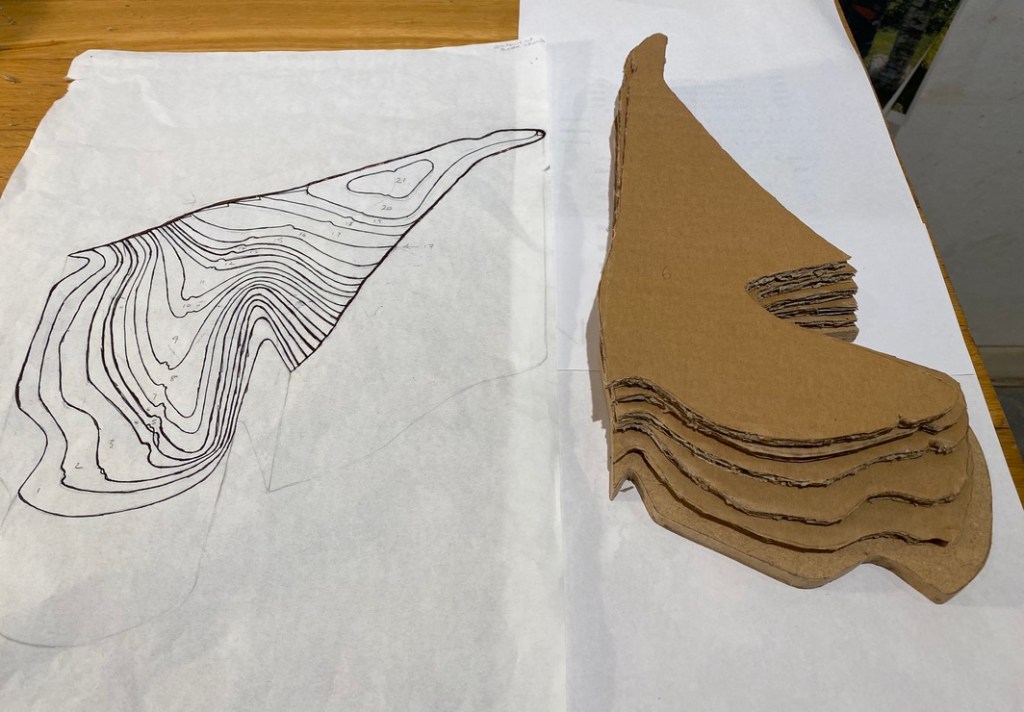
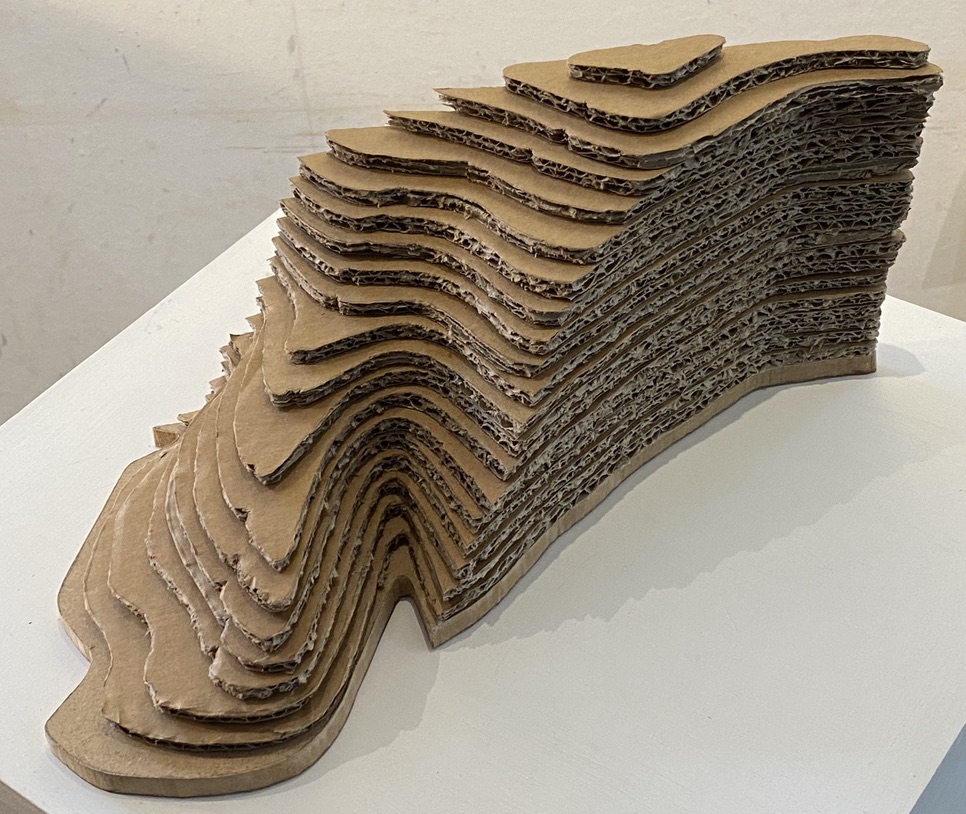
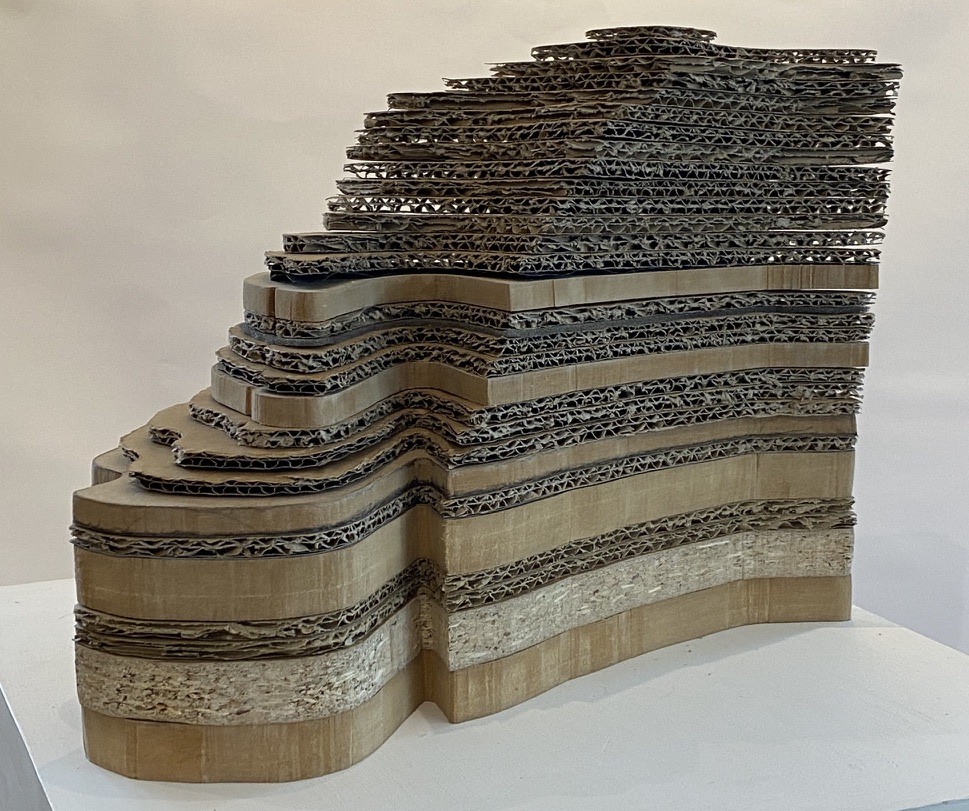
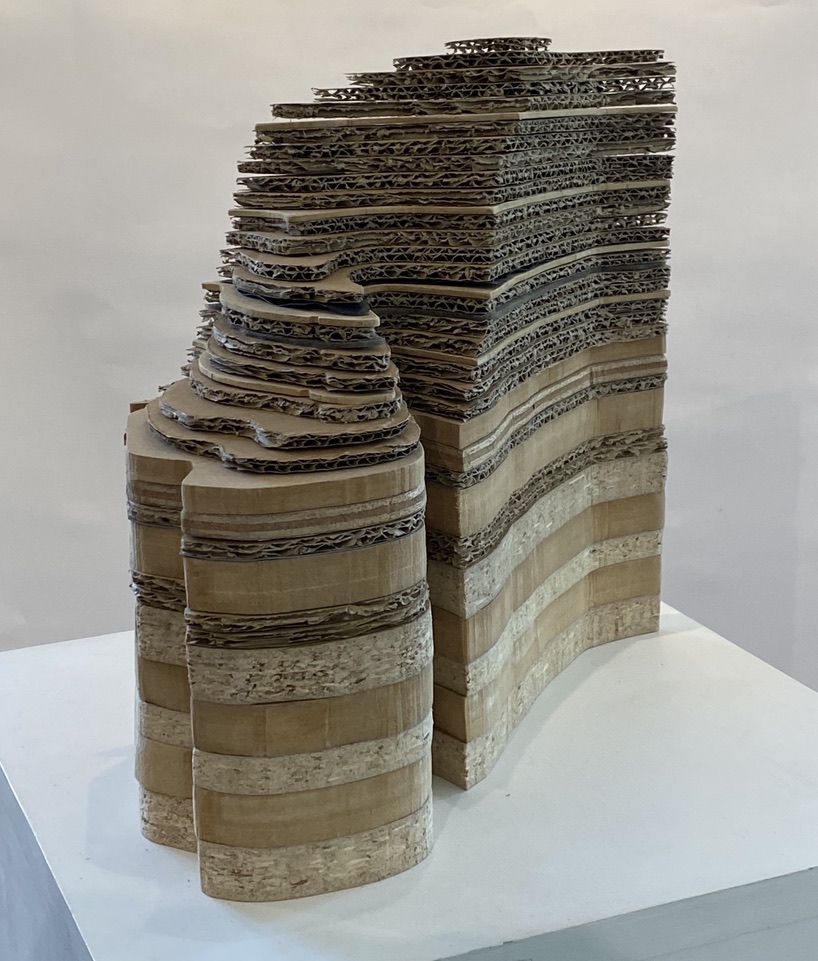
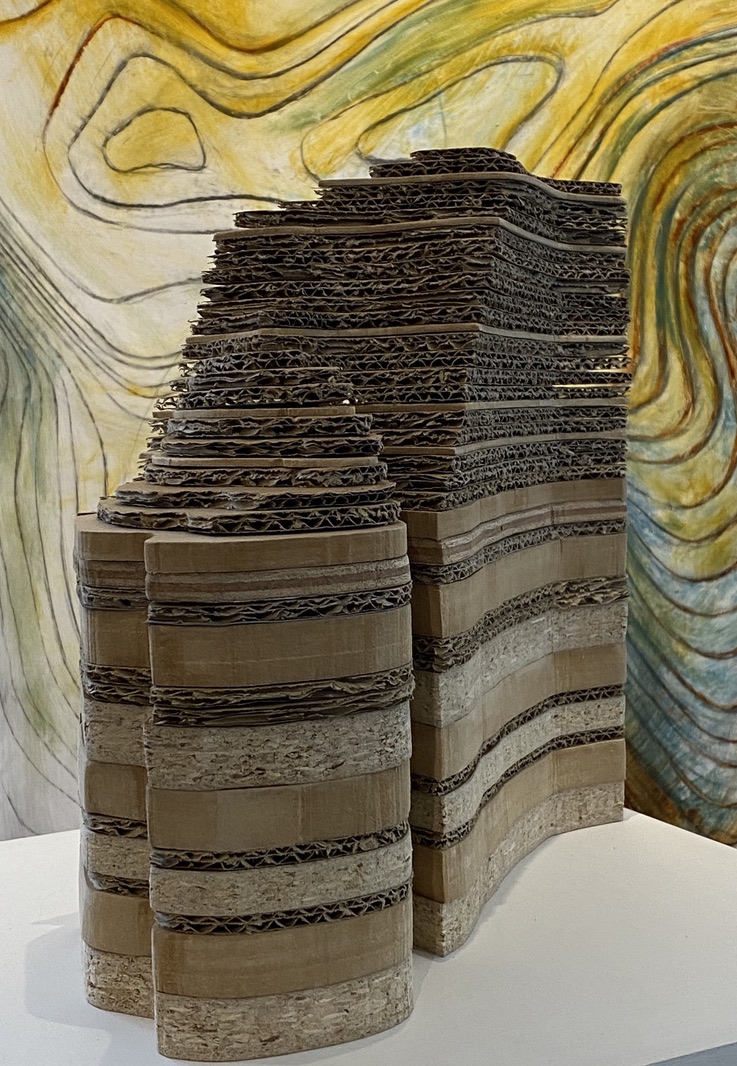
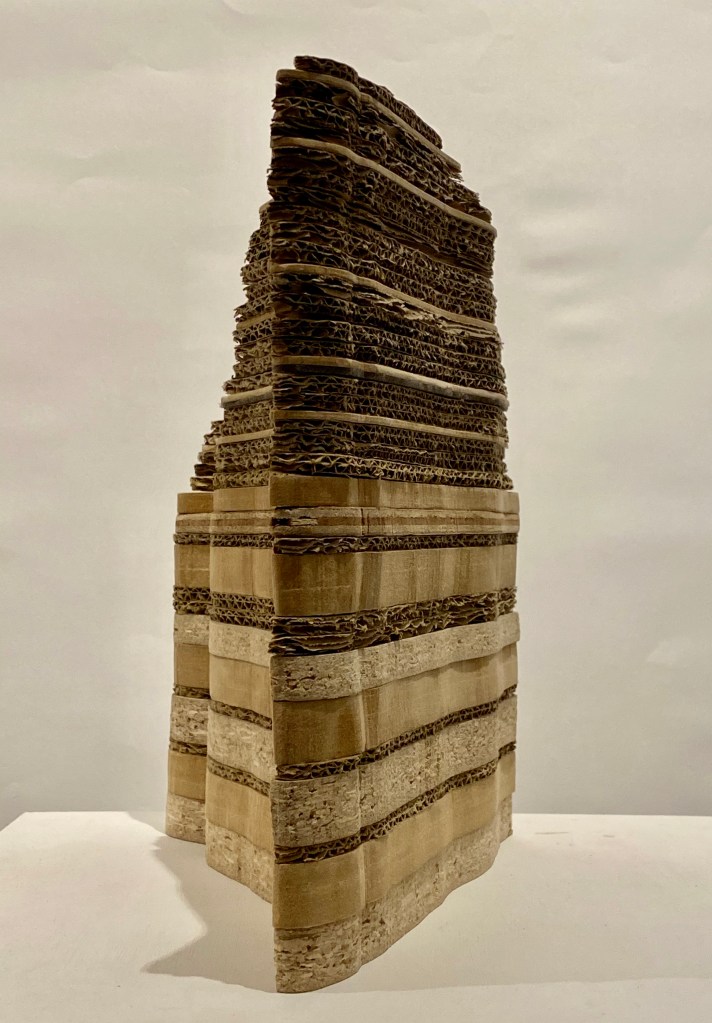
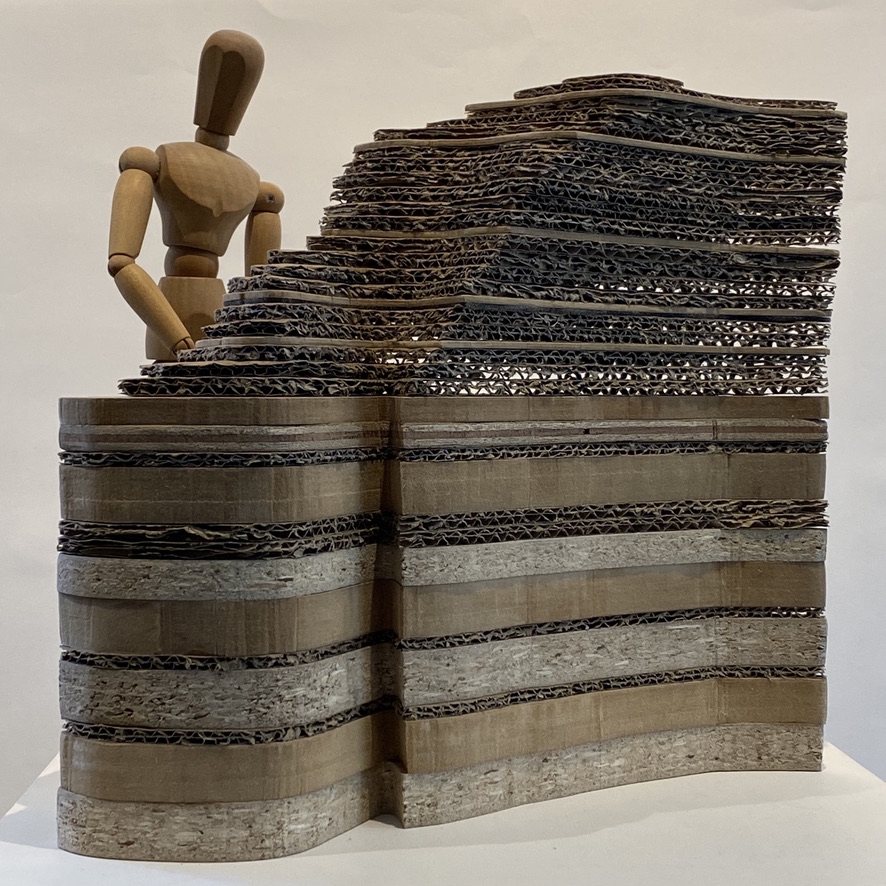
Taking the contours from the OS map and scaling them up, locating the Byway with a notch in each layer, the work was made by cutting scrap materials to build up the layers. The contours from an elevation of 110 to 250 metres above sea level are represented and various combinations of scrap materials were experimented with before the final iteration was glued together. The choice of materials is informed by their availability as off-cut scrap and discarded packaging, but also as various forms of processed wood. This is a wooded hill.
Liz Clifford. Work in progress.
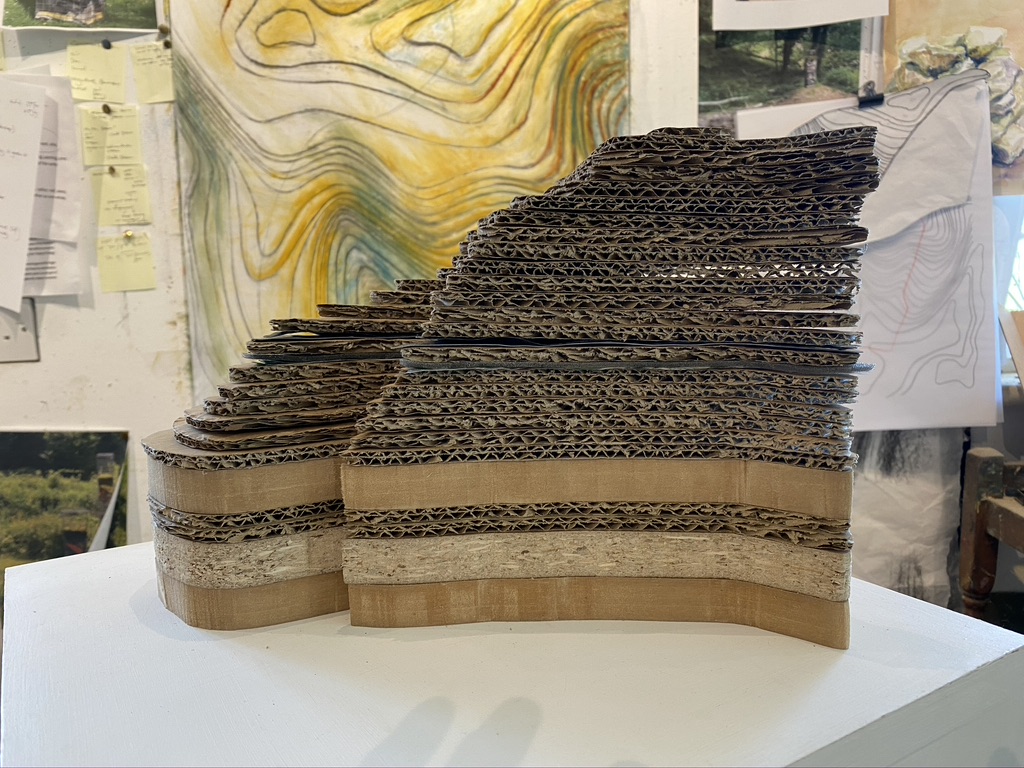
After a lot of work with jigsaw and scalpel I settled on a stack that suggests strata way down in the bedrock by building up a kind of plinth. The contrasting textures of the fairly limited selection of materials emphasises the horizontality and a simplicity is retained by the muted colour and repetition. The exception is in the inserting of a layer of grey plastic foam and black plastic sheeting at the two layers that correspond to the location of the Byway 745 Observatory. This is both to identify the location of the Observatory and as an acknowledgement of the amount of plastic waste that has been found on that part of the track.
Liz Clifford. Wheatham Hill. 2020. 29 x 32 x 16 cm
The resulting piece can be treated as a maquette for a larger scale realisation or as a plinth based small sculpture. The images below use model human figures to visual two different scale options.
Experiments with scale
Two sculptures that I have been looking at whilst building this are both called Stack, one by Tony Cragg from 1975 and the other by Kathy Prendergast from 1989. Both use humble, salvaged materials and create a free-standing form through horizontal layering. The scale that both artists achieve with their Stack is very likely what my work is aspiring towards. It will now form part of my proposal for an installation that aims to bring the landscape of Byway 745 to a gallery audience.
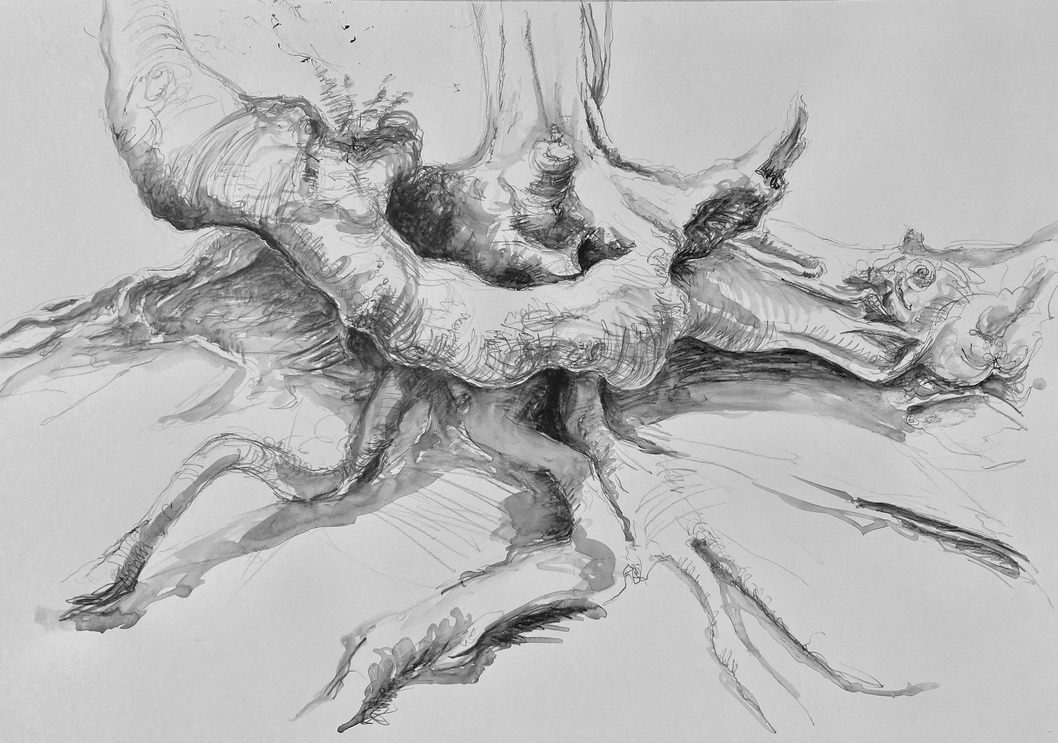
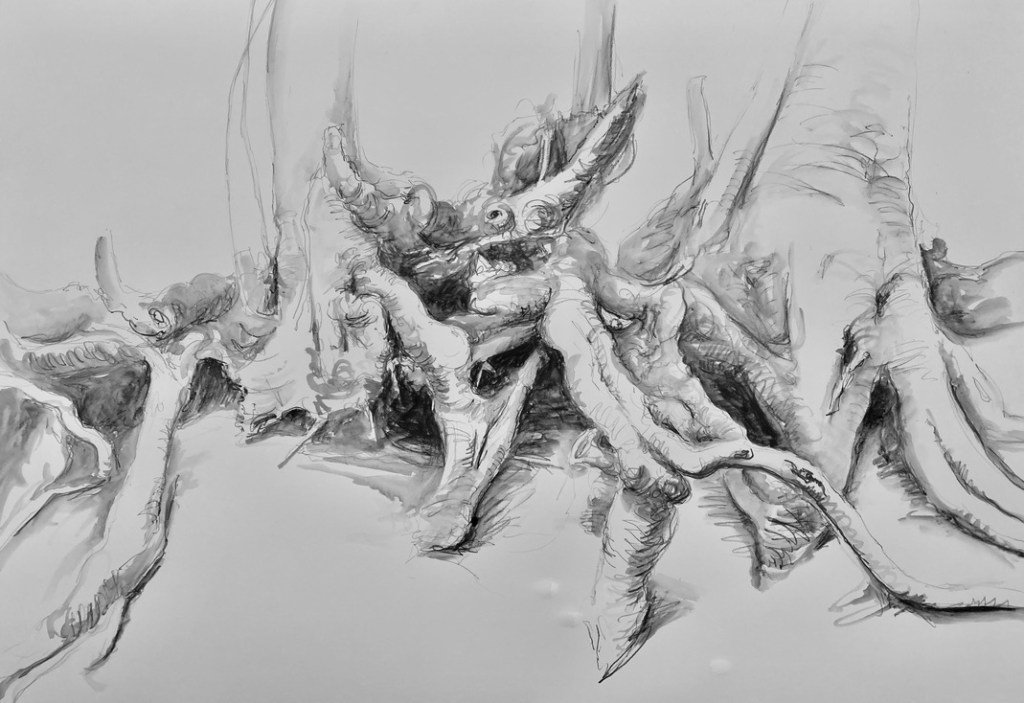
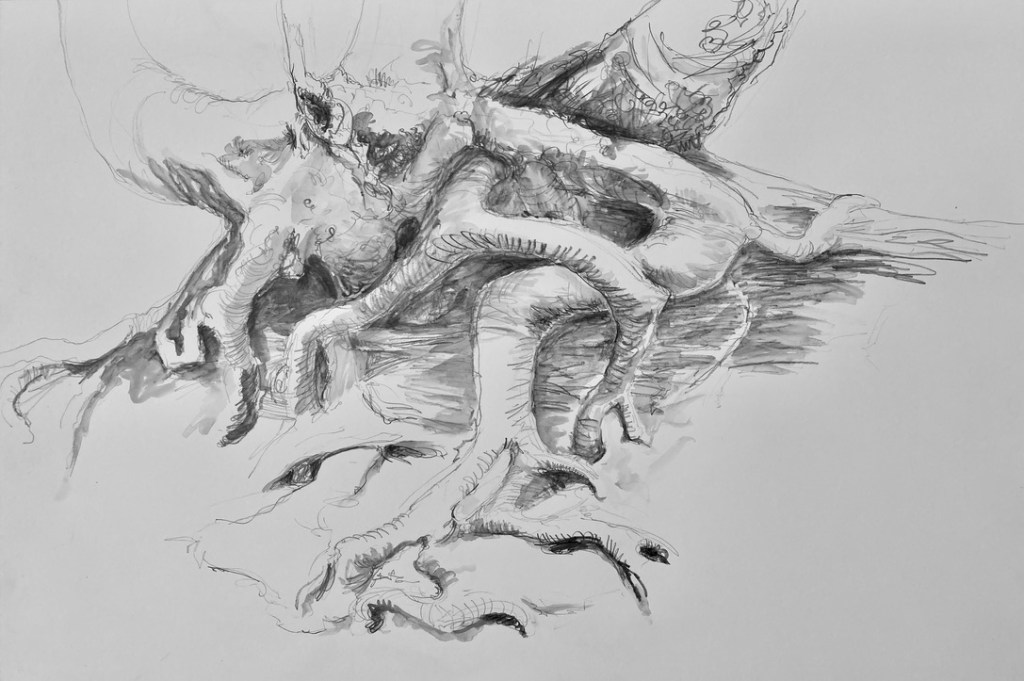
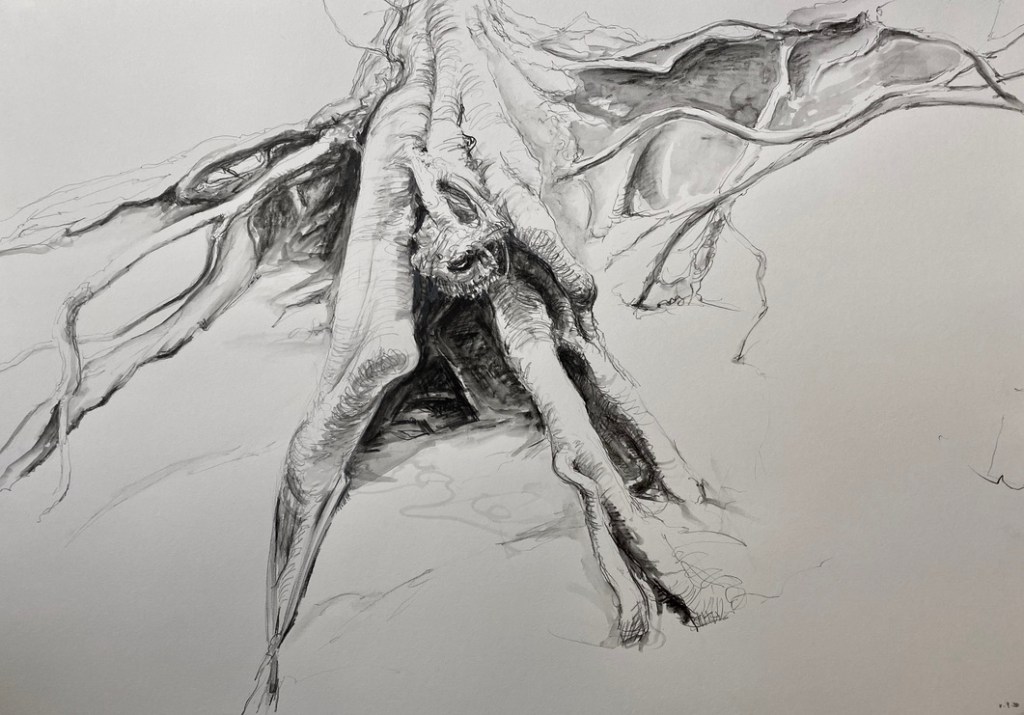
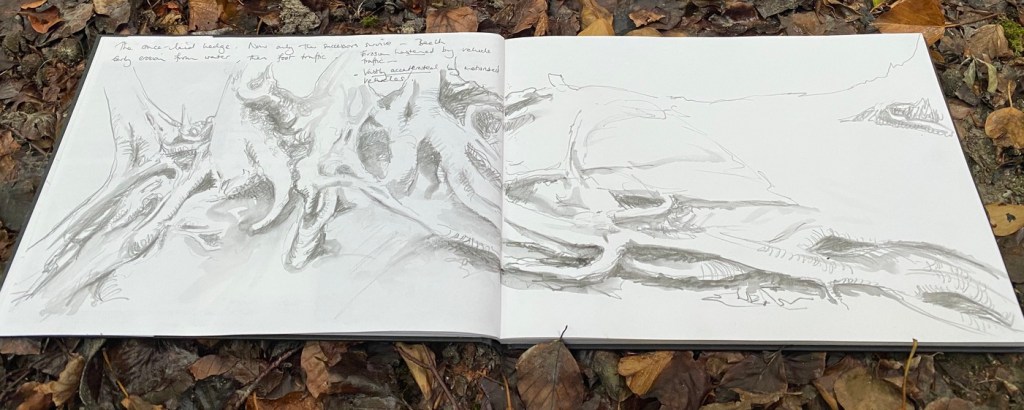
I have recently been in, been-with, the landscape through the experience of working on this series of drawings, on location, beneath the remains of a once-laid beech hedge. That laid hedge, now grown out, its stock-proof boundary-making function replaced with wire fencing, is a marker between public and private land. I place myself in the public Byway 745 that runs below the ancient hedge.
Liz Clifford. Beeches. 2020. graphite and wash.
It is part of my project Byway 745 Observatory to record this location through drawing as well as photography, video and collecting. The physicality of the drawing process is invigorating. Each drawing on white cartridge paper measures 59 x 84 cm and is made with graphite and wash. Perching for over an hour at a time, leaning against the muddy bank with a large drawing board balanced on one’s knees, is to feel the urgency to capture the information as economically as possible before the body can’t stand the aches and pains any longer. The challenge is totally absorbing and during the time spent drawing the smells and sounds of the place become familiar in a way they do not when one simply passes through.
The intervention of humans with these trees, the cutting and bending over of their branches in the past has made for their gnarled, knotted appearance and the horizontal emphasis of the exposed roots. This is accentuated by the erosion of the chalk bank over the years due to the hollowing out of the lane below by the passage of human traffic. Currently the series consists of five drawings but I am aiming for ten to make a bank of images to curate alongside other works from the Observatory.
Seeing the drawings together throws up connections to the human body through the limb-like roots and protrusions. There is an anthropomorphism present in the work which I have also begun to notice in my photographs of the rutted and eroded chalk of the track below these trees. This is something I am exploring further, aware of the metaphor of landscape as body, and a vulnerable one at that.
I was hoping to see this exhibition before lockdown but my plans were thwarted. So perhaps I have relished the opportunity to visit it all the more as there are still not many exhibitions open.
In addition, I now find myself working directly in a wooded space and have been nurturing rescued saplings, so the show has more immediate relevance to my own work than it might have done back in March.
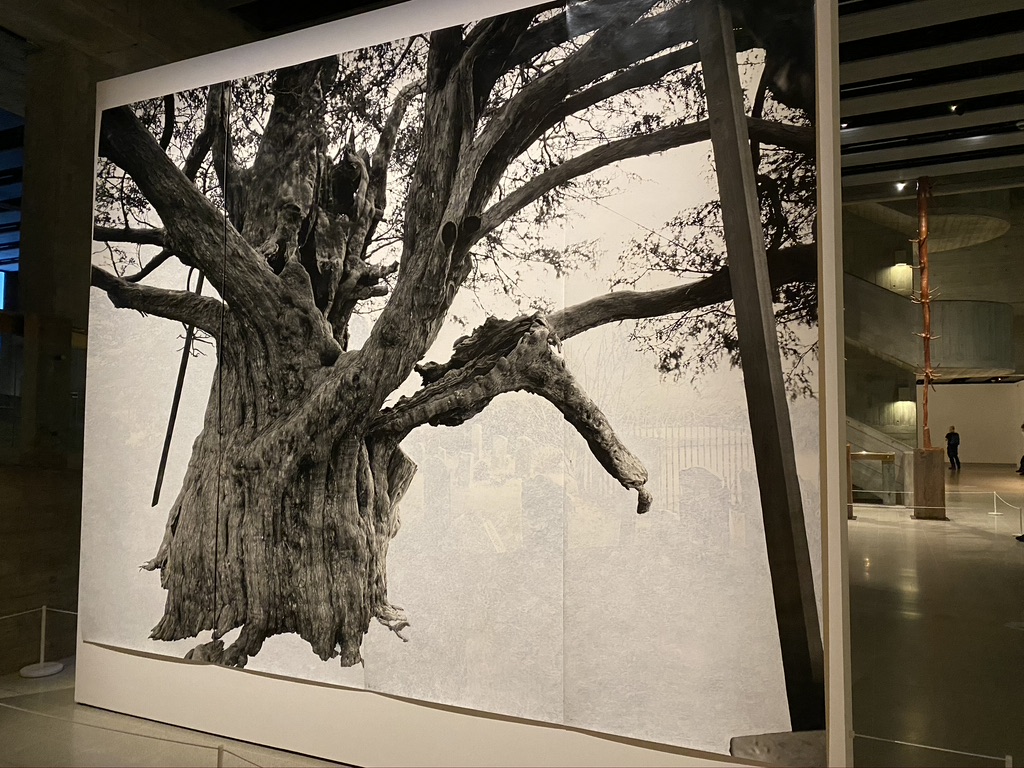
Here I’ll pick out a selection of works from the show that particularly resonate for me. First of all, there is the theme of time running through a lot of the work. Trees are long-lived and often outlive humans by hundreds or thousands of years as seen in Tacita Dean’s painted photograph of one of the oldest yew trees in Britain, Crowhurst 11 2007 which confronts you in the gloom of first room of the exhibition.
Tacita Dean. Crowhurst II 2007. Gouache on photograph.
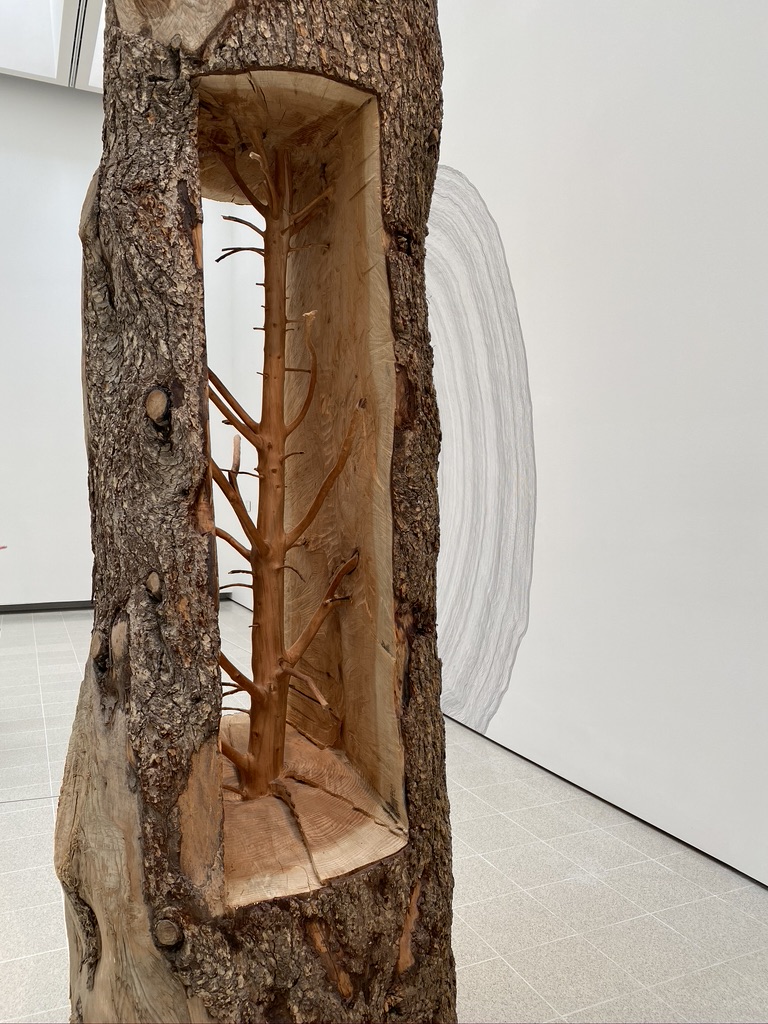
Giuseppe Penone’s Door Tree – Cedar 2012 is all about growth and aging as he cuts into the trunk of a tree to reveal its core and the rings that mark its years of growth. This piece is shown alongside his drawing Propagazione/Growth Rings at the centre of which he placed his thumb print and from which the rings are extended onto the gallery wall to make the cross-section of an ancient trunk.
Giuseppe Penone. Door Tree – Cedar 2012 with Propagazione in the background.
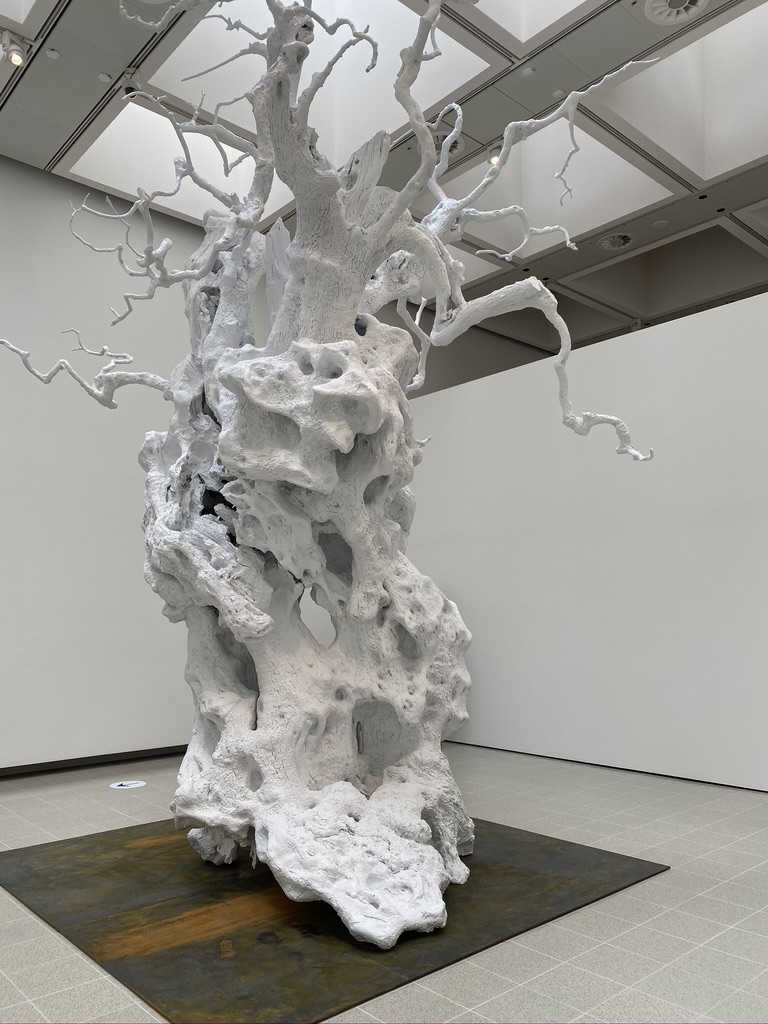
Ugo Rondinone’s Cold Moon 2011 is also a portrait of a specific Italian olive tree cast in aluminium and painted white. It has a ghostly presence, the original tree being over 1000 years old and hugely weathered by the elements, an assemblage of time and the forces of nature.
Ugo Rondinone. cold moon 2011. Cast aluminium & white enamel.
Liz Clifford. Byway 745 Observatory 2020. Digital photograph.
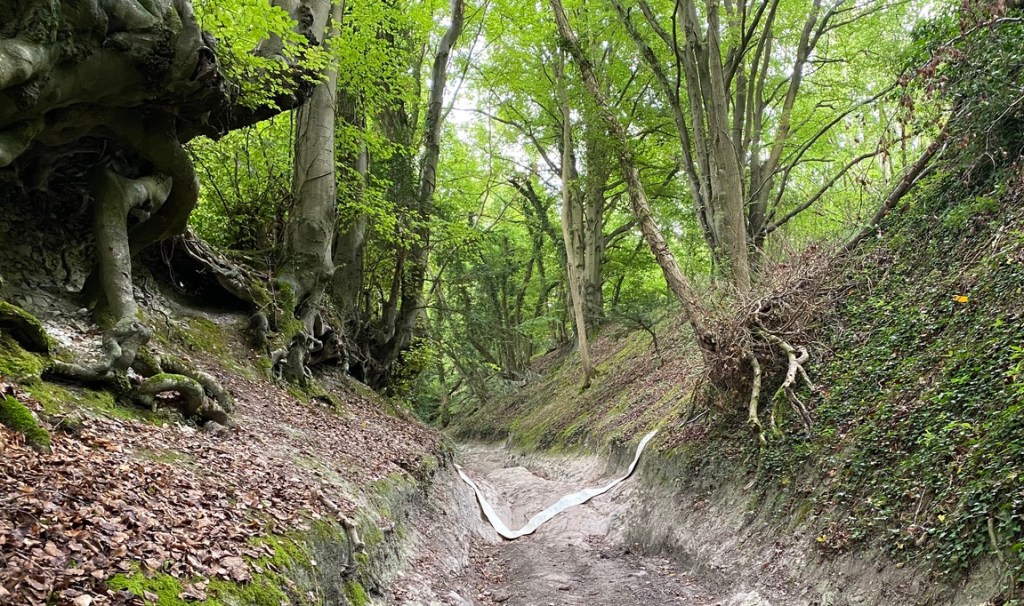
The woodland through which Byway 745 climbs is what’s known locally as a “Hanger” of beech and yew. The track is bounded to the East by a former laid beech hedge now grown out over several hundred years. This line of gnarled trees with exposed roots and horizontal growth marks the boundary of the ancient public right of way and private land. The chalk beneath the shallow roots has eroded away in places, making caves and hollows as the trees form great protuberances over the track as seen in the photograph above. I have started making a series of drawings of this line of beeches including the example below.
Liz Clifford. Beech Roots 2020. Pencil and wash.
Horizontality and focus on roots is apparent in the approach to the subject matter of a number of the artists in the exhibition, most notably Finnish artist Eija-Liisa Ahtila whose video work Horizontal – Vaakasuora 2011, in my first image, is a life size portrait of a spruce shown horizontally so that it fills the whole back wall of the gallery and thereby fits into the space. Thomas Struth’s photograph of a mossy Japanese forest floor draws attention to exposed roots as does Robert Smithson’s 1969 series of Upside Down Trees in which he buried young trees to expose their roots for a series of photographs, exploring and drawing attention to what goes on underground. There are echoes here not only in the subject matter of my drawings but also of recent reading in which the root and rhizome systems are used as metaphors for the entanglement of everything. By Deleuze and Guattari in A Thousand Plateaus (Deleuze & Guattari,1987:5) and Jane Bennett’s attention to horizontal relationships between human and non-human in Vibrant Matter (Bennett,2010:112). The work of earth system scientists is celebrated by Bruno Latour and curators of the Critical Zones Exhibition, currently running at ZKM Karlsruhe, and this has introduced me to the work of biologist Lynn Margulis on the holobiome and rising awareness of the networks of roots, fungi and bacteria that connect living organisms and create ecosystems.
Robert Smithson. Upside Down Tree 1 1969. Print from 35mm slide.
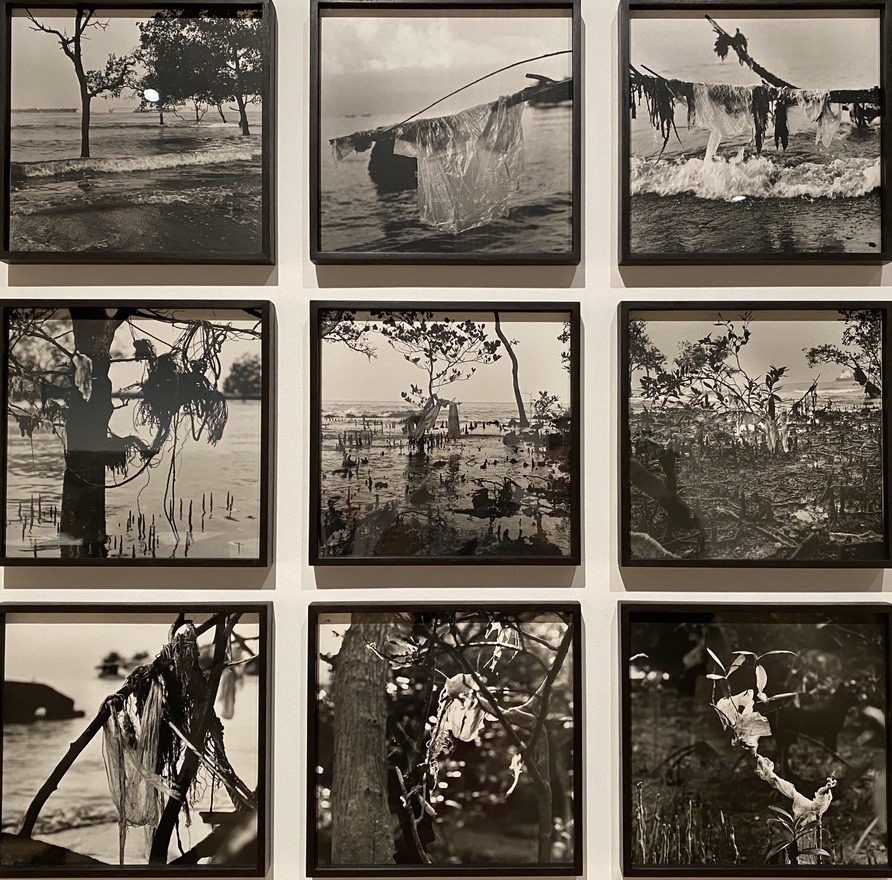
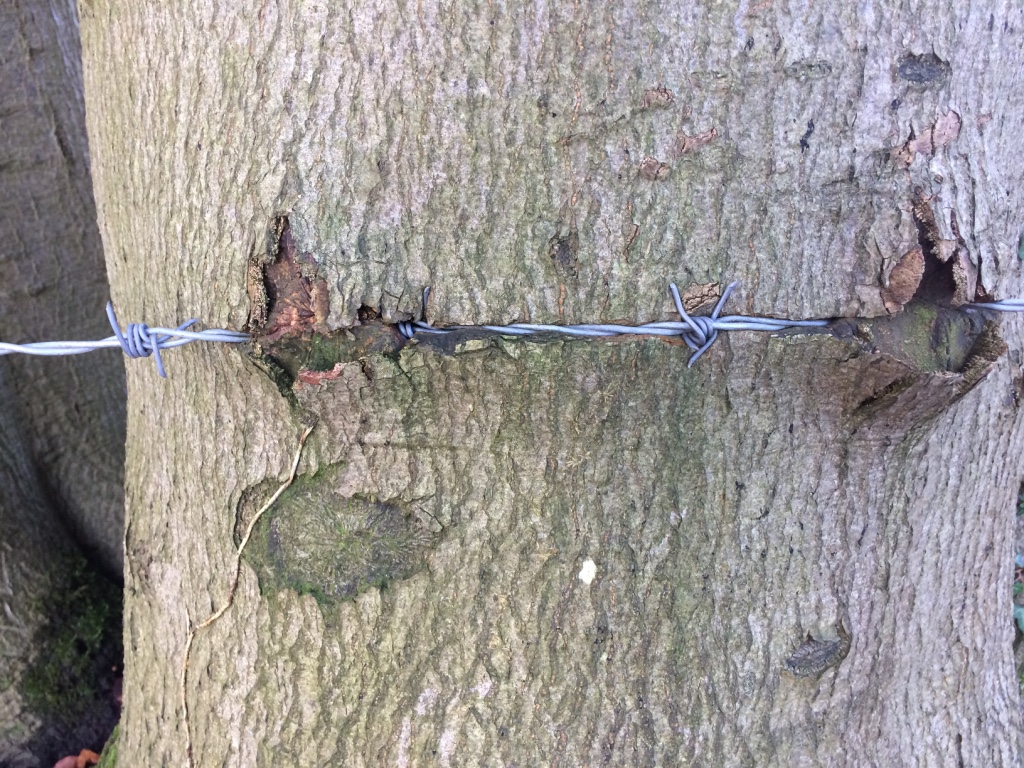
The human impact on trees is explored by artists who draw attention to their role in bearing witness to the atrocities of human activity. Steve McQueen’s location shot for the film 12 Years a Slave actually turns out to contain a tree that had been used in lynchings. The tree is an accomplice and a witness. Simryn Gill makes a record of the plastic detritus that washes into the mangrove trees along the Straits of Malacca in a series of black and white square photographs and Zoe Leonard records trees in New York City that have grown around the wire enclosures that humans have forced them to grow within, leaving them scarred and deformed. In rural boundary-marking trees are also often defaced and injured as my own photographs of trees defaced by being used as posts for barbed wire fencing illustrate.
Liz Clifford. Scarred Tree 2019. Digital photograph.
Time, entanglement and scarring are the themes that stand out and connect with me here but many others run through the exhibition. The Hayward have done a great job in opening up, so get along there if you can.
All photographs by Liz Clifford.
Bennett, Jane (2010) Vibrant Matter: A Political Ecology of Things. Durham, NC: Duke University Press.
Deleuze, Gilles and Guattari, Felix (1987) A Thousand Plateaus, Capitalism and Schizophrenia. Translated by Brian Massumi. 2013. London: Bloomsbury.
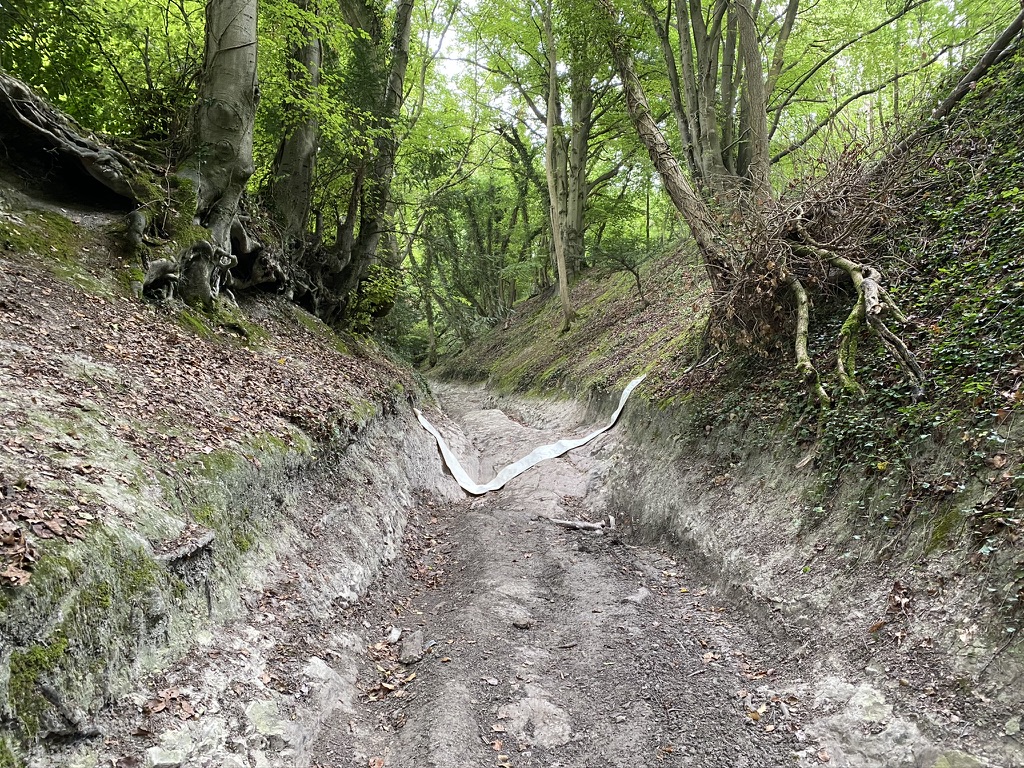
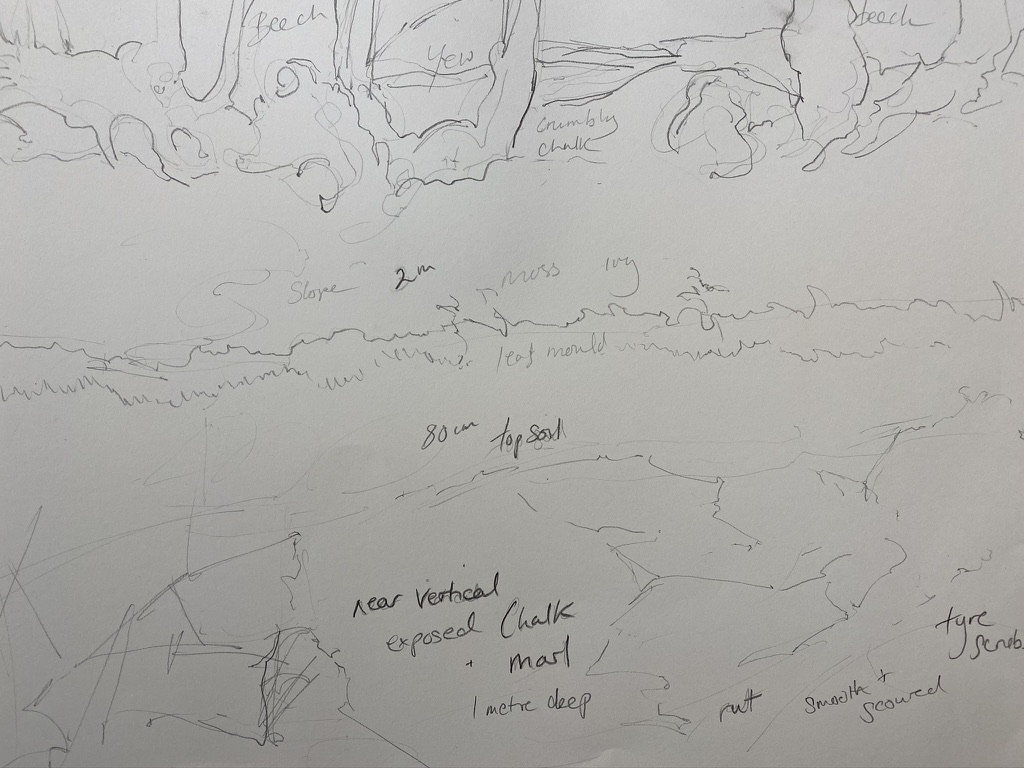
I have recently started making daily drawings on a 10 metre section of Byway 745, deciding to home in on, rather than pass through, the space. To establish a kind of “observatory” examining the whole space from the trees at the top of the banks down into the chalk trench of the track and up again. A cross section of the geological, biological and human history of this critical zone – of air, soil and rock. Data from maps and GPS apps have been recorded to pinpoint the space and more research into it’s history will follow but the real starting point is on site drawing.
Beginning with pencil and wash annotated sketchbook drawings was a fantastic way of tuning into the space. The act of observational drawing perhaps allows thinking time and a level of absorption absent when recording with a camera.
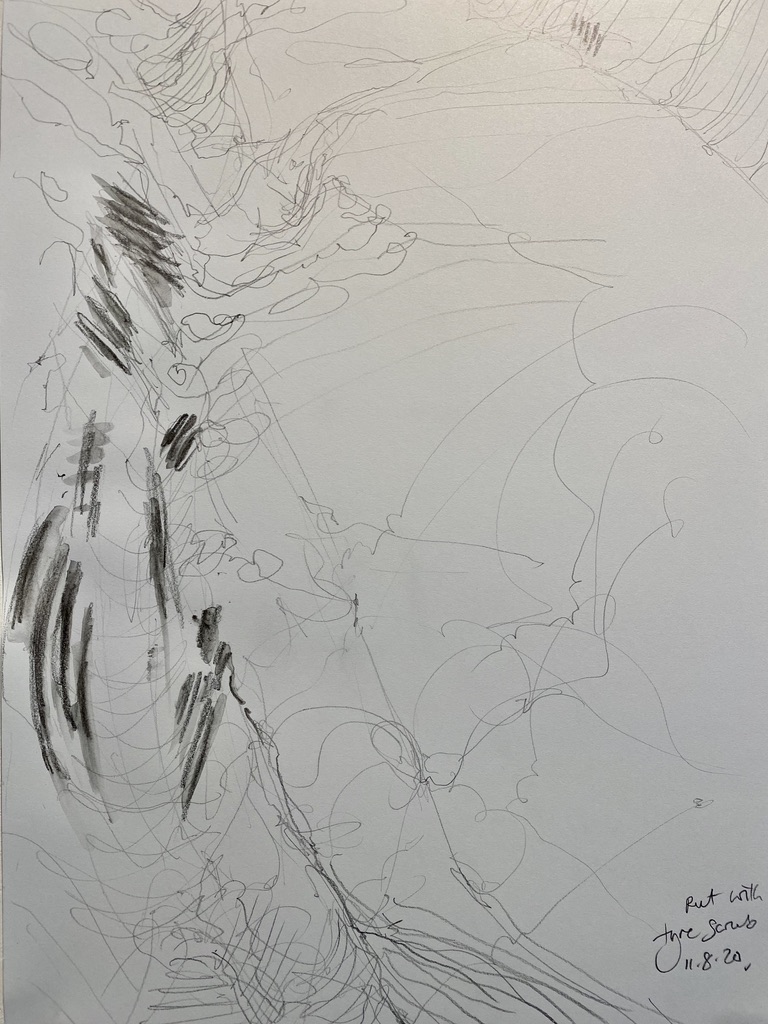
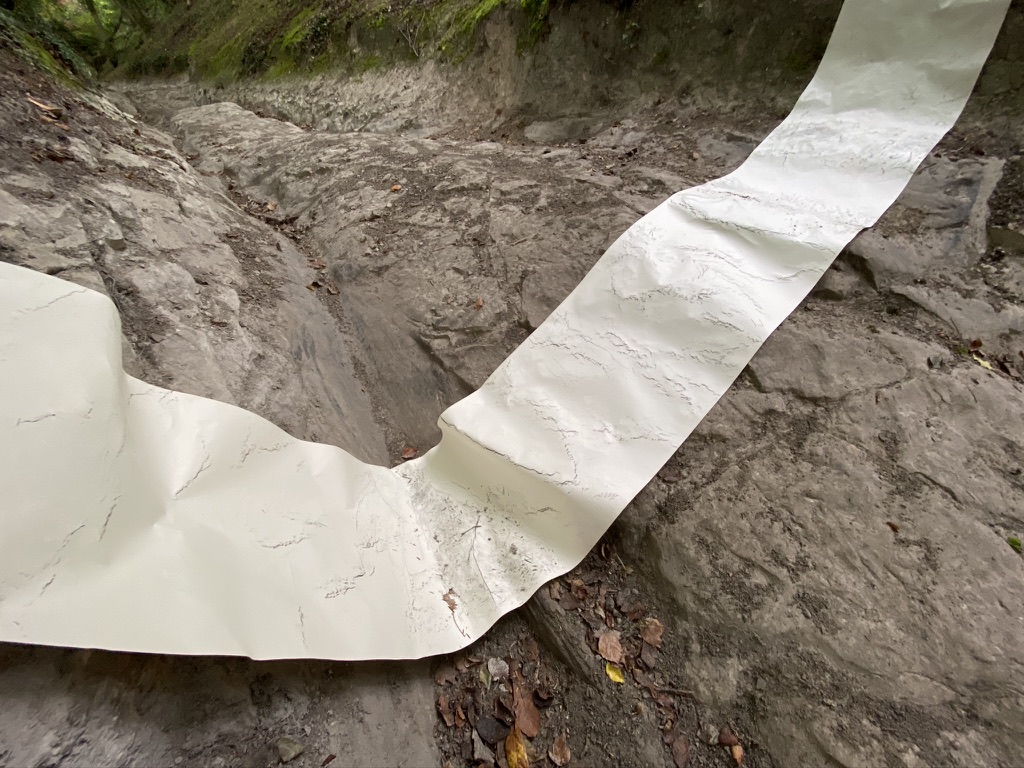
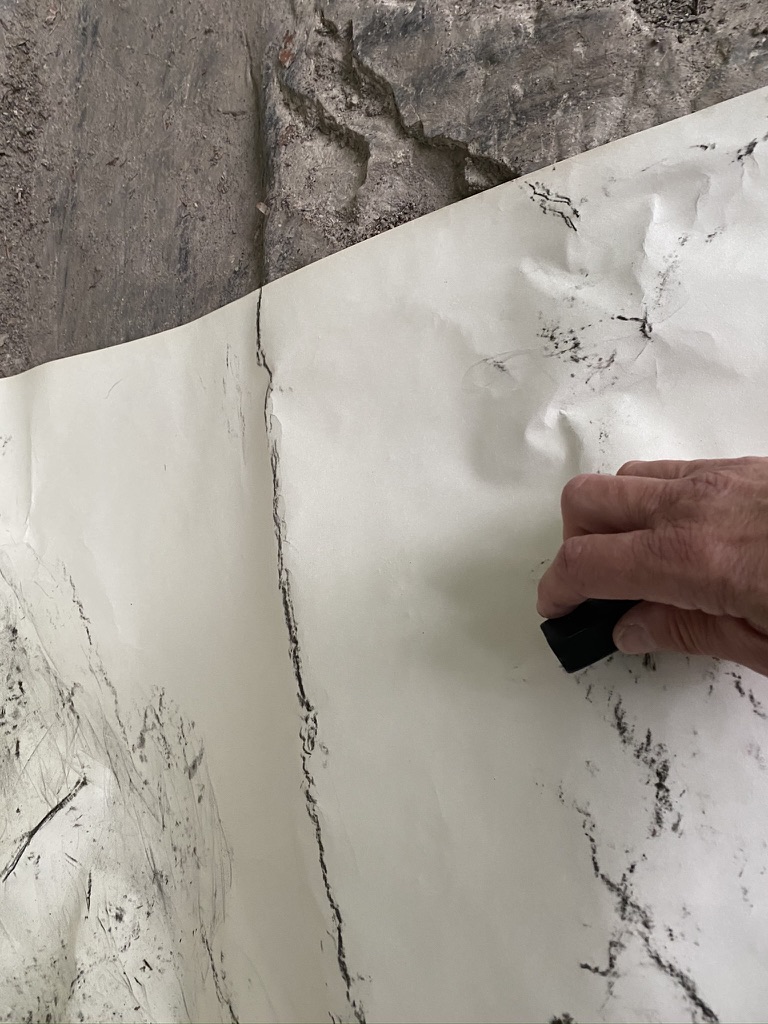
The other form of drawing has been much more physical. A direct drawing made across the width of the track consisting of a mixture of frottage and mark-making using brass rubbing wax and soft graphite stick. I will revisit this method and use longer pieces of paper unraveled from a greater height.
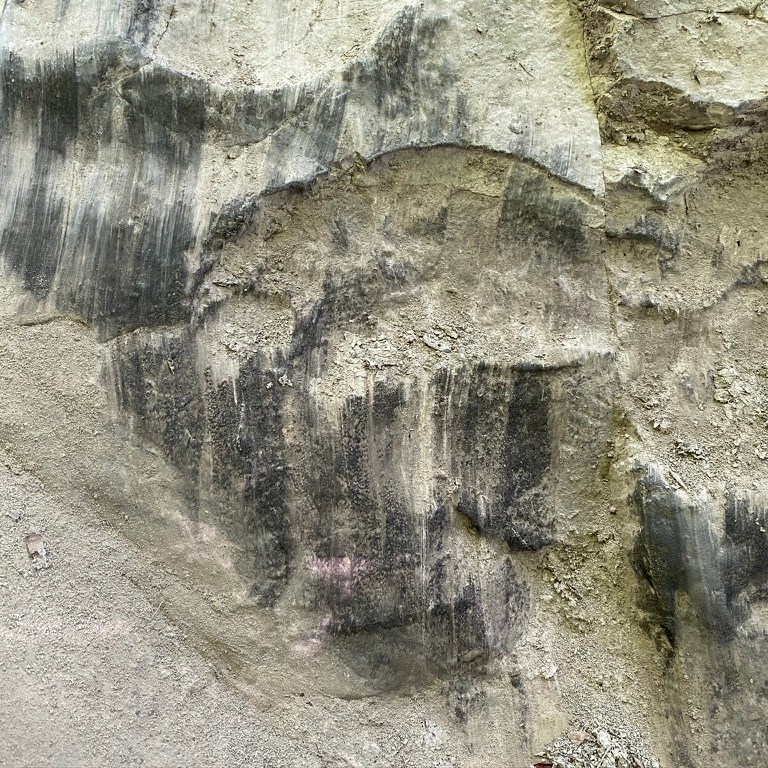
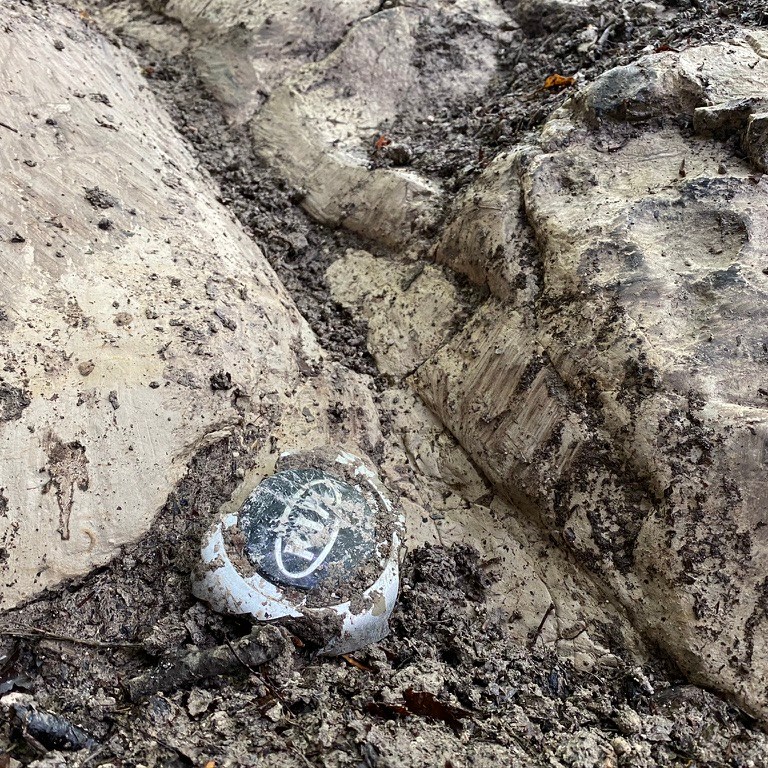
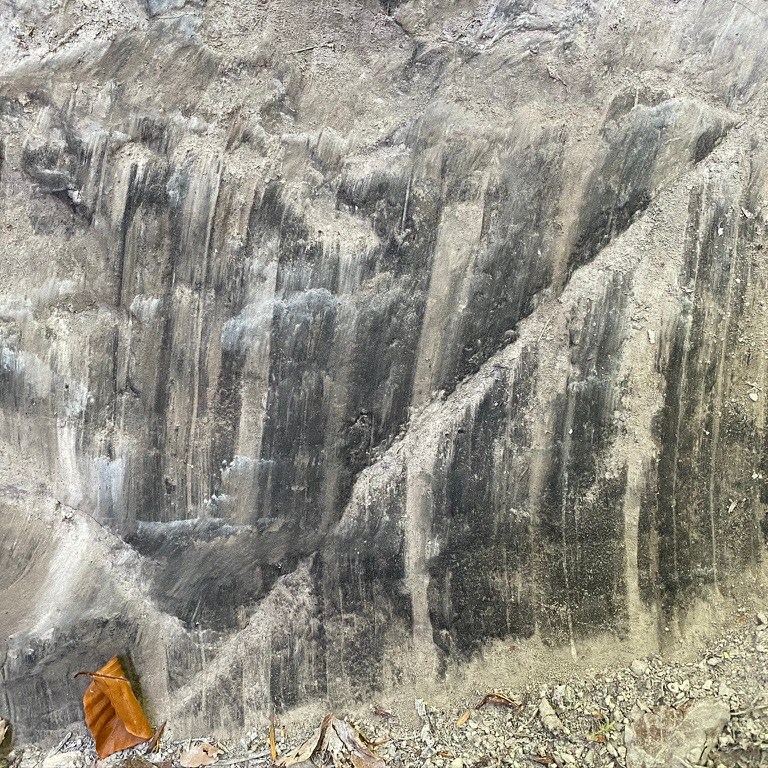
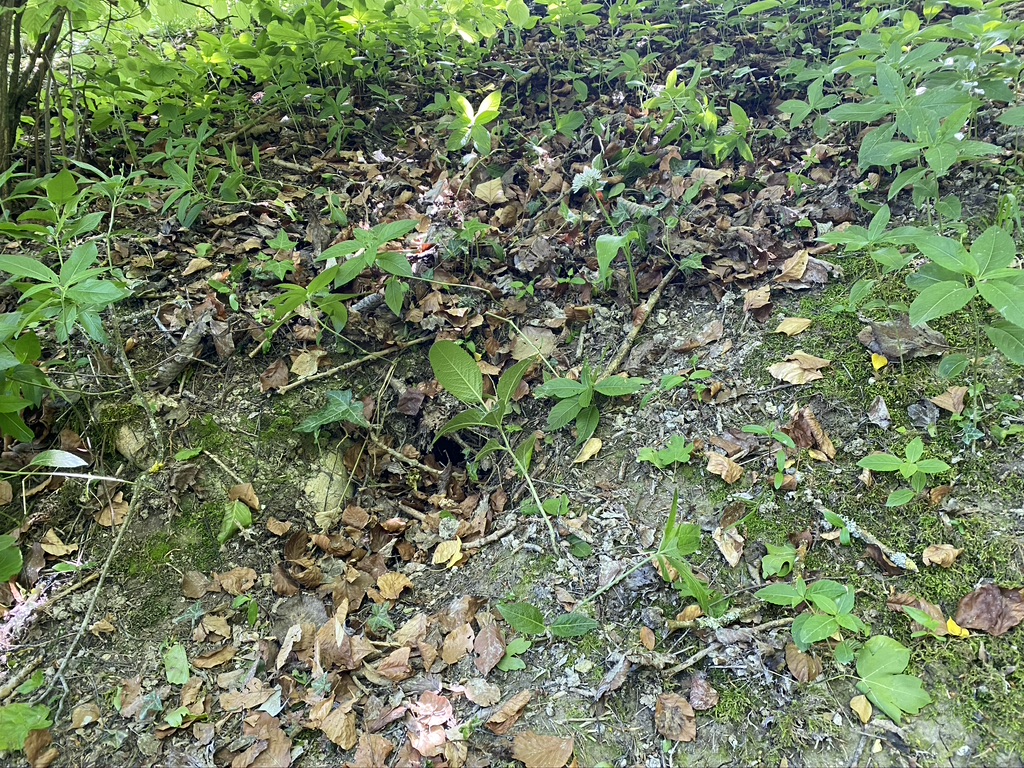
Whilst drawing, natural sounds have felt amplified. Buzzards, woodpeckers, and the nearby grazing sheep. Butterflies and spiders have passed by on their way but, so far, no humans. The human traffic is only evident in what has been left behind. The images below show the 4 x 4 tyre scrubs on the chalk and a smashed logo badge. A reminder of the accelerated erosion of the chalk by recreational vehicle use in recent years.
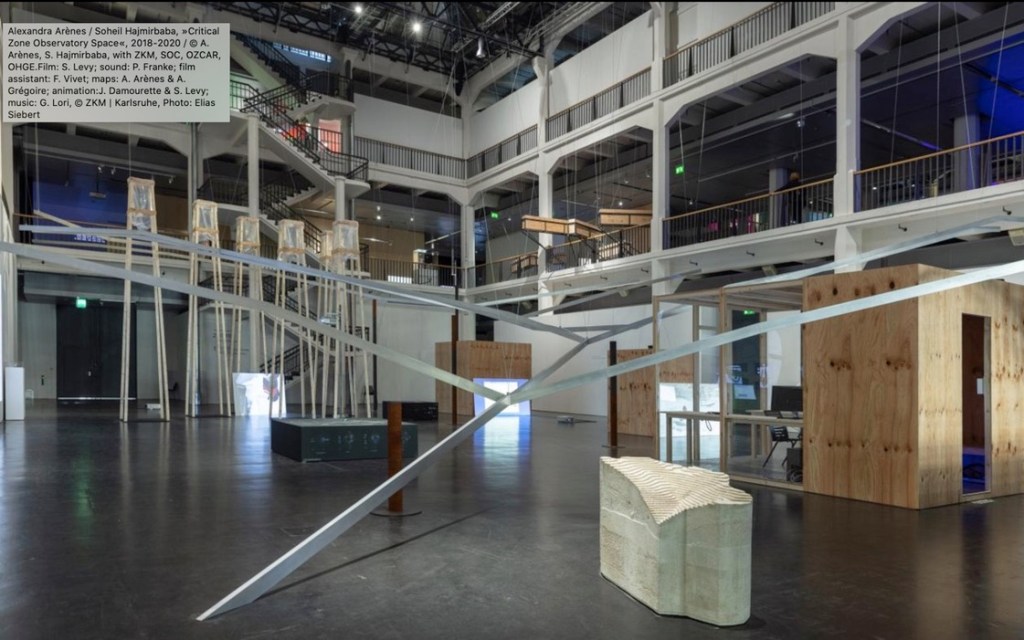
The prompt to take this approach comes from the current exhibition at ZKM Karlsruhe in Germany – Critical Zones: Observatories for Earthly Politics. The first room of this “thought” exhibition curated by Bruno Latour and Peter Weibel is called a Critical Zone Observatory Space. The installation by Alexandra Arènes and Souheil Hajmirbaba represents the work of scientists monitoring a section of the Vosges forest at Strengbach in the Alsace region of France that has been affected in the past by acid rain. The location has been a multi-agency observatory for 35 years with the aim of understanding the local ecosystem as teams work on air, soil and water monitoring. The challenge for the artists and film makers who observe the scientists at work is how do you share that experience in an exhibition space? Below is an installation shot from the exhibition showing the curation of screened films of the scientists in the field along with displays of instruments and representations of the lie of the land. That last element is embodied in a cast model of the contours of the section of forest studied, the main valley of which, the watershed, is a skeletal structure suspended in the space. The artists are not showing landscape in the traditional way, but are rather extracting what the scientists see and collaborating to make a visualisation of scientific data. They use the analogy of a body under observation and the suspended “skeleton” encourages the audience to consider what is under the ground.
Critical Zone Observatory Space. 2018 – 2020 Alexandra Arènes and Souheil Hajmirbaba. At ZKM Karlsruhe 2020 – 2021.
I am encouraged to continue working with multi-disciplinary ways of representing the landscape in a gallery space and the graphic work these artists made for the digital version of the exhibition is also fascinating. Covid-19 delayed the physical opening so the digital platform was a vital component for this piece of work. The animation and graphic explains what is meant by The Critical Zone in general and visualises the scientific data from the Strengbach Critical Zone Observatory in particular, using what the artists call experimental mapping. They place the atmosphere at the centre of their circular map then the canopy, the soil and finally the rocks. In this schema “The Earth is closed – we are earthbound creatures. However, the cycles are endlessly looping from the rocks to the atmosphere or from the atmosphere to the rocks. It is these dynamic cycles driven by the interactions of life forms that scientists trace in the Critical Zone and that make the Earth unique.” (Arènes & Hajmirbaba)
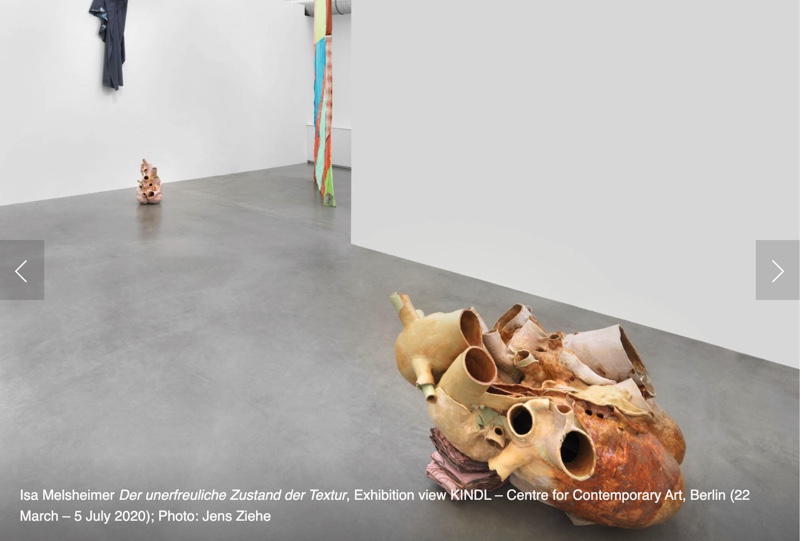
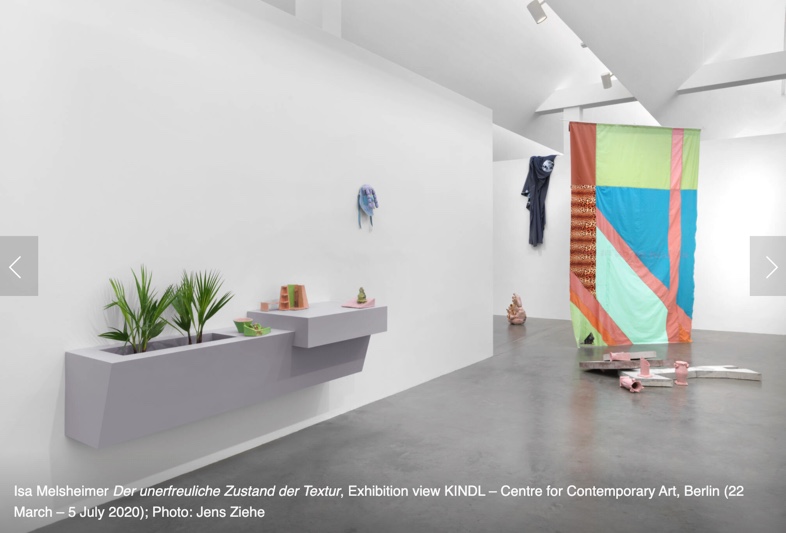
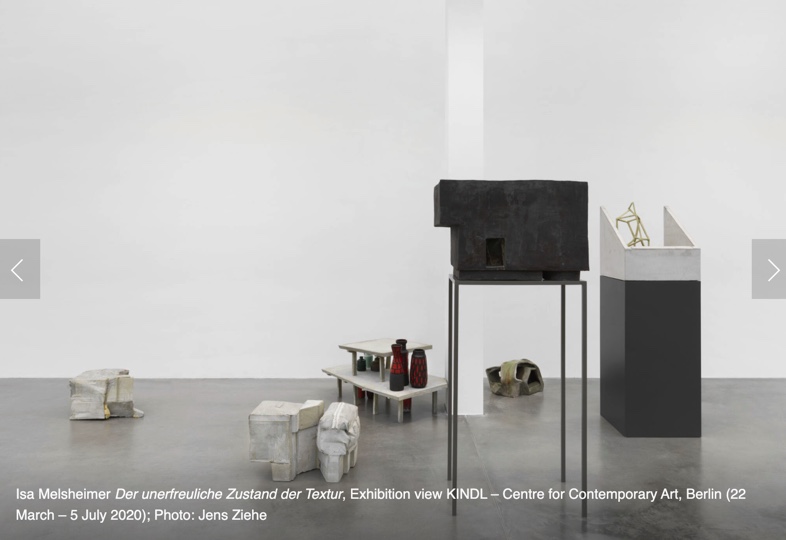
Isa Melsheimer is a Berlin based artist who explores our human relationship with nature through the study of architectural form intersecting with living matter. The materials she uses range from concrete and ceramic through stitch and gouache to living plants. I visited her exhibition at KINDL, Centre for Contemporary Art, Berlin (22.3.20 – 5.7.20) online as it was not possible to travel to Berlin during the run of the show.
This is a show of recent work, including that made during a three month residency on Fogo Island, Newfoundland in 2017. The artist’s residency is the result of an initiative created by Canadian businesswoman and social entrepreneur Zita Cobb in response to the decline of the fishing industry that supported the islanders for generations. The fishing industry has been largely replaced by the tourist industry with construction of a community-owned whale and iceberg watching hotel on the cliffs being a symbol of this change. Ironically the swimming icebergs are themselves also symbols of catastrophic climate change.
The major ceramic piece in this show is the life-size whale’s heart, see exhibition view above, made after returning from Fogo Island as a response to the story of the heart of a stranded blue whale sent from Newfoundland to Germany for taxidermy and now in a Canadian museum. The artist explains in this video.
Melsheimer’s works made whilst on Fogo Island were 2 dimensional responses with embroidery and gouache. She made daily observations of the clifftop view from her studio on a length of cloth with drawing and stitch resulting in Curtain (Year of the Whale). A series of 4 gouaches use the image of the Fogo Island Inn juxtaposed with the cliffs, sea, icebergs and sea creatures deliberately drawing attention to rising sea levels. The crashing of the waves onto the studio windows must have really brought this home to an artist from land-locked Berlin.
What draws me to this artist’s work is her multi-media approach and response to place. Her research methodology and references to the thinking of Donna Haraway on the co-existence of species resonate with me. The daily observations of the landscape during the residency and engagement with the history of the place and wider debates around tourism and climate change also draw me in.
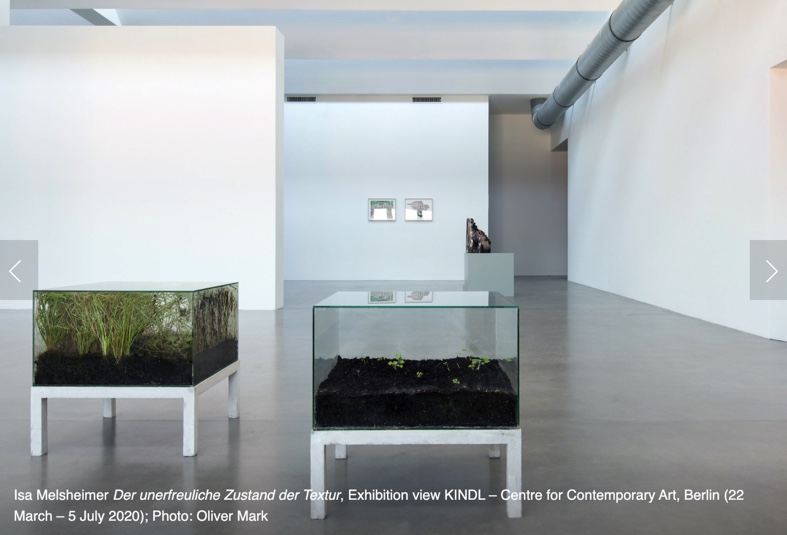
She has been working with plants for a while and this show includes some of her Wardian cases, that use seeds from Fogo Island as part of an ongoing project, Plant Hunters.
I find this project really interesting from the perspective of my own work in which I have begun to use living seedlings, moss and earth. What the artist says about her observation that however diverse the species of seeds she places into the Wardian cases, it is always moss and ferns that prevail, is fascinating and provides a convenient metaphor for the levelling of existence.
Emergence. Liz Clifford. 2020
The curation of the work uses the floor, walls and ceiling. Some work forms its own shelf whilst the three whale heart ceramics are placed directly on the floor, one resting against the wall.
Seeing this use of the gallery space to create a dialogue between pieces of differing scale and materials has set me thinking about the curation of my own sculptural work. I have started making collages that explore the relationships between the pieces and their components, including the growing elements within them.
Byway 745 with intervention. Photograph by Liz Clifford.
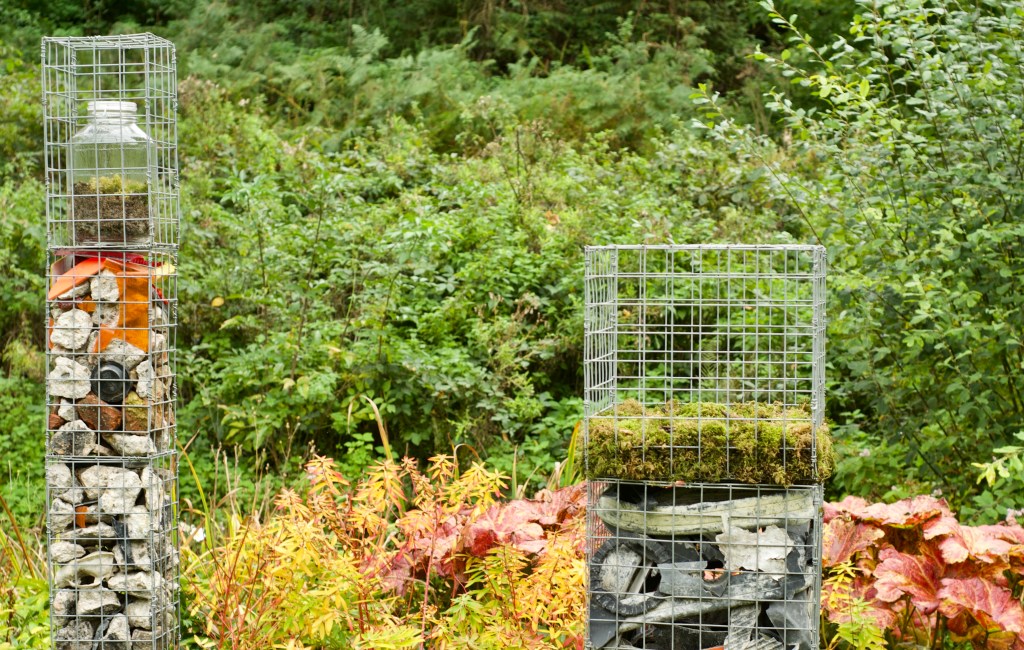
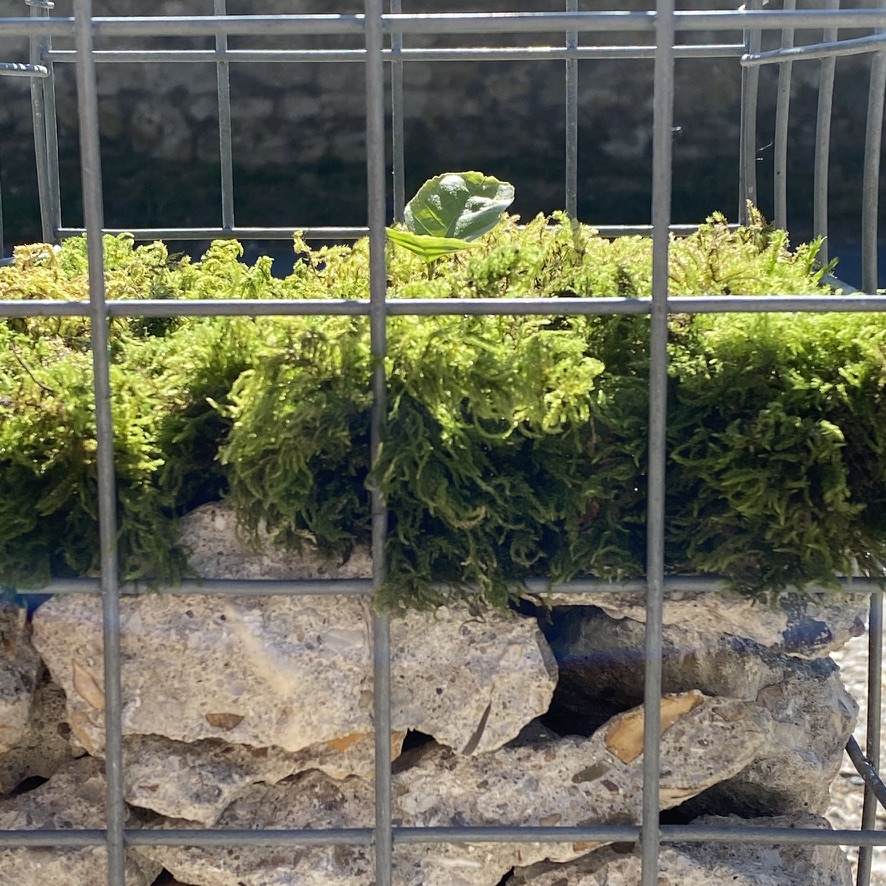
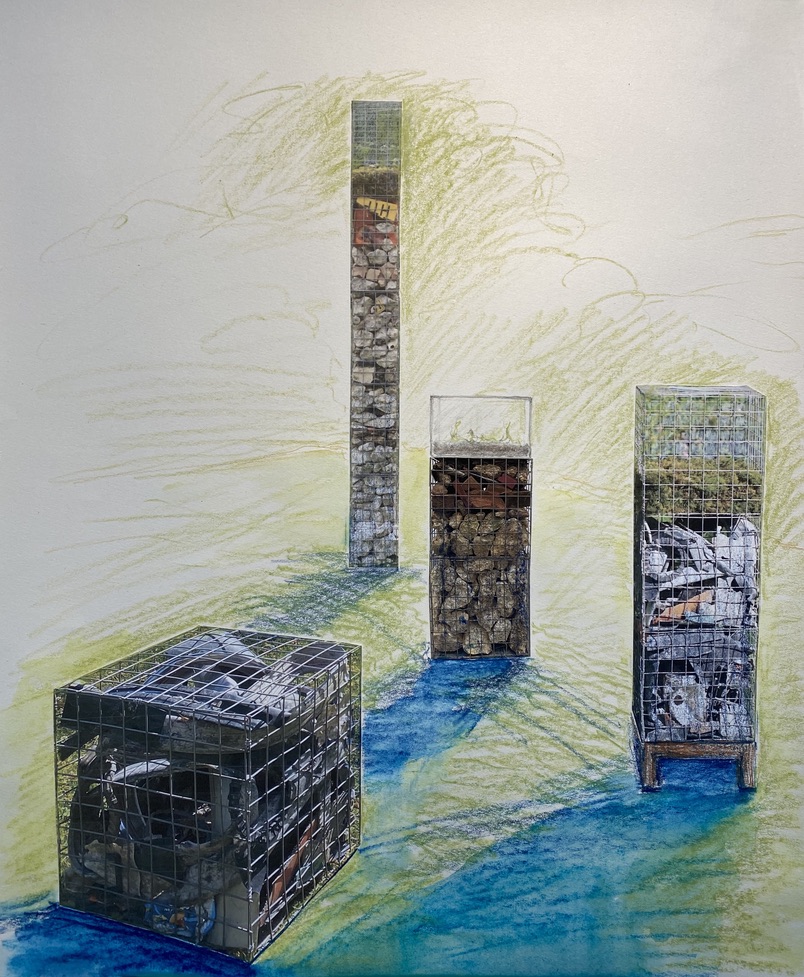
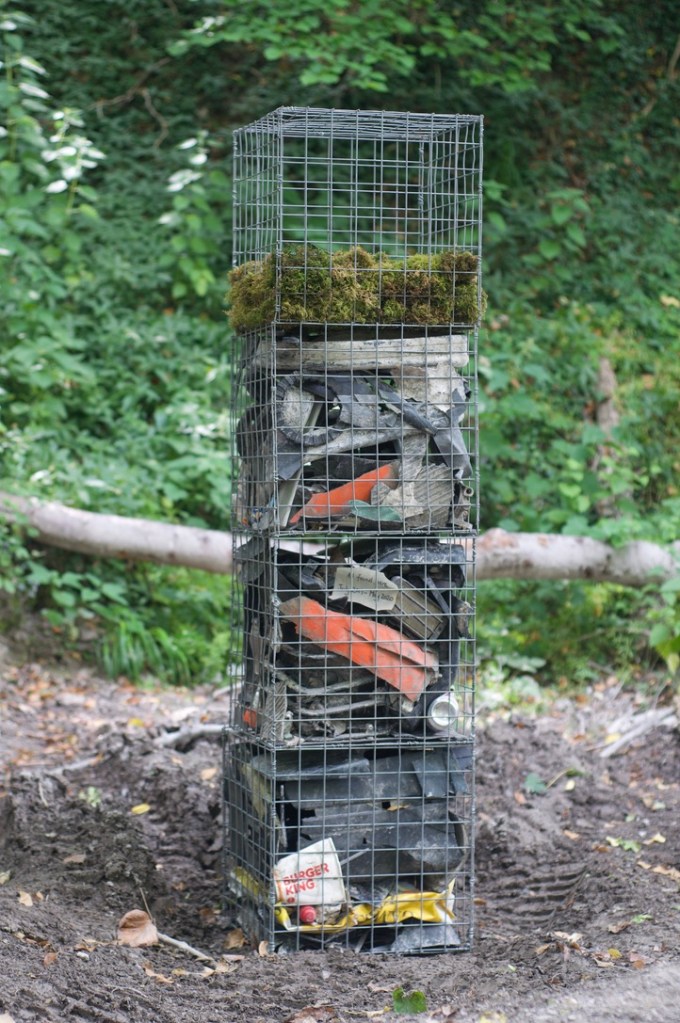
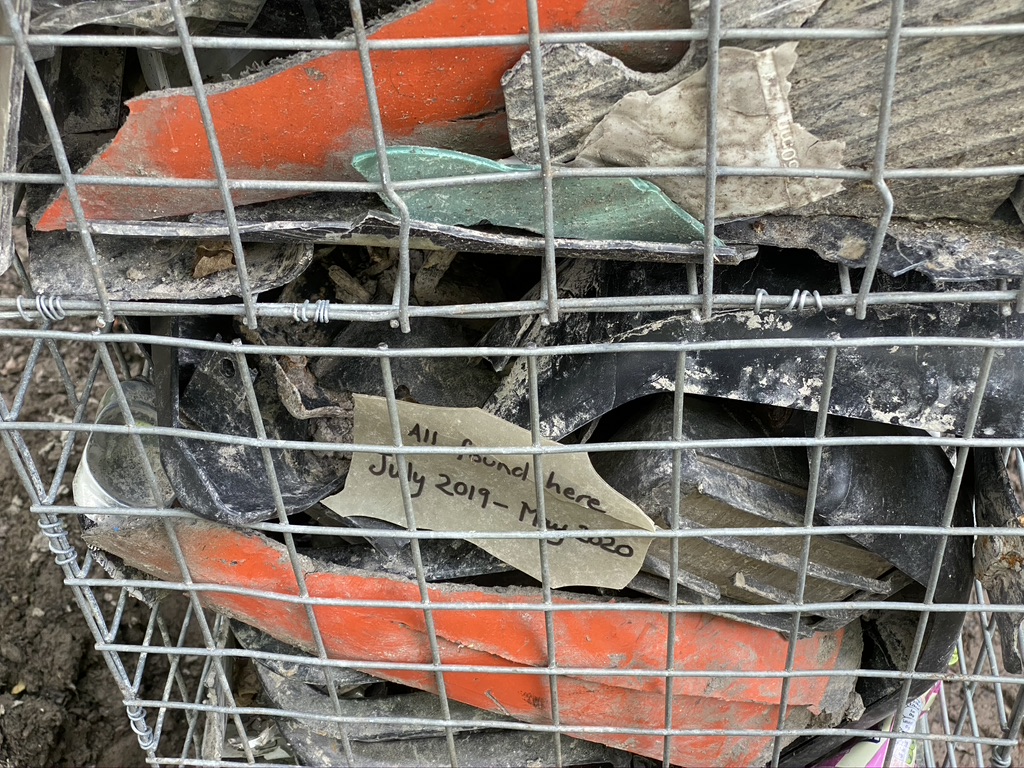
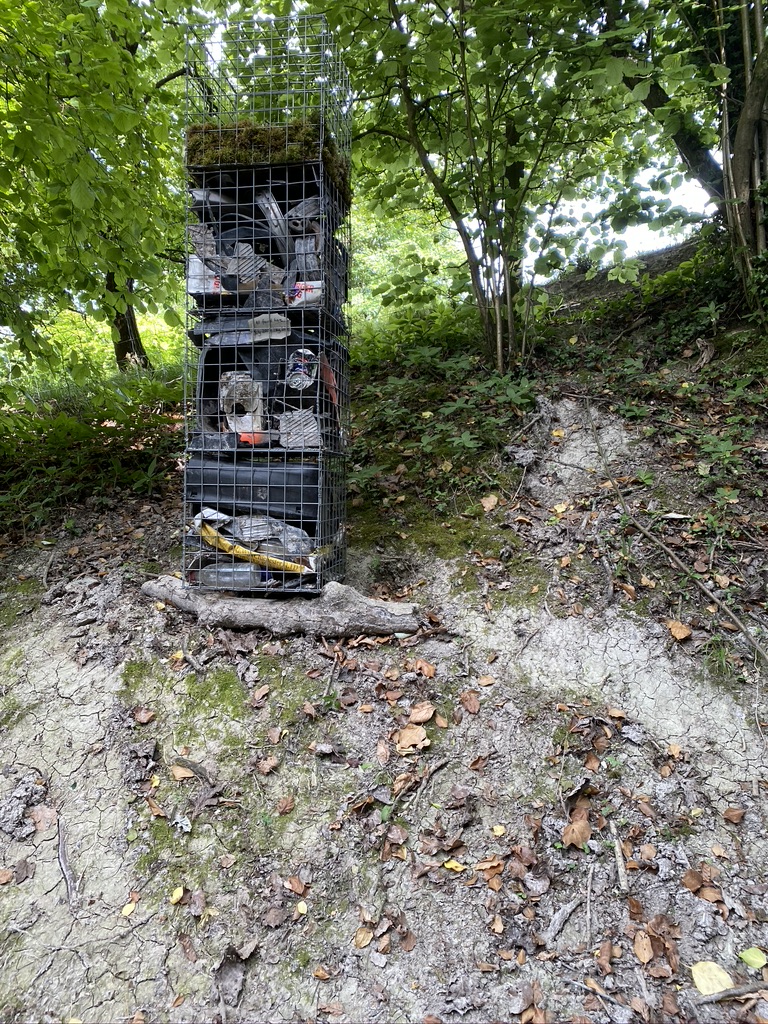
Since my excursion in May to collect up rubbish collected over 10 months on this ancient Byway, I have resolved a piece of work that encases the collection within a gabion basket structure. The work consists of four 40cm cubes, three of which are full of the manmade detritus and one that has a 12cm layer of moss in the bottom, out of which some of the black plastic protrudes. The proportion of living material, in this case moss, to rubbish is a deliberate reference to field geologist and stratigrapher Jan Zalasiewicz’s metaphor of the Anthropocene Square Metre in which the mass of human-made matter is 10 times that of the mass of living matter.
Liz Clifford. Becoming Geology. 160 x 40 x40 cm
I originally read about this proportion in the introduction to the publication that accompanies the exhibition, Critical Zones: Observatories for Earthly Politics at ZKM Karlsruhe in Germany, co-curated by Bruno Latour. One consequence of Covid-19 lockdown is that I have been able to visit the archive of the virtual exhibition opening available on their website. I feel really fortunate to have been able to catch discussions between the international scientists, artists and thinkers involved in this ambitious and important multidisciplinary exhibition that strives to help us understand the complex networks that make up the fragile “critical zone” of the earth’s surface in which all life happens. Jan Zalasiewicz gave a talk at this opening in which he described an average square metre, one of the 510 trillion that make up the earth’s surface, as weighing around 55kg, only 5kg of which would be biomass. Half of the remaining mass is made up of urban matter in the form of concrete, brick and asphalt as well as the vast array of what he calls “technofossils”, human artefacts from toothbrushes to computer chips. Then there are still the minerals and compounds that human activity has produced to be weighed. He has added time to its dimensions of mass, depth and volume, pointing out how living matter is receding over time whilst, for instance, the number of technofossils and quantities of carbon dioxide and melting ice is growing. His talk has got me thinking of further work I can do in an attempt to make visualisations of these proportions and devastating facts.
Liz Clifford. Becoming Geology. 2020. detail
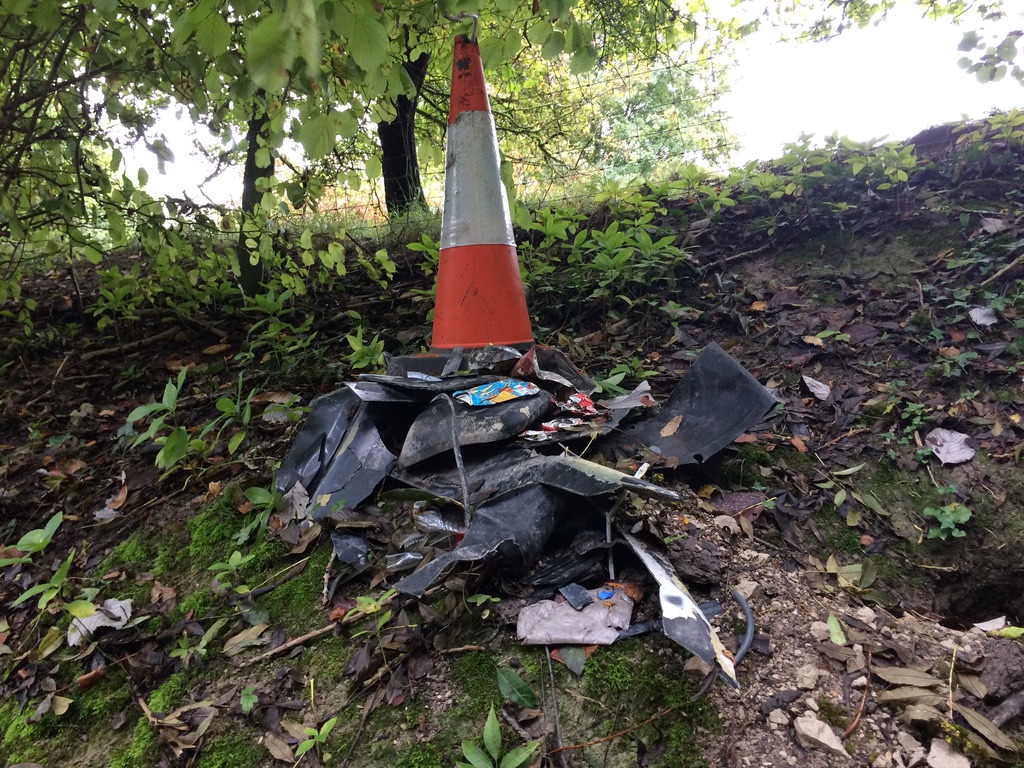
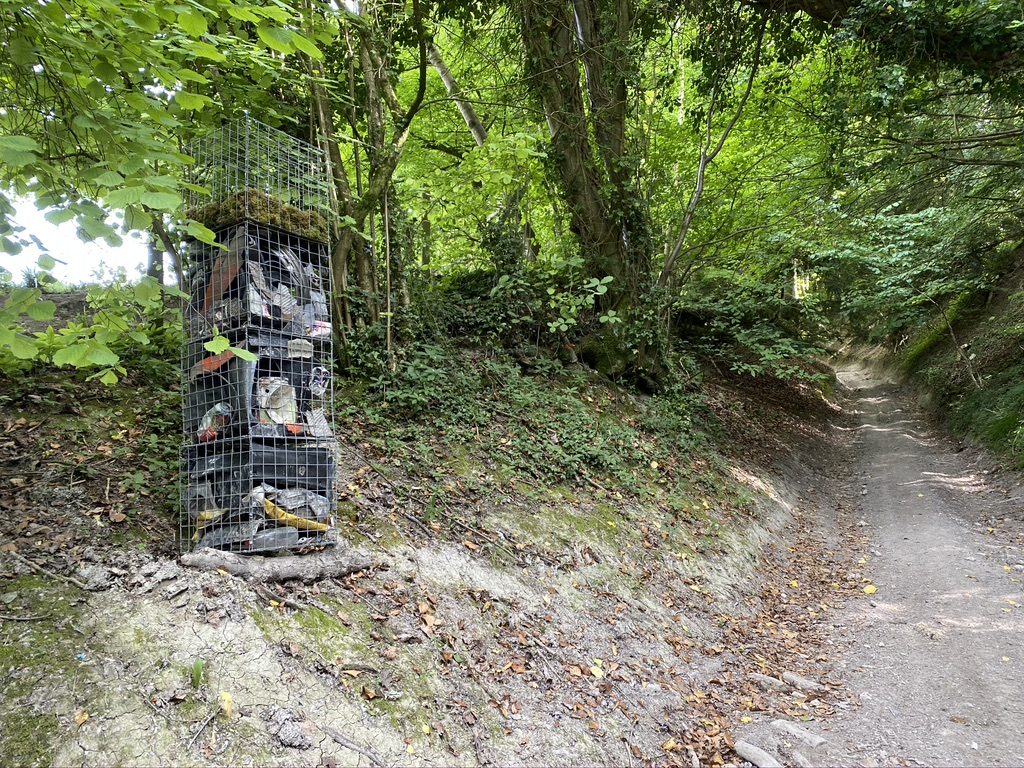
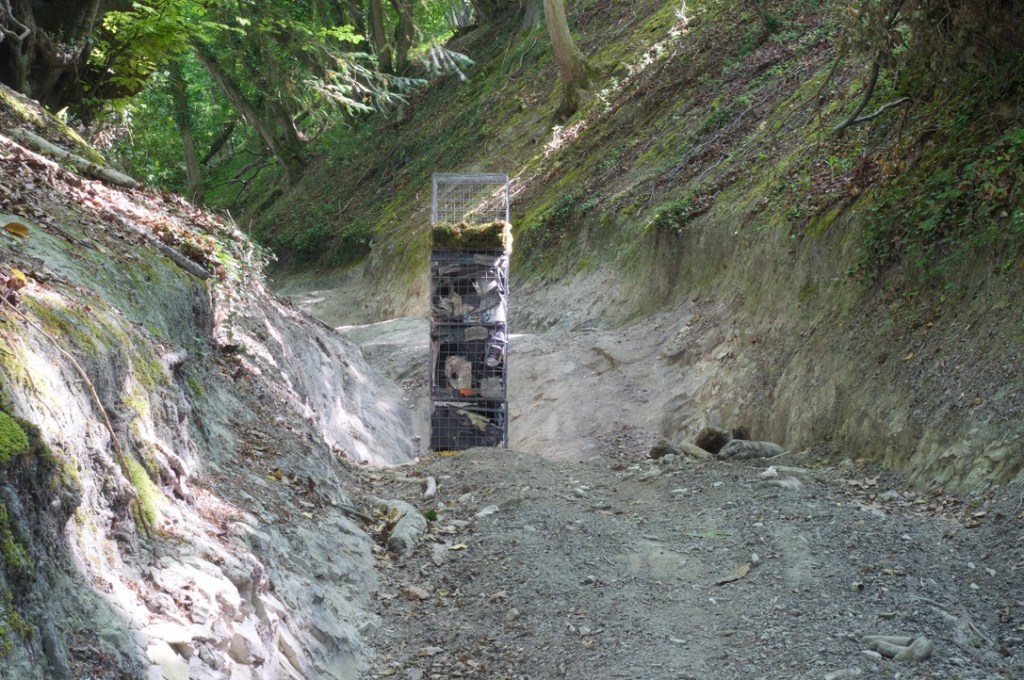
So having built this piece of sculpture, I have since been able to return it to the site as an intervention. As the detail above shows, the dates of the collecting is recorded within the structure – all found here July 2019 – May 2020. The work was photographed in four different locations on the track and then returned to the studio. The images below show it placed on the site of the Rubbish Cairn No.1, now tidied away within the sculpture.
It would be interesting to be able to site the work in this landscape for longer, to engage with the users of the space. In this instance the only passer-by was a cyclist, in a hurry with gravity behind her, who kindly dismounted as she skirted around the work as I attempted to make the photograph below. The photographic evidence of the intervention is very much part of the work and will form part of any gallery presentation of the piece.
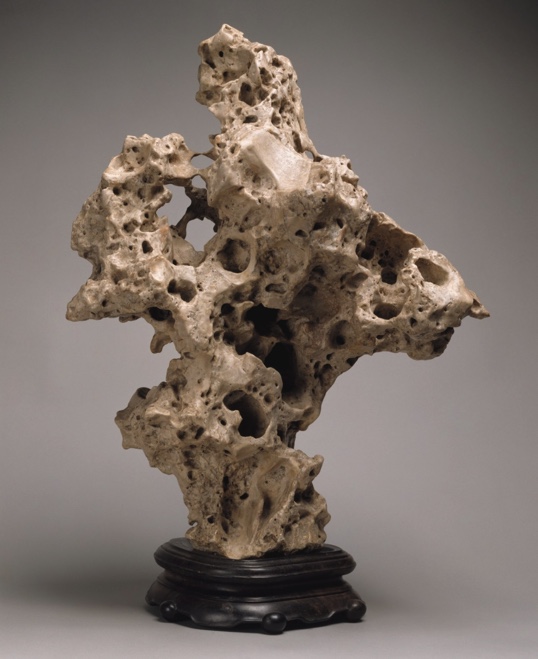
Scholars Rock in the Form of a Fantastic Mountain. Taihu limestone. MET Creative Commons Zero
An MA trip in lockdown.
To replace a planned physical trip to London the group voted to visit galleries virtually in another city. Shanghai was the city we chose. The brief was to find an artwork and respond to it through drawing and reflective writing.
In the Shanghai Museum I was able to visit the exhibition Elegant Friends for a Lofty Studio and catch a glimpse of the Chinese tradition of collecting weathered stones for their resemblance to mountains, clouds and other natural forms. Gongshi, meaning “spirit stones”, are also known as scholars’ rocks and the tradition was established in the Tang dynasty. Large stones were used to decorate gardens and small ones were used as objects of contemplation and meditation indoors. They also form subject matter for traditional Chinese paintings.
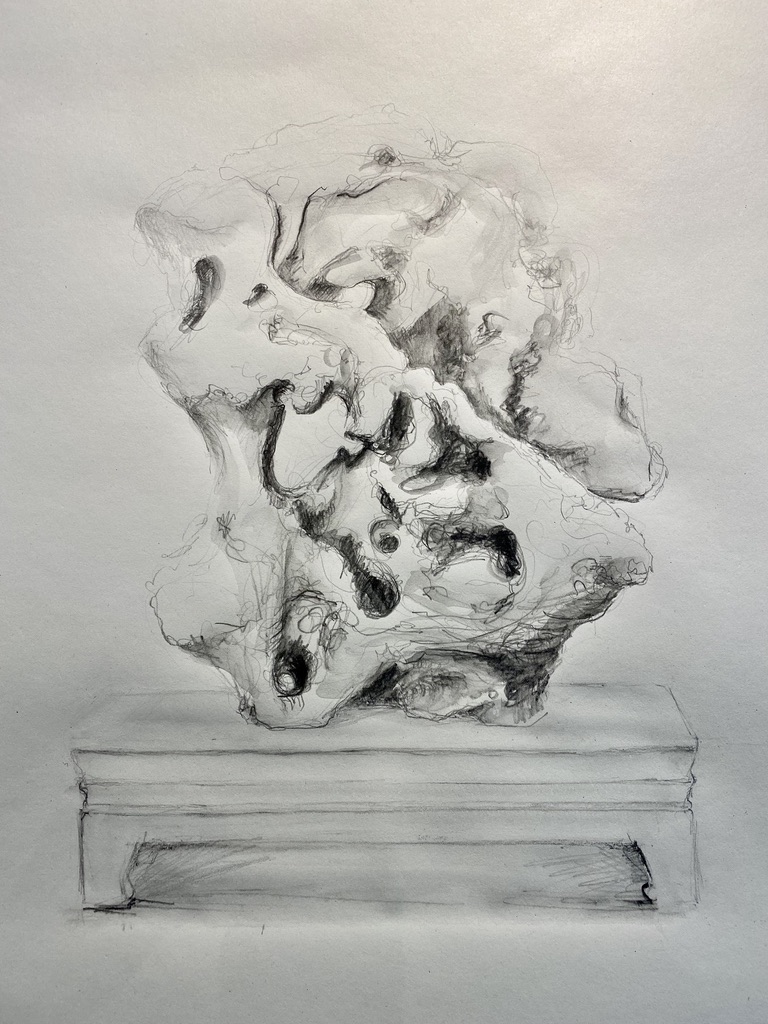
The rocks generally consist of types of limestone that have eroded into softened shapes with perforations and cavities, sometimes further carved into by humans. Each stone is mounted on its own unique rosewood stand and given a poetic name that describes what it resembles. The most sought after tend to be those that resemble mystical mountains and the practice of making and collecting is linked to Taoist beliefs about humanity’s place in nature, and a common spirituality.
I am drawn to the dynamism of these objects. To their history as well as to the geology of the materials and their aesthetic qualities. They have been picked out as special and have been given mystical meanings. They embody time. The rocks with their scars of erosion are millions of years old. The stands on which they are presented are centuries old. The geological features of their titles are anthropomorphised, as in A Peak that Enjoys the Companionship of Clouds, in a way that echoes Jane Bennett’s plea for acknowledgement of the vitality of the non-human and “the common materiality of all that is” (Bennett, 2010:120).
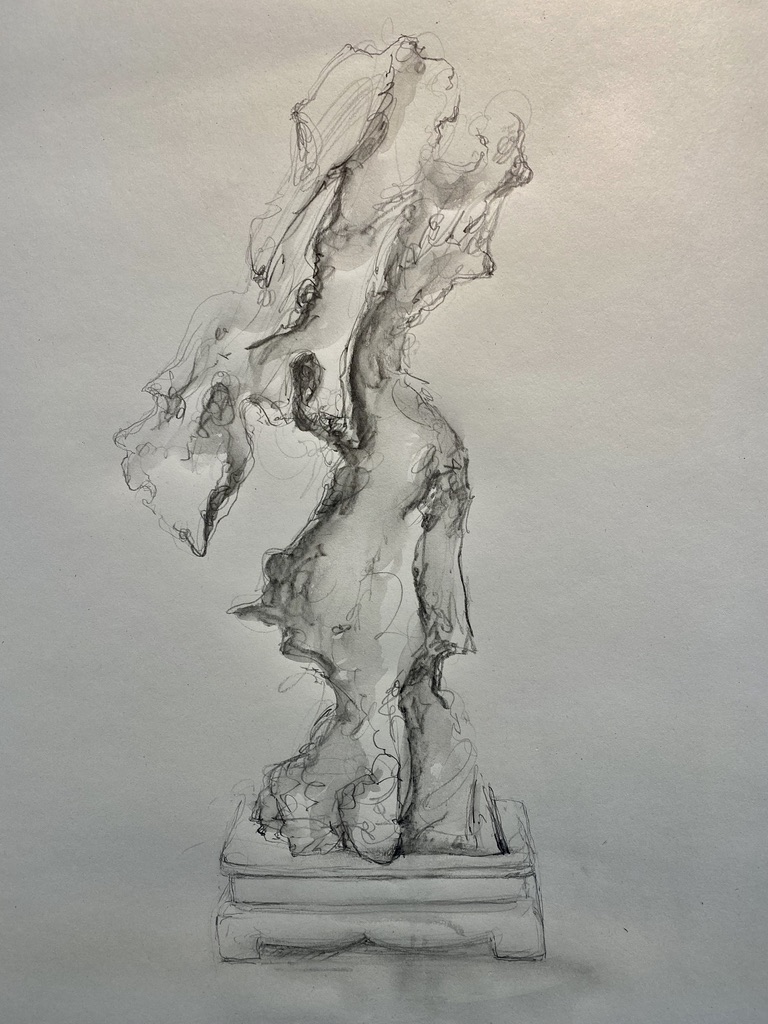
Liz Clifford. A Peak that Enjoys the Companionship of Clouds. Pencil and wash drawing.
I started my investigation with two drawings from the scholars’ rocks I had chosen to home in on. Trying to think 3 dimensionally whilst drawing from a photograph was a challenge. I began to think of sculptors’ drawings I admire – Henry Moore and Tony Cragg – with their use of contours to describe volume. The way their sketchbook pages fill with multiple iterations of forms.
Liz Clifford. A Wrinkled White Cloud. Pencil and wash drawing.
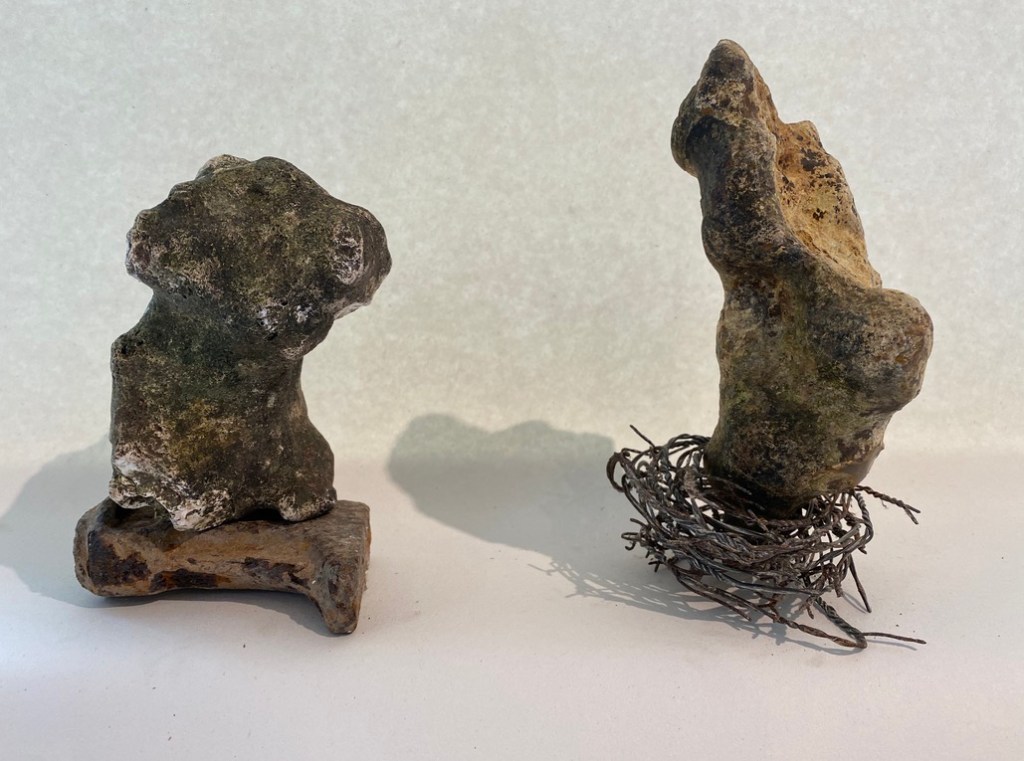
I have a collection of flints with interesting shapes found on the chalk hill on which I walk and have begun to think about how they might work in juxtaposition with other materials like the scholars’ rocks do. How they could each have a stand of a contrasting material. Whether they resemble other natural forms or phenomena. How they might work as a group of forms and in combination with other structures.
Liz Clifford. Sketchbook page – flints. Pencil and wash
I have begun experimenting with stands made from some of the man-made detritus I collect from the same location as the flints. The two examples shown here use steel. Brick, plastic, concrete and wood are other possibilities I’m working with.
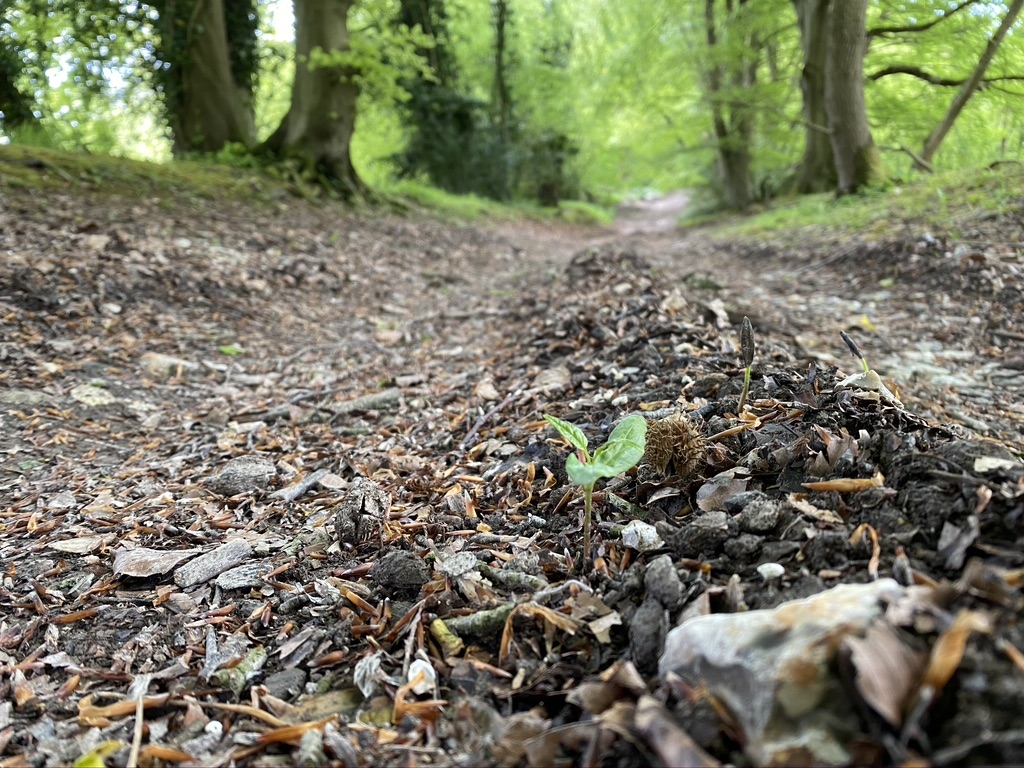
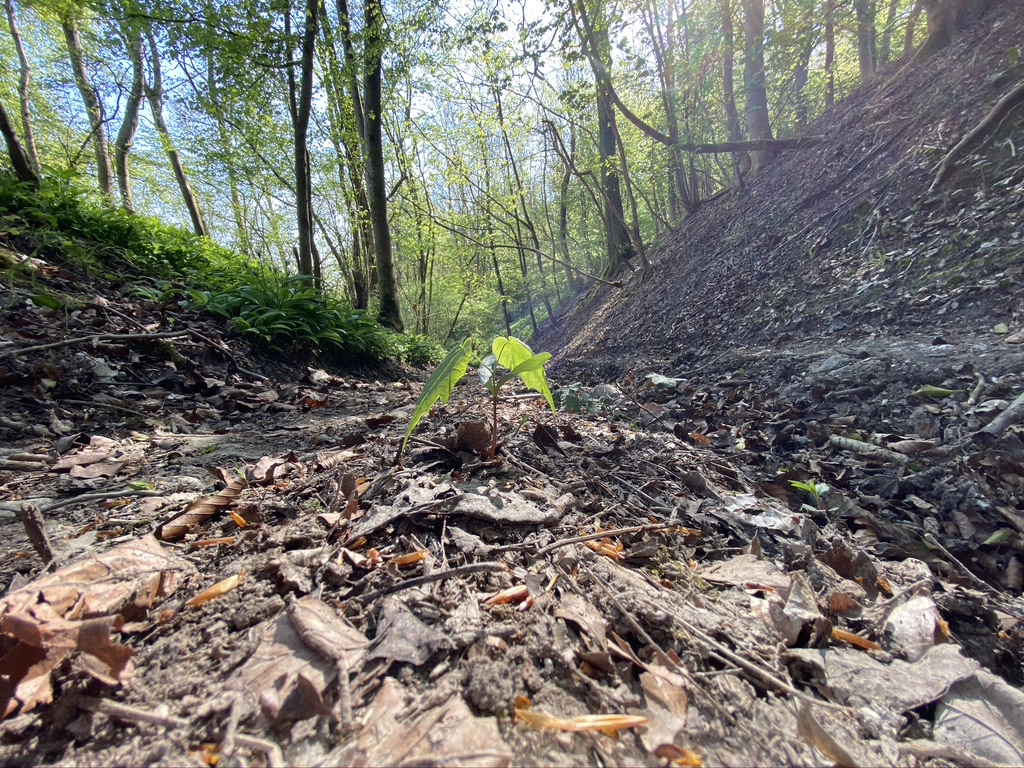
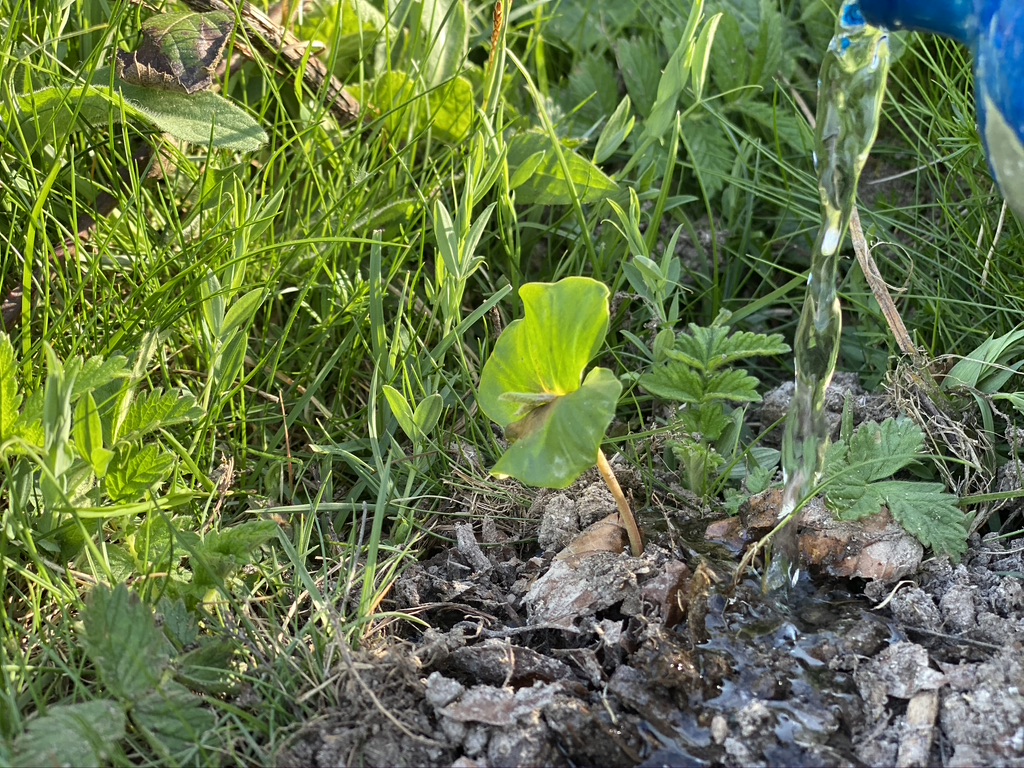
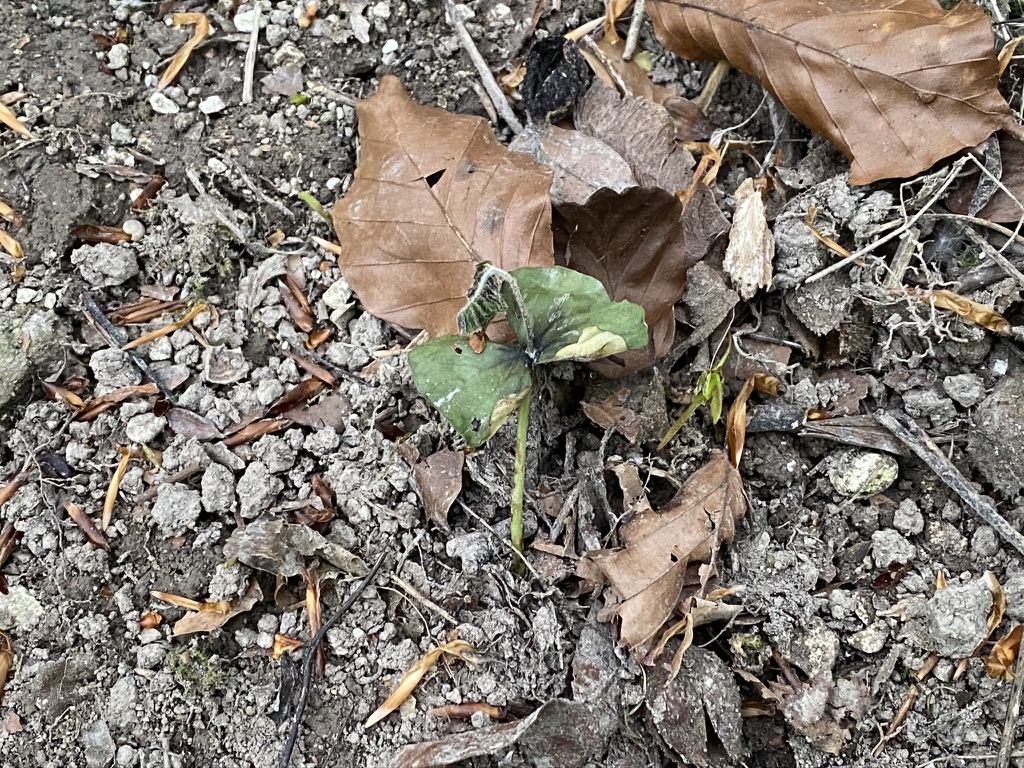
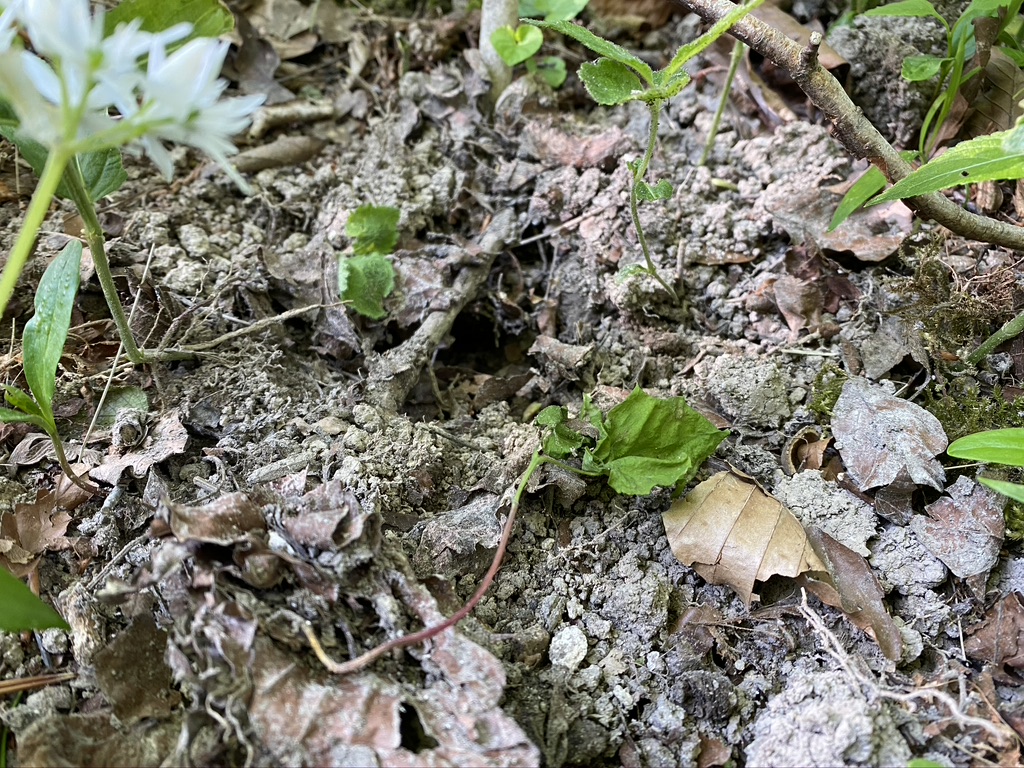
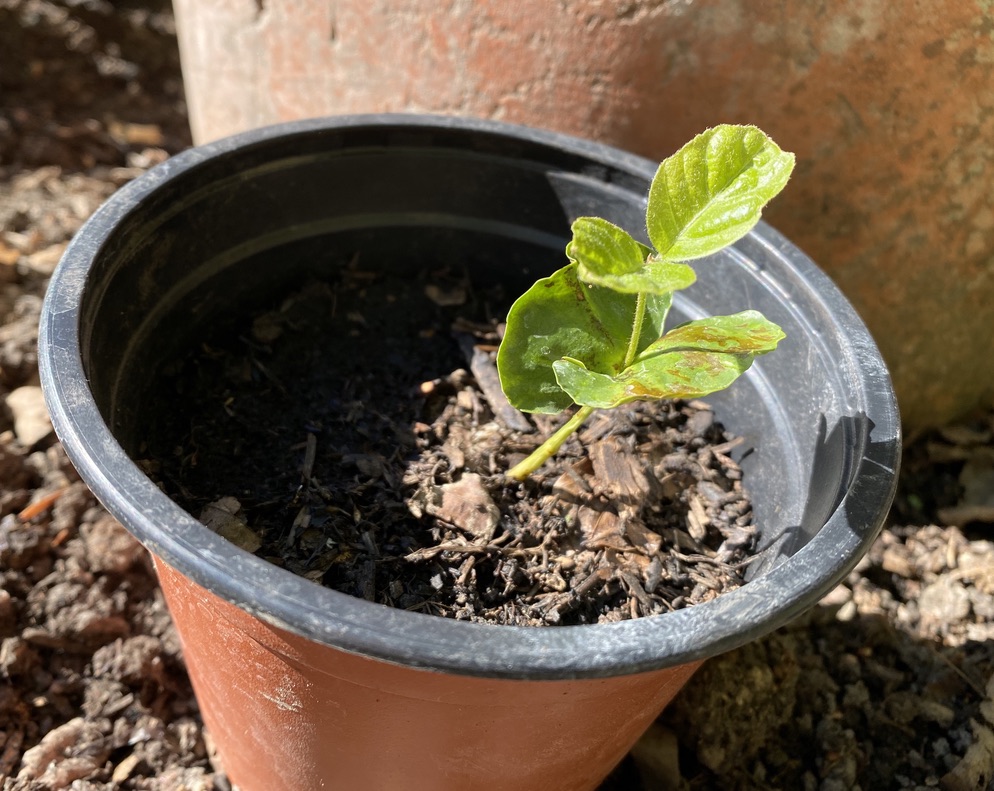
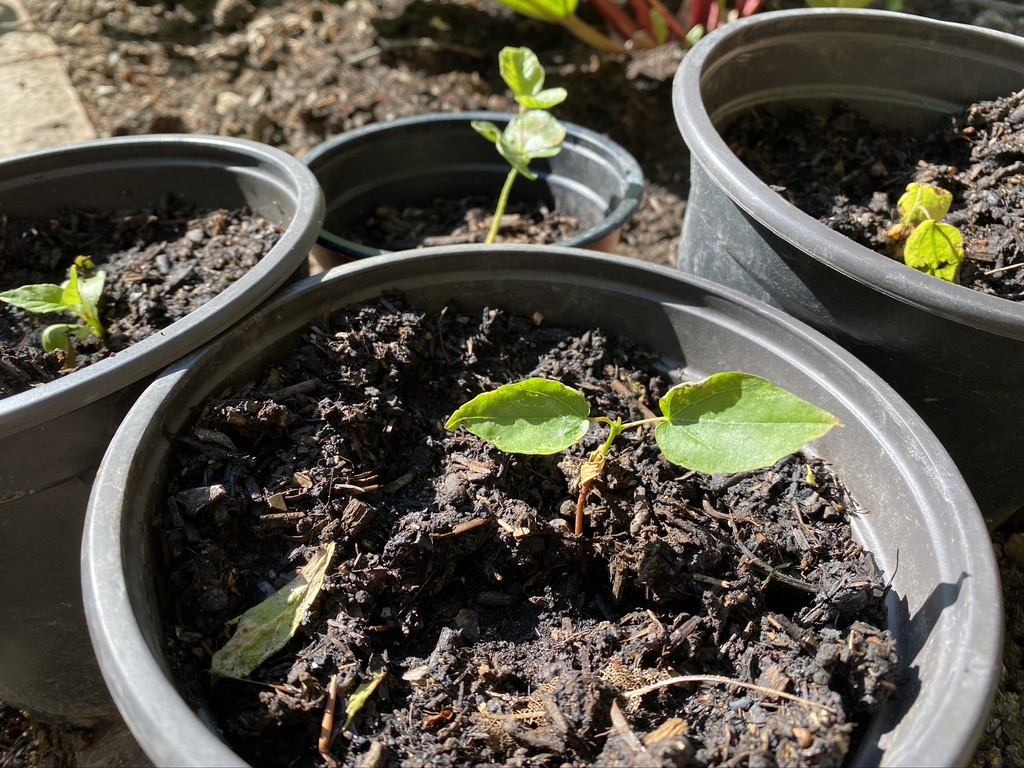
In late April and early May seedlings took root on the muddy track, where normally they would have been mown down by recreational vehicles. Along with what seemed like a more-vigorous-than-normal onset of Spring, these little plants appeared to be benefitting from the lockdown against Covid-19. However, it soon became apparent that drought, along with increased numbers of walkers and still the occasional recreational vehicle did threaten their survival. I decided to rescue some of them by replanting them on the side of the track and others by potting them up and nurturing them at home.
Those replanted in the landscape have failed to survive. Although I watered them, it wasn’t enough, and they either withered or were uprooted by animals.
However, those potted up and borne home are beginning to thrive and promise to become proper trees that can one day be planted somewhere safe.
Why the urge to save them? It’s likely that this happens every year and I don’t even notice. The seedlings take root and occasionally some survive only to be eaten by deer or trodden on or run over. In the current situation there seems a greater poignancy in witnessing a struggle for survival which in turn provokes an urge to nurture. I have been looking at the work of Ackroyd and Harvey and their ongoing Beuys’ Acorns project, wondering how I might be able to incorporate these plants into my work. Their project is a part of a much bigger one initiated by Joseph Beuys in which, with the help of volunteers and posthumously, he planted 7000 oak trees between 1982 and 1987 in Kassel, Germany, each with an accompanying basalt stone. In 2007 Ackroyd and Harvey collected acorns from the 7000 Oaks planted in Kassel, and raised a new generation of trees building on Beuys’ legacy of belief in art as a force for social change. The trees they have managed to raise have been toured extensively in France and the UK as part of a programme of conversations around the role of trees in sustainable urban planning and improving air quality – most recently at Bloomberg Arcade as part of London’s first National Park City Festival in 2019. There is much to learn from these artists’ approach to research and practice as they engage with the pressing concerns of our times. They are key players in discussions of the role of the visual arts in raising awareness of and taking action on the climate emergency. They co-devised the processional event to mark the launch of Culture Declares in April 2019 and continue to be active in that movement.













 Liz Clifford