
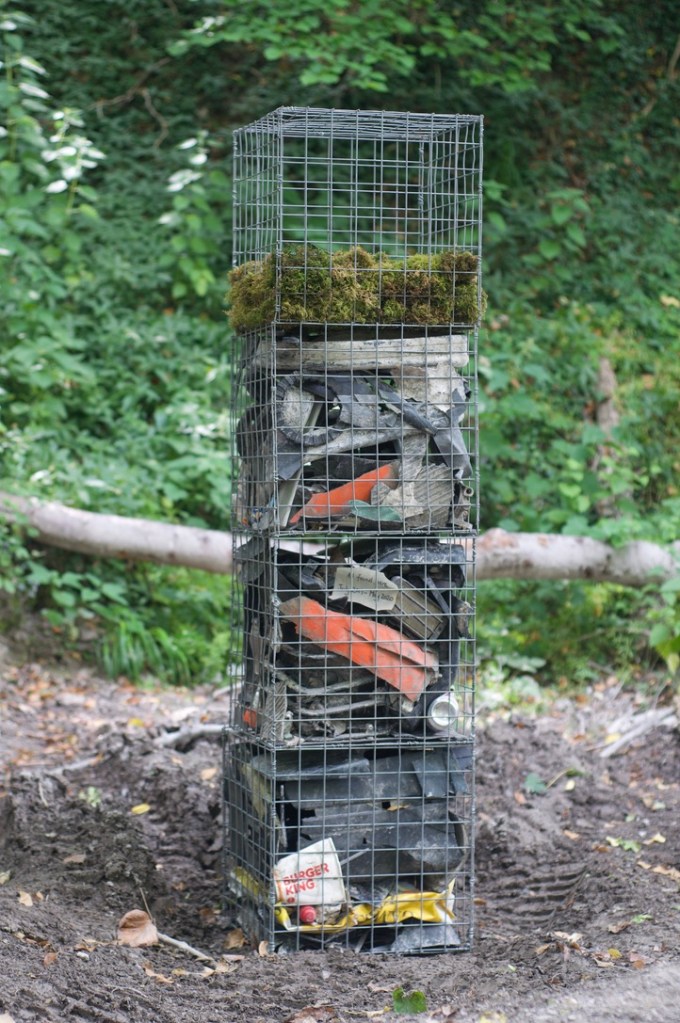
Byway 745 with intervention. Photograph by Liz Clifford.
Since my excursion in May to collect up rubbish collected over 10 months on this ancient Byway, I have resolved a piece of work that encases the collection within a gabion basket structure. The work consists of four 40cm cubes, three of which are full of the manmade detritus and one that has a 12cm layer of moss in the bottom, out of which some of the black plastic protrudes. The proportion of living material, in this case moss, to rubbish is a deliberate reference to field geologist and stratigrapher Jan Zalasiewicz’s metaphor of the Anthropocene Square Metre in which the mass of human-made matter is 10 times that of the mass of living matter.
I originally read about this proportion in the introduction to the publication that accompanies the exhibition, Critical Zones: Observatories for Earthly Politics at ZKM Karlsruhe in Germany, co-curated by Bruno Latour. One consequence of Covid-19 lockdown is that I have been able to visit the archive of the virtual exhibition opening available on their website. I feel really fortunate to have been able to catch discussions between the international scientists, artists and thinkers involved in this ambitious and important multidisciplinary exhibition that strives to help us understand the complex networks that make up the fragile “critical zone” of the earth’s surface in which all life happens. Jan Zalasiewicz gave a talk at this opening in which he described an average square metre, one of the 510 trillion that make up the earth’s surface, as weighing around 55kg, only 5kg of which would be biomass. Half of the remaining mass is made up of urban matter in the form of concrete, brick and asphalt as well as the vast array of what he calls “technofossils”, human artefacts from toothbrushes to computer chips. Then there are still the minerals and compounds that human activity has produced to be weighed. He has added time to its dimensions of mass, depth and volume, pointing out how living matter is receding over time whilst, for instance, the number of technofossils and quantities of carbon dioxide and melting ice is growing. His talk has got me thinking of further work I can do in an attempt to make visualisations of these proportions and devastating facts.
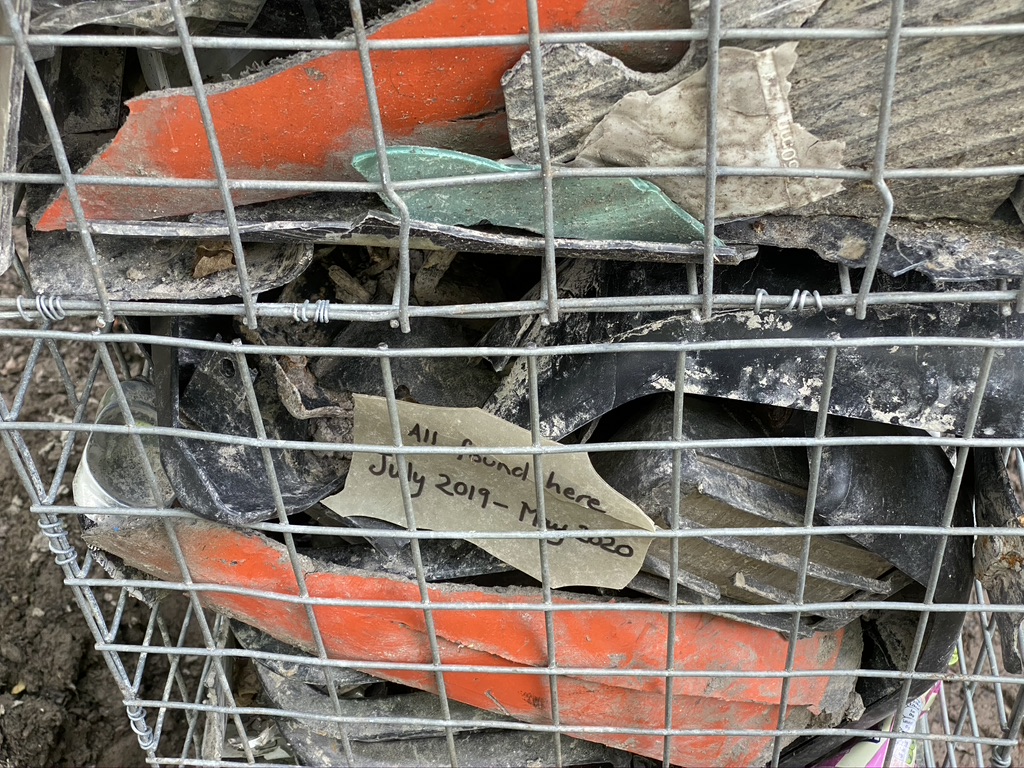
So having built this piece of sculpture, I have since been able to return it to the site as an intervention. As the detail above shows, the dates of the collecting is recorded within the structure – all found here July 2019 – May 2020. The work was photographed in four different locations on the track and then returned to the studio. The images below show it placed on the site of the Rubbish Cairn No.1, now tidied away within the sculpture.
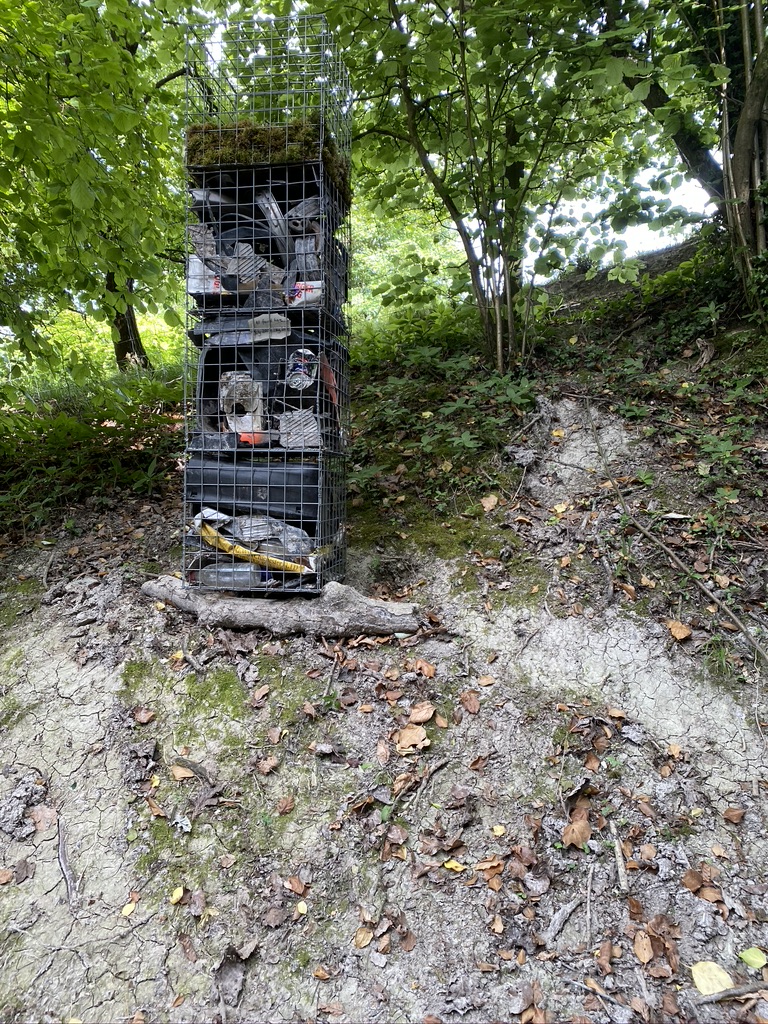
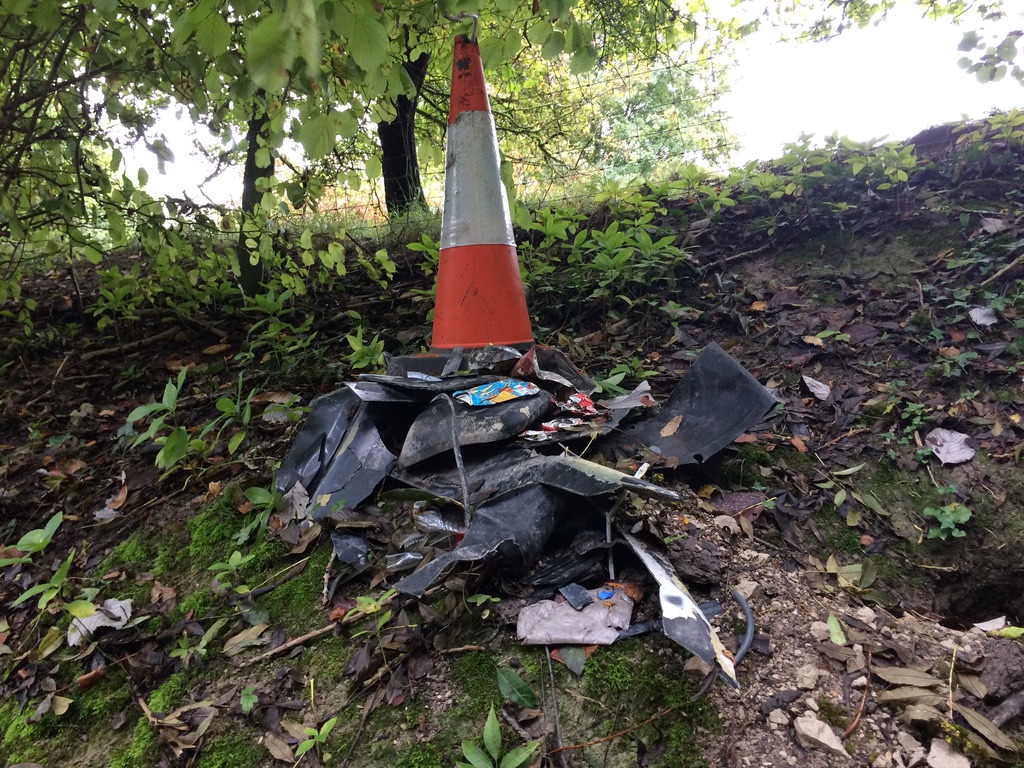
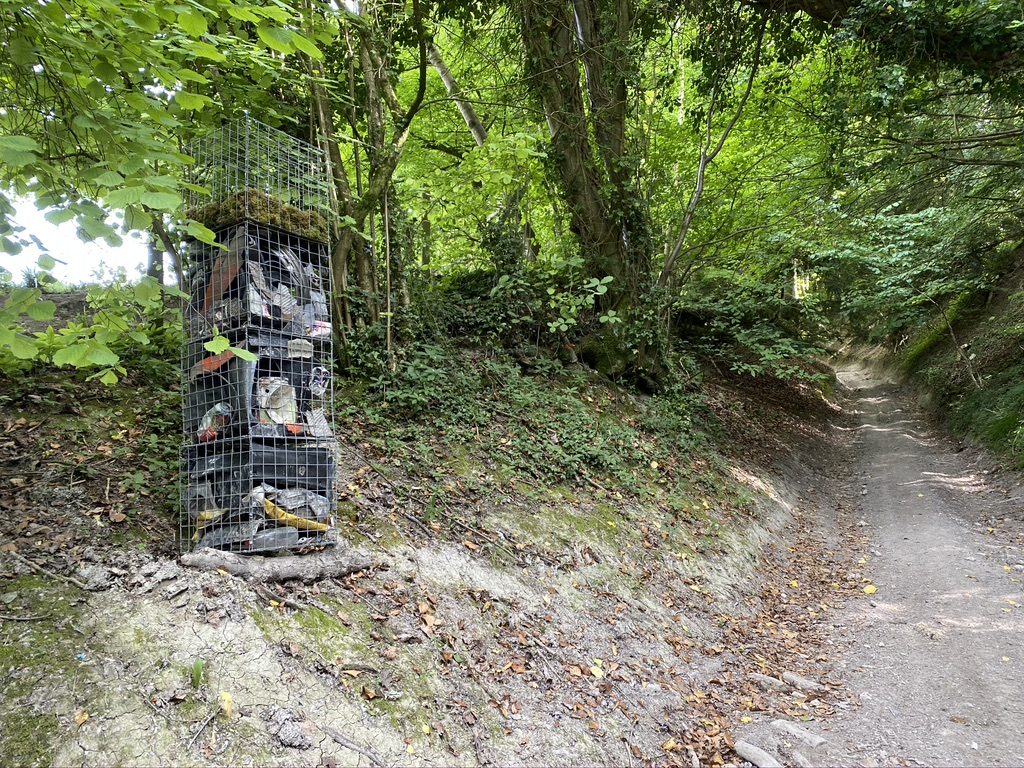
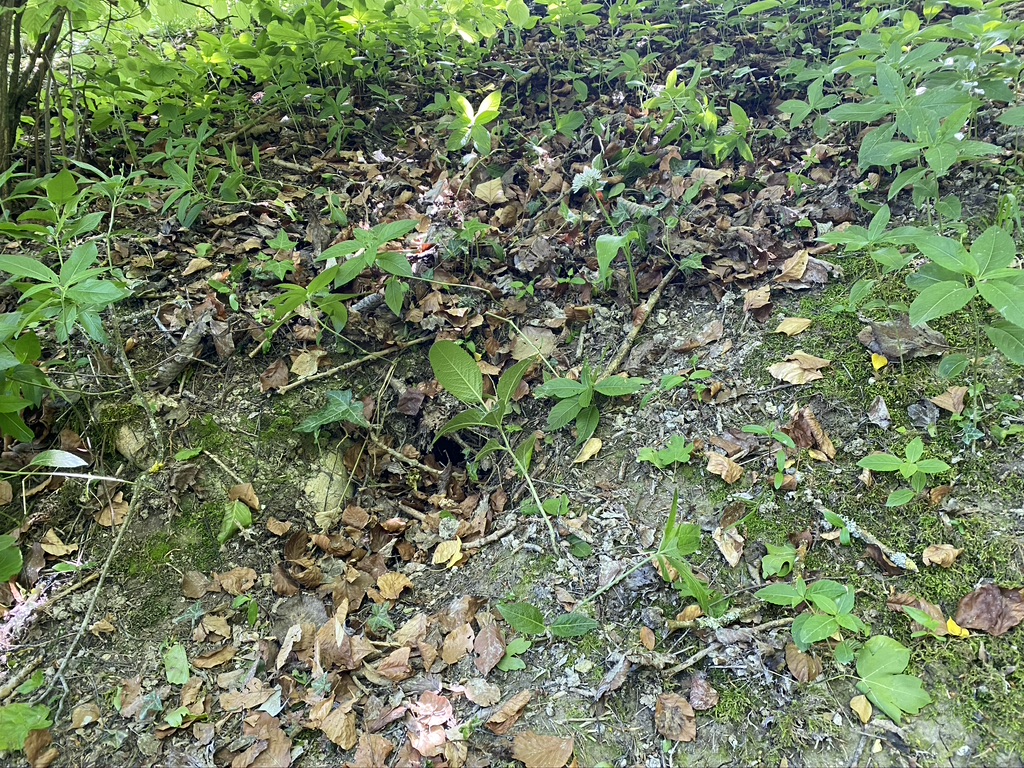
It would be interesting to be able to site the work in this landscape for longer, to engage with the users of the space. In this instance the only passer-by was a cyclist, in a hurry with gravity behind her, who kindly dismounted as she skirted around the work as I attempted to make the photograph below. The photographic evidence of the intervention is very much part of the work and will form part of any gallery presentation of the piece.
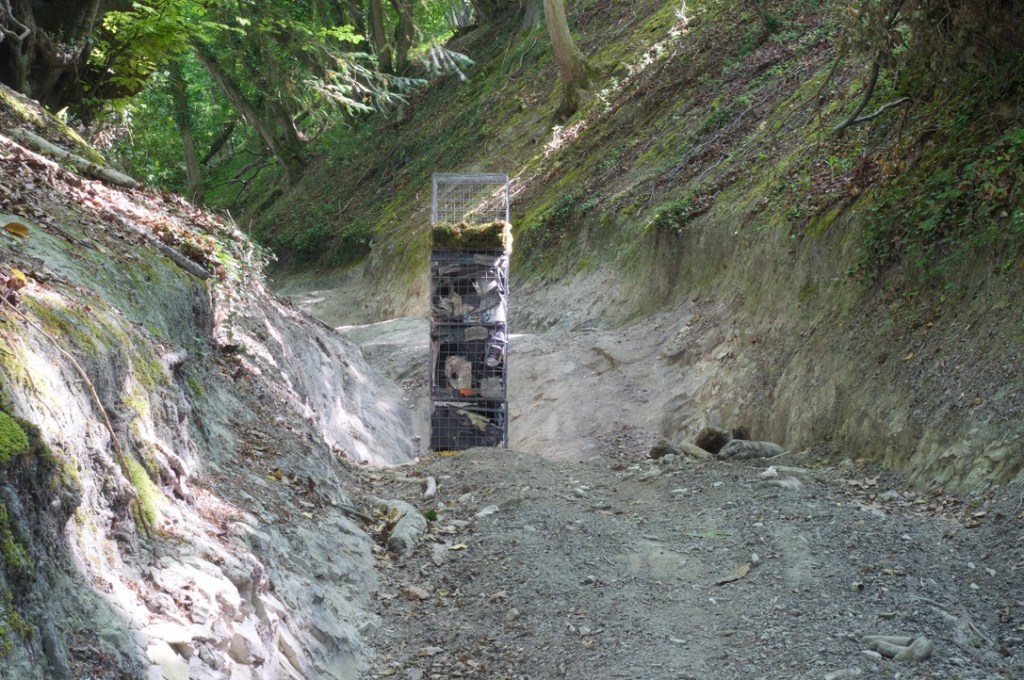
Photographs by Liz Clifford.
 Liz Clifford
I am really interested in your work. Your images of the work in situe are thought provoking. Thank you for the information about the Critical Zones exhibition which I will be looking into, I feel it resonates with what I am exploring at the moment.
LikeLike
Thank you! Critical Zones does feel like a really important and timely exhibition. I’m wondering if it might be possible to make the trek to see it before it closes in February……
LikeLike